数学家传记
费利克斯·豪斯多夫从事拓扑学研究,创立了拓扑空间和度量空间的理论。他还研究集合论,并引入了偏序集的概念。
费利克斯·豪斯多夫的父亲是Louis Hausdorff,他是一位经营纺织品的商人,母亲是Hedwig Tietz;两人都是犹太人。豪斯多夫出生在一个富裕家庭,这对他的生活和事业产生了相当大的影响,因为他从来不必为经济上养活自己而工作。当全家从布雷斯劳搬到莱比锡时,豪斯多夫还是个年幼的男孩,他是在莱比锡长大的。在学校里,他有广泛的兴趣,除了数学,他还被文学和音乐所吸引。事实上,他想从事音乐作曲家的职业,但他的父母向他施压,要他放弃成为作曲家的想法。他们做到了这一点,但费了相当大的力气,因为豪斯多夫一心想着这个想法,此后他转向数学,将其作为大学学习的科目。
豪斯多夫在莱比锡大学师从海因里希·布伦斯和阿道夫·迈尔,于1891年毕业,获得数学应用于天文学的博士学位。他的学位论文题为Zur Theorie der astronomischen Strahlenbrechung Ⓣ(论天文折射理论),研究了大气中光的折射和消光。在接下来的几年里,他发表了四篇关于天文学和光学的论文,并于1895年向莱比锡提交了他的教授资格论文(Habilitation)学位论文,该论文也基于他对天文学和光学的研究。他的方法基于海因里希·布伦斯的方法,后者基于弗里德里希·威廉·贝塞尔的一个想法,发展了自己确定折射和消光的方法。
豪斯多夫的主要兴趣在文学和哲学,他的朋友圈几乎全是作家和艺术家,比如作曲家Max Reger,而不是科学家。他似乎也热衷于在文学界而非数学界扬名,他以Paul Mongré的笔名发表文学作品。1897年,他出版了自己的第一部文学作品Sant' Ilario: Thoughts from Zarathustra's Country,这是一部378页的著作。他出版了一本哲学书Das Chaos in kosmischer Auslese Ⓣ(宇宙选择中的混沌)(1898),这是对形而上学的批判,将经验世界与他所拒绝的先验世界相对照。他的下一部重要文学作品是诗集Ekstases Ⓣ(狂喜)(1900),涉及自然、生命、死亡和情欲,此外他还写了许多关于哲学和文学的文章。正如尔文·席格在[6]中所写:-
作为富裕家庭的孩子,他不必担心以数学家的身份谋生;对他来说,数学无论是作为研究还是作为教学科目,都更像是一种业余爱好,而非其他。
豪斯多夫于1899年在莱比锡与Charlotte Sara Goldschmidt结婚。Charlotte和她的妹妹Edith出身于犹太父母家庭,但已改宗路德宗。尽管当时还只是Privatdozent,豪斯多夫却很富有,因此在他职业生涯的这个阶段结婚没有带来任何经济困难。1902年,他被提升为莱比锡大学的数学编外教授,并拒绝了哥廷根大学类似职位的邀请。这清楚地表明,此时豪斯多夫更愿意留在莱比锡的文学和艺术圈中,而不是在数学事业上取得进展。他继续着自己的文学兴趣,并于1904年出版了一部闹剧Der Arzt seiner Ehre Ⓣ(为医生庆贺)。在许多方面,这标志着他文学兴趣的终结,但这部闹剧于1912年上演,并非常成功。
1904年后,豪斯多夫开始在他著名的领域工作,即拓扑学和集合论。他引入了偏序集的概念,并从1901年到1909年证明了一系列关于有序集的结果。1907年,他引入了特殊类型的序数,试图证明格奥尔格·康托尔的连续统假设。他还提出了连续统假设的推广,询问2的次方是否等于。豪斯多夫在1916年证明了关于埃米尔·博雷尔集合基数的进一步结果。
豪斯多夫在莱比锡任教直到1910年,然后去了波恩。在许多方面,正是爱德华·斯图迪促使豪斯多夫更多地参与数学研究,并发展他的数学事业。他早期职业生涯中缺乏数学动力,部分原因是由于他极度谦逊,因此他与爱德华·斯图迪的友谊是促使他转向重要问题并随后成名的重要因素。在鼓励豪斯多夫搬到波恩之后,爱德华·斯图迪又鼓励他在1913年再次搬迁,这次是去格赖夫斯瓦尔德担任正式教授。一年后,即1914年,豪斯多夫出版了他的著名教科书Grundzüge der Mengenlehre Ⓣ(一般集合论),该书建立在莫里斯·弗雷歇等人的工作基础上,创建了拓扑空间和度量空间的理论。正如Katetov在[1]中所解释的,早期关于拓扑学的结果自然地融入了豪斯多夫所建立的框架中:-
[豪斯多夫的]广阔方法、他的审美感受以及他的平衡感可能发挥了重要作用。他成功地创建了一个拓扑空间和度量空间的理论,使先前的结果很好地融入其中,并用许多新概念和定理丰富了它。从现代的角度来看,《基础》除了其他特殊主题外,还包含了拓扑空间和度量空间理论的萌芽,这些现在已包含在所有关于该主题的教科书中。
Grundzüge Ⓣ(一般集合论)于1927年和1937年以修订形式重新出版。1914年版于1949年和1965年由Chelsea重印,1927年版于1937年以俄文出版,1937年版被翻译成英文,也由Chelsea于1957年出版。
豪斯多夫于1921年回到波恩,此时已是一位杰出的数学家,他在那里工作到1935年,被纳粹政权强迫退休。尽管早在1932年他就感觉到纳粹主义的即将来临的灾难,但在仍有可能时他没有尝试移民。他在1934年11月向希特勒宣誓必要的誓言,但到次年1月,一项新法律迫使他放弃职位。他继续在拓扑学和集合论方面进行研究,但结果无法在德国发表。当然,他想继续研究并希望移民,因为他在1939年写信给理查·科朗特,询问是否能为他找到研究奖学金。遗憾的是,科朗特无法做到。
作为犹太人,他的处境变得越来越困难。1941年,他原定被送往拘留营,但设法避免了被送走。Erich Bessel-Hagen是波恩唯一一位在豪斯多夫被迫退休后仍与他保持联系的同事,他在1941年夏天写给朋友的一封信中写道(见[24]和[6]):-
我常常为豪斯多夫一家感到极度焦虑。豪斯多夫夫人因一种旧疾长期重病——我不知道那是什么病。她刚度过最危险的阶段,就又传来了关于犹太人将被集中关押的骚动。这里的做法简直疯狂。年初,年老的修女们被强行赶出克罗伊茨贝格的一座修道院;这些可怜的老妇人从未伤害过任何人,只是过着退隐的生活,专注于她们虔诚的修行……现在,所有仍住在波恩的犹太人都将被强制集中在这座被强占的建筑里;他们要么拍卖自己的东西,要么把它们交到“忠实”的人手中保管。
波恩大学请求允许豪斯多夫一家留在自己家中,这一请求获得了批准。到1941年10月,他们被迫佩戴“黄星”,大约在年底时,他们被告知将被送往科隆。弗里德里希·威廉·贝塞尔-哈根写道,他知道这是(见[24]和[6]):-
……被驱逐到波兰的前奏。而人们听到的关于那里犹太人的住宿和待遇的情况,完全无法想象。
他们没有被送往科隆,而是在1942年1月被告知将被关押在恩德尼希。1月26日,他与妻子以及妻子的妹妹一起自杀。他在1月25日星期日写信给一位朋友(见[24]和[6]):-
亲爱的沃尔施泰因朋友
当你收到这几行字时,我们三人已经用另一种方式解决了问题——就是你一直试图劝阻我们的那种方式。……
近几个月来对犹太人所做的一切,引起了有充分根据的焦虑:我们将不再被允许经历一种尚可忍受的处境。……
请原谅我们,死后还给你添麻烦;我相信你会做你力所能及的事(也许并不多)。也请原谅我们的逃离!我们希望你和我们所有的朋友都能经历更好的时代
谨启
豪斯多夫
1月25日星期日夜里,三人都服用了巴比妥类药物。到1月26日早晨,豪斯多夫和他的妻子夏洛特都已死亡。夏洛特的妹妹伊迪丝在昏迷中活了几天后去世。
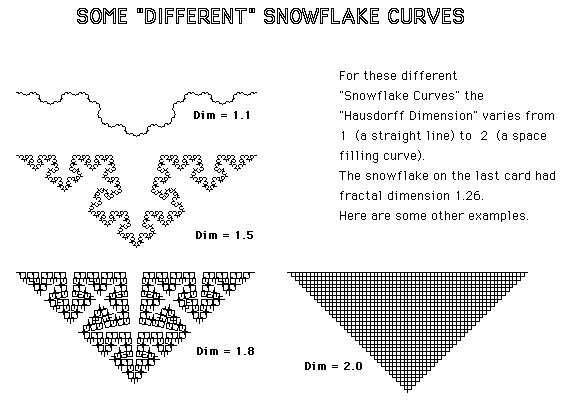
我们上面已经提到了豪斯多夫早期关于天文学的工作、他的哲学工作以及他的文学。我们还提到了他关于有序集的工作以及他关于集合论与拓扑学的杰作Grundzüge der Mengenlehre Ⓣ(《一般集合论》)(1914)。让我们补充一点,一个著名的悖论性结果,即半个球面与三分之一个球面可以彼此全等,就包含在这部著作中(详见[28])。现在让我们考察豪斯多夫作出的其他重要贡献。1919年,他在开创性论文Dimension und äusseres Mass Ⓣ(《维数与外测度》)中引入了豪斯多夫维数的概念。这一想法是对五年前由康斯坦丁·卡拉西奥多里引入的一个概念的推广,但豪斯多夫意识到康斯坦丁·卡拉西奥多里的构造对于定义分数维数是有意义的,而且是有用的。豪斯多夫的论文包含了一个证明:中间三分之一格奥尔格·康托尔集的维数是log 2/log 3。Chatterji写道[10]:-
在豪斯多夫的数学工作中,两篇明确致力于测度论的出版物占有重要地位:它们不仅对测度论很重要,而且从根本上促进了它的发展。人们并不太知道的是,豪斯多夫一生都对测度与积分理论的各种基本问题感兴趣,并在不同时期作出了重要贡献。如果研究他的讲义和其他遗稿,这一点就变得相当明显。
其中一门这样的课程是豪斯多夫于1923年夏天在波恩讲授的概率论。他研究了高斯误差律、极限定理与矩问题,以及集合论与强大数定律,后者他以测度论为基础。
Felix Hausdorff's father was Louis Hausdorff, who was a merchant dealing in textiles, and his mother was Hedwig Tietz; both were Jewish. Felix was born into a wealthy family and this had quite an influence on his life and career since he never had the problem of having to work to support himself financially. Felix was still a young boy when the family moved from Breslau to Leipzig, and it was in Leipzig that he grew up. At school he had wide interests and, in addition to mathematics, he was attracted to literature and music. In fact he wanted to pursue a career in music as a composer but his parents put pressure on him to give up the idea of becoming a composer. They achieved this, but only after quite an effort for Felix had his heart set on the idea, and after this he turned towards mathematics as the subject to study at university.
Hausdorff studied at Leipzig University under Heinrich Bruns and Adolph Mayer, graduating in 1891 with a doctorate in applications of mathematics to astronomy. His thesis was titled Zur Theorie der astronomischen Strahlenbrechung Ⓣ and studied refraction and extinction of light in the atmosphere. He published four papers on astronomy and optics over the next few years and he submitted his habilitation thesis to Leipzig in 1895, also based on his research into astronomy and optics. His methods were based on those of Bruns who had developed his own method of determining refraction and extinction, based on an idea of Bessel.
However Hausdorff's main interests were in literature and philosophy and his circle of friends consisted almost entirely of writers and artists, such as the composer Max Reger, rather than scientists. He also seemed keen to make a name for himself in the world of literature, more so than in the world of mathematics, and he published his literary work under the pseudonym of Paul Mongré. In 1897 he published his first literary work Sant' Ilario: Thoughts from Zarathustra's Country which was a work of 378 pages. He published a philosophy book Das Chaos in kosmischer Auslese Ⓣ (1898) which is a critique of metaphysics contrasting the empirical with the transcendental world that he rejected. His next major literary work was a book of poem Ekstases Ⓣ (1900) which deals with nature, life, death and erotic passion, and in addition he wrote many articles on philosophy and literature. As Segal writes in [6]:-
As the child of a wealthy family, he did not have to worry about making a career as a mathematician; for him, mathematics, both as research and as a subject to teach, was more an avocation than anything else.
Hausdorff married Charlotte Sara Goldschmidt in Leipzig in 1899. Charlotte and her sister Edith were from Jewish parents but had converted to Lutheranism. Although still a Privatdozent, Hausdorff was well off, so marriage at this stage in his career presented no financial difficulties. In 1902 he was promoted to an extraordinary professorship of mathematics at Leipzig and turned down the offer of a similar appointment at Göttingen. This clearly indicates that at this time Hausdorff was keener to remain in his literary and artistic circle in Leipzig than he was to progress his career in mathematics. He continued his literary interests and in 1904 published a farce Der Arzt seiner Ehre Ⓣ. In many ways this marked the end of his literary interests but this farce was performed in 1912 and was very successful.
After 1904 Hausdorff began working in the area for which he is famous, namely topology and set theory. He introduced the concept of a partially ordered set and from 1901 to 1909 he proved a series of results on ordered sets. In 1907 he introduced special types of ordinals in an attempt to prove Cantor's continuum hypothesis. He also posed a generalisation of the continuum hypothesis by asking if 2 to the power was equal to . Hausdorff proved further results on the cardinality of Borel sets in 1916.
Hausdorff taught at Leipzig until 1910 when he went to Bonn. It was Study who in many ways motivated Hausdorff to become more involved in both mathematical research and also in developing his career in mathematics. Partly the lack of mathematical drive in his early career had been due to his extreme modesty, so his friendship with Study was an important factor in turning him towards important problems and his subsequent rise to fame. Having encouraged Hausdorff to move to Bonn, Study encouraged him to move again in 1913, this time to become an ordinary professorship at Greifswald. A year later, in 1914, Hausdorff published his famous text Grundzüge der Mengenlehre Ⓣ which builds on work by Fréchet and others to created a theory of topological and metric spaces. Earlier results on topology fitted naturally into the framework set up by Hausdorff as Katetov explains in [1]:-
[Hausdorff's] broad approach, his aesthetic feeling, and his sense of balance may have played a substantial part. He succeeded in creating a theory of topological and metric spaces into which the previous results fitted well, and he enriched it with many new notions and theorems. From the modern point of view, the Grundzüge contained, in addition to other special topics, the beginnings of the theories of topological and metric spaces, which are now included in all textbooks on the subject.
The Grundzüge Ⓣ was republished in revised form in 1927 and 1937. The 1914 edition was reprinted in 1949 and 1965 by Chelsea, the 1927 edition was published in 1937 in Russian, and the 1937 edition was translated into English and also published by Chelsea in 1957.
Hausdorff returned to Bonn in 1921, by this time an eminent mathematician, and he worked there until 1935 when he was forced to retire by the Nazi regime. Although as early as 1932 he sensed the oncoming calamity of Nazism he made no attempt to emigrate while it was still possible. He swore the necessary oath to Hitler in November 1934 but by the following January a new law forced him to give up his position. He continued to undertake research in topology and set theory but the results could not be published in Germany. Certainly he wanted to continue research and wished to emigrate for in 1939 he wrote to Courant asking if he could find a research fellowship for him. Sadly Courant could not do so.
As a Jew his position became more and more difficult. In 1941 he was scheduled to go to an internment camp but managed to avoid being sent. Erich Bessel-Hagen, the only colleague from Bonn who kept in touch with Hausdorff after his forced retirement, wrote in a letter to a friend in the summer of 1941 (see [24] and [6]):-
I often had great anxiety about the Hausdorffs. Mrs Hausdorff was for a long time seriously ill from an old ailment - I don't know what it is. Scarcely was she over the worst than there came the agitation about the intended internment of the Jews. Here the procedure was mad. In the early part of the year, old nuns were forcibly driven out of a cloister on the Kreuzberg; these poor old women who never harmed anyone and only carried on a retiring life devoted to their pious usages ... Now all Jews still living in Bonn will be compulsorily interned in this stolen building; they must either auction their things, or place them for preservation in "faithful" hands.
Bonn University requested that the Hausdorffs be allowed to remain in their home and this was granted. By October 1941 they were forced to wear the "yellow star" and around the end of the year they were informed that they would be sent to Cologne. Bessel-Hagen wrote that he knew this was (see [24] and [6]):-
... a preliminary to deportation to Poland. And what one hears concerning the accommodation and treatment of Jews there is completely unimaginable.
They were not sent to Cologne but in January 1942 they were informed that they were to be interned in Endenich. Together with his wife and his wife's sister, he committed suicide on 26 January. He wrote to a friend on Sunday 25 January (see [24] and [6]):-
Dear Friend Wollstein
By the time you receive these lines, we three will have solved the problem in another way - in the way which you have continually attempted to dissuade us. ...
What has been done against the Jews in recent months arouses well-founded anxiety that we will no longer be allowed to experience a bearable situation. ...
Forgive us, that we still cause you trouble beyond death; I am convinced that you will do what you are able to do (and which perhaps is not very much). Forgive us also our desertion! We wish you and all our friends will experience better times
Yours faithfully
Felix Hausdorff
On the night of Sunday 25 January all three took barbiturates. Both Hausdorff and his wife Charlotte were dead by the morning of the 26 January. Edith, Charlotte's sister, survived for a few days in a coma before dying.
We have mentioned above Hausdorff's early work on astronomy, his work on philosophy, and his literature. We also mentioned his work on ordered sets and his masterpiece on set theory and topology Grundzüge der Mengenlehre Ⓣ (1914). Let us add that one famous paradoxical result, namely that half a sphere and one third of a sphere can be congruent to each other, is contained in this work (see [28] for details). Let us now examine other important contributions made by Hausdorff. In 1919 he introduced the notion of Hausdorff dimension in the seminal paper Dimension und äusseres Mass Ⓣ. The idea was a generalisation of one which had been introduced five years earlier by Carathéodory but Hausdorff realised that Carathéodory's construction made sense, and was useful, for defining fractional dimensions. Hausdorff's paper includes a proof that the dimension of the middle-third Cantor set is log 2/log 3. Chatterji writes [10]:-
Within the mathematical work of Hausdorff the two publications devoted explicitly to measure theory occupy a significant place: they are not only important for measure theory but have also contributed fundamentally to its development. It is not well known that throughout his life Hausdorff had been interested in various fundamental problems of measure and integration theory and had made important contributions at different times. This becomes quite evident if one studies his lecture notes and other Nachlass papers.
One such lecture course was given on probability theory by Hausdorff in Bonn in the summer of 1923. He studied the Gaussian law of errors, limit theorems and problems of moments, and set theory and the strong law of large numbers, which he based on measure theory.
正文里的方括号编号指向这里,悬停即可直接看到条目。书目保留原文——译了书名反而查不到文献。
原站列出的延伸阅读与外部数据库,照原样保留,目标多为英文页面。
关于费利克斯·豪斯多夫的其它页面:
原站的交叉引用。指向本站已镜像专题的留在站内,其余仍指回原站。