数学家传记
查尔斯·巴贝奇开创了现代分析计算机。他发明了分析机的原理,这是现代电子计算机的前身。
查尔斯·巴贝奇的出生日期和地点都不确定,但现在已确凿查明。例如,在[1]和[12]中,他的出生日期被记为1792年12月26日,且两处都记载他的出生地在Teignmouth附近。同样在[18]中写道:-
关于巴贝奇先生的家世和早年生活所知甚少,只知道他出生于1792年12月26日。
然而,在讣告[18]发表一周后,一位侄子写信给The Times,说巴贝奇出生于1791年12月26日。几乎没有证据能证明哪个正确,直到1975年Hyman(见[8])发现巴贝奇的出生已于1792年1月6日在伦敦圣玛丽纽因顿登记。巴贝奇的父亲是Benjamin Babbage,一位银行家,母亲是Betsy Plumleigh 巴贝奇。鉴于其出生登记的地点,Hyman在[8]中说,几乎可以肯定巴贝奇出生于伦敦Walworth Road的Crosby Row 44号家中。
巴贝奇幼年体弱多病,正如他在[4]中所述:-
五岁时健康受损,十岁时又因剧烈高烧险些丧命,我被送到德文郡,交由一位牧师(他在埃克塞特附近的Alphington办了一所学校)照料,并嘱咐他关注我的健康;但不要给我施加太多知识:这一任务他忠实地完成了。
由于父亲相当富有,他能够负担巴贝奇在私立学校接受教育。在Alphington的学校之后,他被送到米德尔塞克斯郡恩菲尔德Forty Hill的一所学院,他的教育真正开始于此。他开始表现出对数学的热情,但不喜欢古典文学。离开学院后,他继续在家学习,请了一位牛津导师将他提升到大学水平。巴贝奇在[4]中列出了他这一时期与导师一起学习的数学书籍:-
其中包括Humphry Ditton的《流数》,我对此一窍不通;玛利亚·阿涅西夫人的《分析指导》,我从中获得了一些知识;罗伯特·伍德豪斯的《分析计算原理》,我从中学习了哥特弗里德·威廉·莱布尼茨的记号法;以及约瑟夫·拉格朗日的《函数论》。我还拥有科林·麦克劳林和罗伯特·西姆松的《流数》。
巴贝奇于1810年10月进入剑桥大学三一学院。然而,他从所研读的书籍中获得的基础使他对剑桥的教学感到不满。他写道[4]:-
因此,当我来到剑桥时,我能够以同等的熟练程度,用艾萨克·牛顿的点、哥特弗里德·威廉·莱布尼茨的d或约瑟夫·拉格朗日的撇号,解出我当时所掌握的极为有限的数学知识所允许的那些问题。我由此对当地学习的常规产生了厌恶,并如饥似渴地阅读莱昂哈德·欧拉以及其他数学家的论文,这些论文散见于我所查阅的图书馆所藏圣彼得堡、柏林和巴黎科学院的无数卷文集中。
在这种情况下,我察觉到并深刻感受到哥特弗里德·威廉·莱布尼茨记号法的优越力量,这并不令人惊讶。
有点难以理解的是,罗伯特·伍德豪斯的Principles of Analytic Calculation竟是一本如此出色的书,可以从中学习哥特弗里德·威廉·莱布尼茨的方法,而罗伯特·伍德豪斯却在剑桥教授艾萨克·牛顿的微积分,完全不提及哥特弗里德·威廉·莱布尼茨的方法。罗伯特·伍德豪斯是巴贝奇在剑桥的老师之一,但他似乎没有参与巴贝奇为试图将现代大陆数学引入剑桥而设立的那个学会。
巴贝奇试图购买西尔维斯特·佛朗索瓦·拉克鲁瓦关于微分和积分的书,但在与拿破仑作战的这段时期,这并不容易。当他确实找到一本该著作时,他不得不为此支付七几尼——在当时这是一笔难以置信的金额。巴贝奇于是想到设立一个学会来翻译这部著作[4]:-
随后我起草了一个学会的纲要,旨在翻译西尔维斯特·佛朗索瓦·拉克鲁瓦关于微分与积分的小册子。它提议我们应定期集会以传播d;并将所有支持点号异端的人打入地狱。它主张西尔维斯特·佛朗索瓦·拉克鲁瓦的工作如此完美,任何评论都是多余的。
巴贝奇与他的朋友Edward Bromhead(几年后将成为乔治·格林的朋友——见关于乔治·格林的文章)交谈,后者鼓励他建立自己的学会。分析学会成立于1812年,其成员均为剑桥大学本科生。九位数学家出席了首次会议,但除巴贝奇外,最杰出的两位成员是约翰·赫歇尔和乔治·皮科克。
巴贝奇和约翰·赫歇尔于1813年出版了Memoirs of the Analytical Society,这是分析学会的首批出版物之一。当意识到这是由两名本科生所写时,这便是一部极为深刻的作品。他们给出了微积分的历史,关于艾萨克·牛顿、哥特弗里德·威廉·莱布尼茨之争,他们写道:-
令人遗憾的是,那项为人类才智带来最多荣誉的发现,竟伴随着一系列对其心灵如此不光彩的反思。
分析学会的另外两部出版物是巴贝奇、约翰·赫歇尔和乔治·皮科克的合作成果。它们是1816年出版的西尔维斯特·佛朗索瓦·拉克鲁瓦的Sur le calcul différentiel et intégral的英译本,以及他们于1820年出版的一本关于微积分的例题集。
巴贝奇已从三一学院转到彼得学院,并于1814年从该学院毕业,获得学士学位。然而,巴贝奇意识到约翰·赫歇尔是一位比他强大得多的数学家,因此[12]:
他没有为荣誉而竞争,认为约翰·赫歇尔肯定第一,不在乎得第二。
确实约翰·赫歇尔是第一,数学荣誉学位考试一等及格者(Wrangler)第二,乔治·皮科克第三。巴贝奇于1814年结婚,然后1815年离开剑桥去伦敦居住。他在1815年和1816年写了两篇关于函数方程的重要论文。同样在1816年,年仅24岁的他当选为伦敦皇家学会会士。在接下来的几年里,他写了关于几个不同数学主题的论文,但没有一篇特别重要,有些,比如他关于无穷级数的工作,显然是不正确的。
巴贝奇对当时学术团体的运作方式感到不满。虽然当选为皇家学会,但他对它不满意。他写下了他对皇家学会运作方式的感受:-
Royal Society的理事会是一群人,他们互相选举担任职务,然后在这个团体的费用下一起用餐,在酒桌上互相赞扬并互相颁发奖章。
然而在1820年,他当选为爱丁堡皇家学会会士,并在同一年对创立皇家天文学会产生了重大影响。在皇家天文学会存在的最初四年里,他担任秘书,后来担任该学会的副主席。
巴贝奇与约翰·赫歇尔一起,在1825年进行了一些关于磁性的实验,发展了弗朗索瓦·阿拉戈引入的方法。1827年,巴贝奇成为剑桥大学的卢卡斯数学教授,他担任这个职位12年,尽管他从未授课。他担任这个有声望的职位却未能履行人们期望该职位持有者所应履行的职责,原因在于此时他已经全神贯注于后来成为他一生主要热情的事业,即机械计算机的研制。
巴贝奇无疑是现代计算机背后概念的创始者。对数的计算使他在1812年左右意识到人类计算的误差。他在[4]中写道:-
……我当时坐在剑桥分析学会的房间里,头向前靠在桌子上,处于一种梦幻般的心境,面前摊开着一本对数表。另一位会员走进房间,看见我半睡半醒,便喊道:“喂,巴贝奇,你在做什么梦?”我回答说:“我在想,所有这些表”(指着对数表)“也许可以用机器计算出来。”
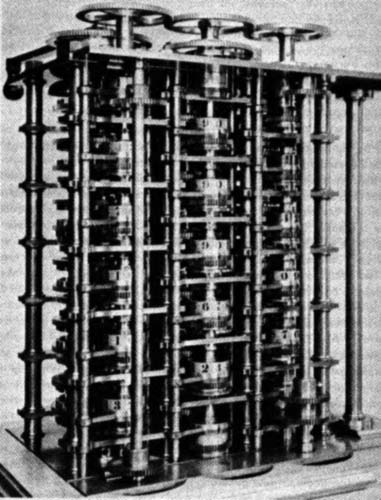
巴贝奇当时没有继续推进这个想法,但到了1819年,当他的兴趣转向天文仪器时,他的想法变得更加精确,他制定了一个计划,用机械方法按照差分法构造表。这样的机器只需借助加法机构就能执行复杂的运算。巴贝奇于1819年开始建造一台小型差分机,并在1822年完成。他在1822年6月14日向皇家天文学会宣读的一篇论文Note on the application of machinery to the computation of astronomical and mathematical tables中宣布了他的发明。
巴贝奇设想了一种能够打印出所获得结果的机器,但在论文写成时这还没有实现。必须由助手写下所获得的结果。巴贝奇通过计算序列的连续项,说明了他的小型引擎能够做什么。
这个数列的项是41, 43, 47, 53, 61, ...,而各项之差是2, 4, 6, 8, ..,二阶差是2, 2, 2, .....。差分机被给定初始数据2, 0, 41;它构造下一行2, (0 + 2), [41 + (0 + 2)],即2, 2, 43;然后行2, (2 + 2), [43 + (2 + 2)],即2, 4, 47;然后2, 6, 53;然后2, 8, 61;... 巴贝奇报告说他的小型差分机能够以每5分钟约60个的速度产生数列的成员。
巴贝奇显然深受de Prony为法国政府进行的一项重大工作的影响,该工作是用团队进行计算来制作对数表和三角函数表。他认为一台大型差分机可以完成团队所做的工作,节省成本并且完全准确。
1824年7月13日,巴贝奇因研制差分机而获得天文学会颁发的金质奖章。随后他会见了财政大臣,为建造一台大型差分机寻求公共资金。Royal Society已经向政府提出了积极的建议:——
巴贝奇在建造他的计算机器方面表现出巨大的才能和独创性,委员会认为这完全足以实现清单所提出的目标;他们认为巴贝奇在推进其艰巨事业方面非常值得公众鼓励。
他最初的拨款为1500英镑,并开始研制一台他相信能在三年内完成的大型差分机。他着手制造一台具有3的机器:——
……六阶差分,每阶二十位数字,而前三列每列还会多出半打数字。
这样的引擎本可以轻松计算出de Prony一直在计算的所有表格,并且计划配备打印机自动打印结果。然而,建造进度比预期的要慢。到1827年,费用已经失控。
1827年对巴贝奇来说是悲剧性的一年;他的父亲、妻子和两个孩子都在那一年去世。他自己的健康也垮了,并被建议去欧洲大陆旅行。旅行之后,他在1828年底返回。进一步争取政府支持的努力最终导致威灵顿公爵、财政大臣和政府其他成员亲自访问巴贝奇并检查工作。到1830年2月,政府已经支付或承诺支付9000英镑用于该项目。
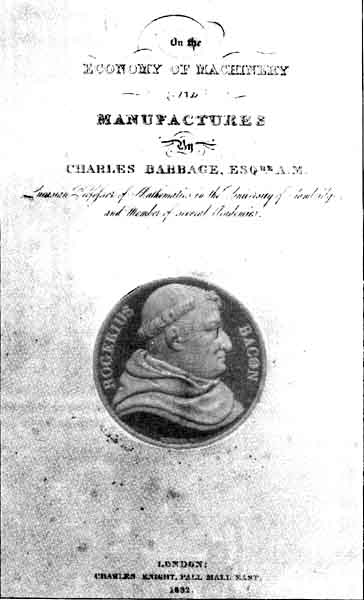
1830年,巴贝奇出版了Reflections on the Decline of Science in England,这是一部有争议的著作,导致一年后英国协会 for the Advancement of Science的成立。1834年,巴贝奇出版了他最有影响力的著作On the Economy of Machinery and Manufactures,在其中他提出了我们今天称之为运筹学的早期形式。
1834年是差分机工作停止的一年。到那时,政府已在该项目上投入了17000英镑,而巴贝奇也投入了自己的6000英镑。从1834年到1842年的八年里,政府一直未决定是否继续支持。1842年,罗伯特·皮尔政府决定不再继续。Dubbey在[6]中写道:-
巴贝奇完全有理由对历届政府对他的待遇感到愤慨。他们未能理解他工作的巨大可能性,忽视了最负盛名的科学家和工程师的建议,在就差分机做出决定之前拖延了八年,误解了他的动机和他所做的牺牲,并且……未能保护他免受公众的诽谤和嘲笑。
到1834年,巴贝奇已经完成了分析机的第一批图纸,这是现代电子计算机的前身。他在差分机上的工作使他产生了一个更为复杂精妙的想法。尽管分析机从未超越详细图纸阶段,但其逻辑组件与当今计算机极为相似。巴贝奇描述了五个逻辑组件:存储库、作坊、控制、输入和输出。存储库包含[4]:-
……所有待运算的变量,以及所有由其他运算结果产生的量。
作坊相当于现代计算机中的CPU,它是[4]的地方:-
……将要被运算的量总是被送入其中。
要执行的操作序列由一个雅卡尔织机式装置控制。它由穿孔卡片操作,而穿孔卡片包含特定任务的程序[4]:-
为任何公式制作的每一套卡片,在将来任何时候都能用所需的任何常数重新计算该公式。
因此,分析机将拥有自己的一个库。每一套卡片一旦制成,任何时候都能重现它最初被安排进行的计算。
存储装置要容纳1000个数,每个数50位,但巴贝奇设计分析机使其实际上具有无限存储。这是通过将数据输出到穿孔卡片来实现的,这些卡片在以后需要时可以再次读入。然而,巴贝奇在经历了差分机之后,决定不再寻求政府支持。
巴贝奇于1840年访问都灵,并与那里的数学家讨论了他的想法,其中包括费德里科·路易吉。在巴贝奇访问期间,费德里科·路易吉收集了描述分析机所需的全部材料,并于1842年10月发表了这些材料。阿达·洛夫莱斯将费德里科·路易吉的文章译成英文,并添加了比原回忆录详尽得多的注释。此文于1843年发表,其中包括[7]:-
……对费德里科·路易吉所提出观点的进一步阐述,以及她自己的一些复杂程序,其中最复杂的一个是计算伯努利数的序列。
巴贝奇从未建造过一台可运行的机械计算机,但他的设计概念已被证明是正确的,而且最近有人按照巴贝奇自己的设计标准建造了这样一台计算机。
参见THIS LINK。
他在1851年写道(见[7]):-
分析机的图纸完全是我自费绘制的:我进行了一系列漫长的实验,目的是把它的建造费用降低到我本人能够负担得起的限度之内。我现在只好认命,不得不放弃建造它……
尽管有最后这句话,巴贝奇从未完全放弃建造分析机的希望,他在1864年于[4]中写道:-
……如果我能再多活几年,分析机就会存在……
巴贝奇去世后,British Association [12] 任命了一个委员会,其成员包括 阿瑟·凯莱 和 威廉·金顿·克利福德:-
……以报告该设计的可行性,他们记录的意见是,其成功实现可能标志着计算史上一个与对数的引入同样值得纪念的新纪元……
这是一个低估。现代计算机的建造在逻辑上与 巴贝奇 的设计相似,已经改变了整个数学,甚至夸张地说,它们已经改变了整个世界。
Both the date and place of Charles Babbage's birth were uncertain but have now been firmly established. In [1] and [12], for example, his date of birth is given as 26 December 1792 and both give the place of his birth as near Teignmouth. Also in [18] it is stated:-
Little is known of Mr Babbage's parentage and early youth except that he was born on 26 December 1792.
However, a nephew wrote to The Times a week after the obituary [18] appeared, saying that Babbage was born on 26 December 1791. There was little evidence to prove which was right until Hyman (see [8]) in 1975 found that Babbage's birth had been registered in St Mary's Newington, London on 6 January 1792. Babbage's father was Benjamin Babbage, a banker, and his mother was Betsy Plumleigh Babbage. Given the place that his birth was registered Hyman says in [8] that it is almost certain that Babbage was born in the family home of 44 Crosby Row, Walworth Road, London.
Babbage suffered ill health as a child, as he relates in [4]:-
Having suffered in health at the age of five years, and again at that of ten by violent fevers, from which I was with difficulty saved, I was sent into Devonshire and placed under the care of a clergyman (who kept a school at Alphington, near Exeter), with instructions to attend to my health; but, not to press too much knowledge upon me: a mission which he faithfully accomplished.
Since his father was fairly wealthy, he could afford to have Babbage educated at private schools. After the school at Alphington he was sent to an academy at Forty Hill, Enfield, Middlesex where his education properly began. He began to show a passion for mathematics but a dislike for the classics. On leaving the academy, he continued to study at home, having an Oxford tutor to bring him up to university level. Babbage in [4] lists the mathematics books he studied in this period with the tutor:-
Amongst these were Humphry Ditton's 'Fluxions', of which I could make nothing; Madame Agnesi's 'Analytical Instructions' from which I acquired some knowledge; Woodhouse's 'Principles of Analytic Calculation', from which I learned the notation of Leibniz; and Lagrange's 'Théorie des Fonctions'. I possessed also the 'Fluxions' of Maclaurin and of Simson.
Babbage entered Trinity College, Cambridge in October 1810. However the grounding he had acquired from the books he had studied made him dissatisfied with the teaching at Cambridge. He wrote [4]:-
Thus it happened that when I went to Cambridge I could work out such questions as the very moderate amount of mathematics which I then possessed admitted, with equal facility, in the dots of Newton, the d's of Leibniz, or the dashes of Lagrange. I thus acquired a distaste for the routine of the studies of the place, and devoured the papers of Euler and other mathematicians scattered through innumerable volumes of the academies of St Petersburg, Berlin, and Paris, which the libraries I had recourse to contained.
Under these circumstances it was not surprising that I should perceive and be penetrated with the superior power of the notation of Leibniz.
It is a little difficult to understand how Woodhouse's Principles of Analytic Calculation was such an excellent book from which to learn the methods of Leibniz, yet Woodhouse was teaching Newton's calculus at Cambridge without any reference to Leibniz's methods. Woodhouse was one of Babbage's teachers at Cambridge yet he seems to have taken no part in the Society that Babbage was to set up to try to bring the modern continental mathematics to Cambridge.
Babbage tried to buy Lacroix's book on the differential and integral calculus but this did not prove easy in this period of war with Napoleon. When he did find a copy of the work he had to pay seven guineas for it - an incredible amount of money in those days. Babbage then thought of setting up a Society to translate the work [4]:-
I then drew up the sketch of a society to be instituted for translating the small work of Lacroix on the Differential and Integral Calculus. It proposed that we should have periodical meetings for the propagation of d's; and consigned to perdition all who supported the heresy of dots. It maintained that the work of Lacroix was so perfect that any comment was unnecessary.
Babbage talked with his friend Edward Bromhead (who would become George Green's friend some years later- see the article on Green) who encouraged him to set up his Society. The Analytical Society was set up in 1812 and its members were all Cambridge undergraduates. Nine mathematicians attended the first meeting but the two most prominent members, in addition to Babbage, were John Herschel and George Peacock.
Babbage and Herschel produced the first of the publications of the Analytical Society when they published Memoirs of the Analytical Society in 1813. This is a remarkably deep work when one realises that it was written by two undergraduates. They gave a history of the calculus, and of the Newton, Leibniz controversy they wrote:-
It is a lamentable consideration, that that discovery which has most of any done honour to the genius of man, should nevertheless bring with it a train of reflections so little to the credit of his heart.
Two further publications of the Analytical Society were the joint work of Babbage, Herschel and Peacock. These are the English translation of Lacroix's Sur le calcul différentiel et intégral published in 1816 and a book of examples on the calculus which they published in 1820.
Babbage had moved from Trinity College to Peterhouse and it was from that College that he graduated with a B.A. in 1814. However, Babbage realised that Herschel was a much more powerful mathematician than he was so [12]:-
He did not compete for honours, believing Herschel sure of first place and not caring to come out second.
Indeed Herschel was first Wrangler, Peacock coming second. Babbage married in 1814, then left Cambridge in 1815 to live in London. He wrote two major papers on functional equations in 1815 and 1816. Also in 1816, at the early age of 24, he was elected a fellow of the Royal Society of London. He wrote papers on several different mathematical topics over the next few years but none are particularly important and some, such as his work on infinite series, are clearly incorrect.
Babbage was unhappy with the way that the learned societies of that time were run. Although elected to the Royal Society, he was unhappy with it. He was to write of his feelings on how the Royal Society was run:-
The Council of the Royal Society is a collection of men who elect each other to office and then dine together at the expense of this society to praise each other over wine and give each other medals.
However in 1820 he was elected a fellow of the Royal Society of Edinburgh, and in the same year he was a major influence in founding the Royal Astronomical Society. He served as secretary to the Royal Astronomical Society for the first four years of its existence and later he served as vice-president of the Society.
Babbage, together with Herschel, conducted some experiments on magnetism in 1825, developing methods introduced by Arago. In 1827 Babbage became Lucasian Professor of Mathematics at Cambridge, a position he held for 12 years although he never taught. The reason why he held this prestigious post yet failed to carry out the duties one would have expected of the holder, was that by this time he had become engrossed in what was to became the main passion of his life, namely the development of mechanical computers.
Babbage is without doubt the originator of the concepts behind the present day computer. The computation of logarithms had made him aware of the inaccuracy of human calculation around 1812. He wrote in [4]:-
... I was sitting in the rooms of the Analytical Society, at Cambridge, my head leaning forward on the table in a kind of dreamy mood, with a table of logarithms lying open before me. Another member, coming into the room, and seeing me half asleep, called out, Well, Babbage, what are you dreaming about?" to which I replied "I am thinking that all these tables" (pointing to the logarithms) "might be calculated by machinery."
Certainly Babbage did not follow up this idea at that time but in 1819, when his interests were turning towards astronomical instruments, his ideas became more precise and he formulated a plan to construct tables using the method of differences by mechanical means. Such a machine would be able to carry out complex operations using only the mechanism for addition. Babbage began to construct a small difference engine in 1819 and had completed it by 1822. He announced his invention in a paper Note on the application of machinery to the computation of astronomical and mathematical tables read to the Royal Astronomical Society on 14 June 1822.
Although Babbage envisaged a machine capable of printing out the results it obtained, this was not done by the time the paper was written. An assistant had to write down the results obtained. Babbage illustrated what his small engine was capable of doing by calculating successive terms of the sequence .
The terms of this sequence are 41, 43, 47, 53, 61, ... while the differences of the terms are 2, 4, 6, 8, .. and the second differences are 2, 2, 2, ..... The difference engine is given the initial data 2, 0, 41; it constructs the next row 2, (0 + 2), [41 + (0 + 2)], that is 2, 2, 43; then the row 2, (2 + 2), [43 + (2 + 2)], that is 2, 4, 47; then 2, 6, 53; then 2, 8, 61; ... Babbage reports that his small difference engine was capable of producing the members of the sequence at the rate of about 60 every 5 minutes.
Babbage was clearly strongly influenced by de Prony's major undertaking for the French Government of producing logarithmic and trigonometric tables with teams of people to carry out the calculations. He argued that a large difference engine could do the work undertaken by teams of people saving cost and being totally accurate.
On 13 July 1824 Babbage received a gold medal from the Astronomical Society for his development of the difference engine. He then met the Chancellor of the Exchequer to seek public funds for the construction of a large difference engine. The Royal Society had already given positive advice to the government:-
Mr Babbage has displayed great talent and ingenuity in the construction of his machine for computation, which the committee thanks fully adequate to the attainment of the objects proposed by the inventory; and they consider Mr Babbage as highly deserving of public encouragement, in the prosecution of his arduous undertaking.
His initial grant was for £1500 and he began work on a large difference engine which he believed he could complete in three years. He set out to produce an engine with [3]:-
... six orders of differences, each of twenty places of figures, whilst the first three columns would each have had half a dozen additional figures.
Such an engine would easily have been able to compute all the tables that de Prony had been calculating, and it was intended to have a printer to print out the results automatically. However the construction proceeded slower than had been expected. By 1827 the expenses were getting out of hand.
The year 1827 was a year of tragedy for Babbage; his father, his wife and two of his children all died that year. He own health gave way and he was advised to travel on the Continent. After his travels he returned near the end of 1828. Further attempts to obtain government support eventually resulted in the Duke of Wellington, the Chancellor of the Exchequer and other members of the government visiting Babbage and inspecting the work for themselves. By February 1830 the government had paid, or promised to pay, £9000 towards the project.
In 1830 Babbage published Reflections on the Decline of Science in England, a controversial work that resulted in the formation, one year later, of the British Association for the Advancement of Science. In 1834 Babbage published his most influential work On the Economy of Machinery and Manufactures, in which he proposed an early form of what today we call operational research.
The year 1834 was the one in which work stopped on the difference engine. By that time the government had put £17000 into the project and Babbage had put £6000 of his own money. For eight years from 1834 to 1842 the government would make no decision as to whether to continue support. In 1842 the decision not to proceed was taken by Robert Peel's government. Dubbey in [6] writes:-
Babbage had every reason to feel aggrieved about his treatment by successive governments. They had failed to understand the immense possibilities of his work, ignored the advice of the most reputable scientists and engineers, procrastinated for eight years before reaching a decision about the difference engine, misunderstood his motives and the sacrifices he had made, and ... failed to protect him from public slander and ridicule.
By 1834 Babbage had completed the first drawings of the analytical engine, the forerunner of the modern electronic computer. His work on the difference engine had led him to a much more sophisticated idea. Although the analytic engine never progressed beyond detailed drawings, it is remarkably similar in logical components to a present day computer. Babbage describes five logical components, the store, the mill, the control, the input and the output. The store contains [4]:-
... all the variables to be operated upon, as well as all those quantities which had arisen from the results of other operations.
The mill is the analogue of the cpu in a modern computer and it is the place [4]:-
... into which the quantities about to be operated upon are always bought.
The control on the sequence of operations to be carried out was by a Jacquard loom type device. It was operated by punched cards and the punched cards contained the program for the particular task [4]:-
Every set of cards made for any formula will at any future time recalculate the formula with whatever constants may be required.
Thus the Analytical Engine will possess a library of its own. Every set of cards once made will at any time reproduce the calculations for which it was first arranged.
The store was to hold 1000 numbers each of 50 digits, but Babbage designed the analytic engine to effectively have infinite storage. This was done by outputting data to punched cards which could be read in again at a later stage when needed. Babbage decided, however, not to seek government support after his experiences with the difference engine.
Babbage visited Turin in 1840 and discussed his ideas with mathematicians there including Menabrea. During Babbage's visit, Menabrea collected all the material needed to describe the analytical engine and he published this in October 1842. Lady Ada Lovelace translated Menabrea's article into English and added notes considerably more extensive than the original memoir. This was published in 1843 and included [7]:-
... elaborations on the points made by Menabrea, together with some complicated programs of her own, the most complex of these being one to calculate the sequence of Bernoulli numbers.
Although Babbage never built an operational, mechanical computer, his design concepts have been proved correct and recently such a computer has been built following Babbage's own design criteria.
See THIS LINK.
He wrote in 1851 (see [7]):-
The drawings of the Analytical Engine have been made entirely at my own cost: I instituted a long series of experiments for the purpose of reducing the expense of its construction to limits which might be within the means I could myself afford to supply. I am now resigned to the necessity of abstaining from its construction...
Despite this last statement, Babbage never did quite give up hope that the analytical engine would be built writing in 1864 in [4]:-
... if I survive some few years longer, the Analytical Engine will exist...
After Babbage's death a committee,whose members included Cayley and Clifford, was appointed by the British Association [12]:-
... to report upon the feasibility of the design, recorded their opinion that its successful realisation might mark an epoch in the history of computation equally memorable with that of the introduction of logarithms...
This was an underestimate. The construction of modern computers, logically similar to Babbage's design, have changed the whole of mathematics and it is even not an exaggeration to say that they have changed the whole world.
正文里的方括号编号指向这里,悬停即可直接看到条目。书目保留原文——译了书名反而查不到文献。
原站列出的延伸阅读与外部数据库,照原样保留,目标多为英文页面。
关于查尔斯·巴贝奇的其它页面:
关于查尔斯·巴贝奇的其它网站:
原站的交叉引用。指向本站已镜像专题的留在站内,其余仍指回原站。