数学家传记
于尔班·勒维耶最著名的是导致发现海王星的计算。
于尔班·勒维耶 的父亲路易-巴蒂斯特·勒维耶 是一位地产管理人和政府官员,1779年出生于卡朗唐,而他的母亲玛丽-让娜-约瑟芬·德·博德尔1783年出生于博德尔,就在圣洛以南几公里处。我们注意到卡朗唐位于圣洛东北仅约23公里处。路易-巴蒂斯特于1807年10月29日在圣洛的圣母院与让娜-约瑟芬结婚。勒维耶 有一个姐姐莱昂蒂娜·安妮·约瑟芬(1808年出生,1808年9月29日在圣洛受洗),这个家境有限,住在圣洛战神广场的一所简朴房子里。勒维耶 在圣洛的学院学习了八年,1827年十六岁时在那里完成了学业。他表现出自己是一个非常有天赋的学生,在圣洛的学院之后,他在卡昂皇家学院学习了三年数学,从1827年到1830年。
尽管在卡昂学院是一名出色的学生,在班上名列前茅,但他在1830年的巴黎综合理工学院竞争性入学考试中失败了。勒维耶的父亲非常希望他的儿子有一切机会继续深造,所以他卖掉了在圣洛的房子,以获得必要的资金将勒维耶送到巴黎的迈耶学院。在那里,他在数学家古斯塔夫·肖凯(迈耶学院的院长)的指导下学习了一年,并于1831年在全国会考中获得第二名,被巴黎综合理工学院录取。他学习了两年后毕业,在年级中排名第八。他的主要兴趣是化学,毕业后头两年,即1833-35年,他在巴黎奥赛学习工业化学。此时他的主要兴趣是烟草工业,他对磷与氧和氢的化合进行了研究,这些是烟草工业的重要课题,因为火柴是由磷制成的。他在本科期间曾师从化学家路易·约瑟夫·盖-吕萨克(1778-1850),盖-吕萨克指导了勒维耶正在进行的实验。他的研究很快引起了其他顶尖科学家的注意,如物理学家和化学家皮埃尔·路易·杜隆(1785-1838)和化学家路易·安托万热罗姆·巴拉尔(1802-1876)。他在Annales de Chimie et de Physique上发表了两篇关于化学研究的论文,即Sur les combinaisons du phosphore avec l'hydrogèneⓉ(论磷与氢的化合)(1835年)和Sur les combinaisons du phosphore avec l'oxygèneⓉ(论磷与氧的化合)(1837年)。
勒维耶于1836年获得外省化学教师职位,但选择留在巴黎与盖-吕萨克一起进行研究。当然,他需要收入来源,于是被任命为巴黎斯坦尼斯拉斯学院的教师。他通过私下教授数学来增加收入。1837年,他与Lucile Marie Clothilde 古斯塔夫·肖凯结婚,后者是他以前在迈耶学院的老师的女儿。他们有三个孩子:Léon(生于1838年)、勒维耶-Louis-Paul(生于1849年)和Marie Geneviève Josephine Lucile(生于1853年)。勒维耶的妻子Lucile是一位优秀的业余音乐家,从作曲家和钢琴家César-Auguste Franck(1822-1890)那里接受课程。结婚后,勒维耶雇佣他的妹妹Léontine作为管家。
1836年,巴黎综合理工学院有两个辅导教师职位空缺。一个职位是盖-吕萨克的辅导教师,这是一个化学职位,勒维耶申请了这个职位。维克多·勒尼奥(1810-1878)也申请了这个职位,他是一个强有力的候选人,因为1835年他开始了一系列关于卤代烃和其他不饱和烃衍生物的重要研究。勒尼奥被任命为巴黎综合理工学院盖-吕萨克的辅导教师。勒维耶随后决定申请第二个职位,即菲力克斯·瓦利的辅导教师,这是一个天文学职位。虽然对于一个正在进行化学研究的人来说,申请天文学职位可能看起来很奇怪,但勒维耶的数学专长意味着他有资格。他获得了这个职位并接受了。他写信给他的父亲(例如,见[5]):-
敢于接受先后由弗朗索瓦·阿拉戈、Claude-Louis Mathieu和菲力克斯·瓦利履行的职责,我给自己施加了义务,不让它们所占据的职位在公众评价中降低,为此我不仅必须接受,而且必须寻找机会扩展我的知识。……我已经升了许多级,为什么我不应该继续升得更高呢?
勒维耶于1837年被任命为巴黎综合理工学院的菲力克斯·瓦利的辅导教师,教授天文学。除了勒维耶之外,乌惹内·查尔斯·卡塔兰和夏尔-欧仁·德洛奈于1838年被任命为菲力克斯·瓦利的辅导教师。同样在1837年,勒维耶被任命为巴黎综合理工学院的入学考试考官。当菲力克斯·瓦利于1840年病重时,勒维耶接管了菲力克斯·瓦利的全部教学工作。菲力克斯·瓦利于1841年7月去世,勒维耶可能期望被任命接替他的职位。然而,米歇尔·沙勒被任命为菲力克斯·瓦利的继任者,而勒维耶继续担任米歇尔·沙勒的辅导教师(乌惹内·查尔斯·卡塔兰和夏尔-欧仁·德洛奈也是如此)。勒维耶对天文学的第一个贡献是论文Sur les variations séculaires des orbites des planètes Ⓣ(《论行星轨道的长期变化》),他于1839年9月提交给科学院。这篇论文考虑了太阳系的稳定性问题。勒维耶随后研究了周期彗星,并能够证明某些彗星——先前被认为是不同的天体——实际上是同一个天体因木星的引力吸引而被扰动到截然不同的轨道上。他的工作为他赢得了相当大的认可,并于1846年1月19日被选入科学院。
尽管现在已是一位重要人物,勒维耶显然仍处于某种经济困难之中,这可以从他当选科学院院士[15]后不久写的一封信中看出:-
巴黎,1846年4月18日。
部长先生,
我的父亲,巴黎遗产税征收员,去世时留下了一位寡妇,我的母亲,她除了六百法郎的养老金外没有任何收入;还有一个女儿,莱昂蒂娜·勒维耶小姐,完全没有钱。我冒昧地为她[母亲]请求在巴黎获得一个印花税纸分发处的职位。我完全相信,只要我能有幸得到您的一句好话,我的请求就不会失败,尤其是考虑到我父亲曾在其手下工作的那位前主管。部长先生,我向您提出这一请求的理由是:我与一所学校有教学关系,而该校有幸将您列为其前学生之一;并且我进行了一些天文学研究,学者们对此给予了肯定的认可;此外,我最近当选为科学院的成员。
部长先生,请接受我尊敬的敬意。
U J 勒维耶,研究院成员。
他一生大部分时间都在巴黎天文台工作,在那里他对效率的追求使他非常不受欢迎。一位同时代的人这样评价他:-
我不知道勒维耶先生是否真的是法国最可憎的人,但我非常确定他是最被憎恨的人。
他的主要工作在天体力学领域,他最著名的成就是根据天王星轨道的不规则性计算出一颗未知行星(后来命名为海王星)的位置。弗朗索瓦·阿拉戈曾要求他在1845年研究天王星轨道的不规则性,勒维耶于1845年12月发表了他关于该主题的第一篇论文。1846年6月的第二篇论文证明这些不规则性不可能由已知行星引起,他假设这些不规则性是由天王星轨道之外的另一颗行星引起的。1846年8月,他发表了他对这颗假想行星的预测位置。他的摄动分析展示了非凡的计算能力,因为他将近似计算进行到了第七阶,涉及469个不同的项。1846年9月18日,勒维耶写信给柏林天文台的Johann Galle,请他在他预测的位置寻找这颗行星。Galle此前知道有人预测过一颗行星,但他说那是:-
……仅凭理论推导就进行观测,这是何等新奇的事;而且,虽然必定要付出许多劳动,成功却显得很可疑。
然而,在信寄出五天后收到勒维耶的来信时,Galle看到了勒维耶对自己工作的信心,于是在收到信的当天晚上就寻找这颗新行星。他在那天夜里找到了它,位置与预测位置相差不到一度;第二天夜里又观测了一次,以绝对确认它是一颗行星,然后他回信给勒维耶:——
你所指出的位置上的那颗行星确实存在。收到你信的同一天,我发现了一颗八等星,它没有记录在出色的Carta Hora XXI(由Bremiker博士绘制)上。……第二天的观测证实,它就是所要寻找的那颗行星。
正如勒维耶的一位同事所说:——
……他用笔尖发现了一颗星,除了他计算的力量之外,没有使用任何仪器。
弗朗索瓦·阿拉戈最初曾建议勒维耶研究这个问题,他说:——
在所有公正的人看来,这一发现将始终是理论天文学最辉煌的胜利之一,是Académie的荣耀之一,也是我们国家最美丽的殊荣之一。
约翰·柯西·亚当斯被公认独立于勒维耶做出了对一颗摄动行星的类似计算。此处不是讨论约翰·柯西·亚当斯优先权主张有效性的地方,但我们应当注意到,最近的研究表明,他的结果远不如勒维耶的结果精确。勒维耶因其成就获得了许多荣誉和广泛认可。London Times在1846年10月1日以如下标题报道:-
勒维耶发现的行星。
他被授予伦敦皇家学会的科普利奖章,并在法国成为荣誉军团军官。1847年,索邦大学专门为勒维耶设立了一个天体力学讲席。他着手进行一项雄心勃勃的研究计划,即为整个行星系统撰写一部单一著作。在这部著作中,他希望(用他自己的话来说)[12]:-
……如果可能的话,把一切协调起来;如果不可能,就明确宣告仍然存在未知的摄动原因,只有到那时,这些原因的来源才能被识别出来。
勒维耶此时已获得重要地位,他利用自己的影响力彻底改变了巴黎综合理工学院的数学教学。Ivor Grattan-Guinness写道[13]:-
1850年,勒维耶 主持了一个委员会,以决定该校未来的作用。其成员包括 让-维克托·彭赛列 将军(1788-1867),他刚刚在担任司令两年后退休,这两年的任期相当无效(自1804年改革以来第一位担任此职的学者),以及作为学业主任的 让-马里·迪阿梅尔。在1850年的六个月里,勒维耶 写了一篇关于该校的宏大而卓越的报告,其中包括从档案中提取的许多历史方面。他还与国民议会一起出版了一份重要的补充材料。他一定有非常有影响力的支持者,因为我认为在其历史上独一无二的举动是,国家报纸《世界箴言报》在其1851年1月15日的一期中出版了一份34页的增刊,转载了报告的大约250页。由于对 皮埃尔·西蒙·拉普拉斯 和 奥古斯丁·路易·柯西 的政策长期且近期的支配感到恼火,勒维耶 实际上主张回归 加斯帕尔·蒙日 的愿望。分析和力学的“旗舰”课程被停办;分析部分有所简化,力学部分侧重于应用,并与机器理论课程相结合。当这些建议被批准时,学校的一些反应非常激烈:约瑟夫·刘维尔 和 米歇尔·沙勒 立即辞职,以抗议对他们从 奥古斯丁·路易·柯西 等前辈继承并延续的强调教授纯数学的否定。
勒维耶 值得赞扬的不仅是他对天文学的理论贡献。此外,他还是现代气象学的创始人之一 [1]:-
1854年,战争部长要求他研究袭击塞瓦斯托波尔的舰队所遭遇的飓风。他在欧洲和亚洲的系统调查使他能够确定飓风的路径。在此期间,忙于重组巴黎天文台的气象观测服务,勒维耶 构想了“一个庞大的气象网络项目,旨在警告水手即将来临的风暴。”最大的困难在于确保各电报部门的合作。到1857年,该项目已足够先进,可以分发每日公报,提供14个法国站和5个外国站的大气状况。
同样在1854年,勒维耶 成为巴黎天文台的台长,该天文台在 弗朗索瓦·阿拉戈 的领导下,没有达到 勒维耶 所期望的标准。他不得不求助于柏林天文台来发现海王星,他认为这是国家的耻辱。接任台长后,他立即坚持军事纪律,但他所推行的新制度遭到工作人员的强烈反对,几乎所有人都辞职了。最终,他的不受欢迎导致他在1870年被免职。夏尔-欧仁·德洛奈 被任命为他的继任者,但 夏尔-欧仁·德洛奈 在1872年8月的一次悲惨事故中去世。此后,在1873年,勒维耶 再次被授予该职位,但他的权力受到严重限制,因为他受到一个委员会的监督。
勒维耶 研究整个行星系统的主要工作始于对内行星的观察,他立即在1855年发现了水星近日点运动的差异。事实上,水星近日点每世纪前进5600角秒。其中5026角秒由地球的 岁差 解释,531角秒是其他行星摄动的结果。这留下了每世纪43角秒无法解释。事实上,勒维耶 因为在他那个时代行星的质量并不十分准确,发现水星近日点每世纪有38角秒的前进无法解释。现在,水星近日点前进超过牛顿理论预测的数值,成为 阿尔伯特·爱因斯坦 广义相对论的重要证据,但当然 勒维耶 不可能知道这一点,他在1859年9月12日提交给 科学院 的一篇论文中,将其归因于一颗未发现的行星,他称之为祝融星,比水星更靠近太阳,或者是一个如此靠近太阳以至于不可见的第二小行星带。他花费了大量精力在水星轨道内寻找小行星,以试图证明他的理论。在提交论文仅三个月后,他收到了住在雷恩附近奥尔热尔的埃德蒙·莱斯卡博的信,说他在九个月前观察到了祝融星的凌日。勒维耶 赶到奥尔热尔与莱斯卡博先生会面。以下是他们会面的当代记述 [12]
人们应该见过莱斯卡博先生,如此矮小,如此朴素,如此谦逊,如此胆怯,才能理解当他被 勒维耶 以高大的身材和那种他能发出的直率语调这样对他说话时,他所感到的情绪:“那么,先生,就是您自称观察到了水内行星,并且犯下了将您的观察保密九个月的严重过错。我警告您,我来这里是为了公正对待您的主张,并证明您要么不诚实,要么受骗了。那么,明确地告诉我,您看到了什么。”
勒维耶最终确信莱斯卡博看到了祝融星的凌日。其他天文学家并不信服,因为没有其他天文学家观测到这次凌日。在接下来的几年里,许多人试图找到祝融星,或是通过寻找凌日,或是在日全食时,此时靠近太阳的行星会变得可见。例如,勒维耶本人于1860年7月率领一支探险队前往西班牙观测日全食。许多虚假报告鼓舞了勒维耶,但没有一个被证明是正确的。直到勒维耶去世很久之后的1915年,阿尔伯特·爱因斯坦的广义相对论才解释了水星的轨道,而无需摄动天体。
在许多方面,祝融星是勒维耶关于所有行星体轨道的重要工作中一段不幸的插曲。他为各行星构建了星表并建立了轨道理论。他出版了Théorie du mouvement apparent du SoleilⓉ(《太阳视运动理论》)(1858年)和Tables du SoleilⓉ(《太阳表》)(1858年);Théorie de MercureⓉ(《水星理论》)(1859年)和Tables de MercureⓉ(《水星表》)(1859年);Théorie de VénusⓉ(《金星理论》)(1861年)和Tables de VénusⓉ(《金星表》)(1861年);Théorie de MarsⓉ(《火星理论》)(1861年)和Tables de MarsⓉ(《火星表》)(1861年);Théorie de JupiterⓉ(《木星理论》)(1876年)和Tables de JupiterⓉ(《木星表》)(1876年);Théorie de SaturneⓉ(《土星理论》)(1876年)和Tables de SaturneⓉ(《土星表》)(1876年);Théorie d'UranusⓉ(《天王星理论》)(1876年);Théorie de NeptuneⓉ(《海王星理论》)(1876年);以及Tables d'UranusⓉ(《天王星表》)(1877年)。他因关于水星、金星、地球和火星的理论与星表的工作,于1868年获得皇家天文学会金质奖章,又因关于其余行星的工作,于1876年获得皇家天文学会的第二枚金质奖章。Charles Pritchard(1808-1893)于1868年向他颁发了金质奖章,约翰·柯西·亚当斯于1876年向勒维耶颁发了第二枚金质奖章,但此时他已病重,无法亲自领取。
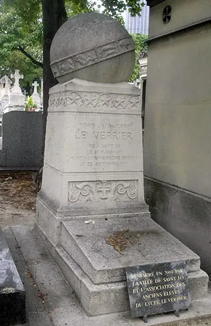
勒维耶于1873年开始患肝病。病情逐渐恶化,他在巴黎去世,葬于蒙帕纳斯公墓,墓上立有一个巨大的石制天球。
参见THIS LINK。
除上述荣誉外,他还获得过许多荣誉。他几乎被选入欧洲每一个科学院。一颗小行星、海王星的一个环以及一个月球陨石坑以勒维耶命名。贝桑松、布里夫拉盖亚尔德、卡昂、茹埃莱图尔、里尔、南特、巴黎、圣洛、图卢兹和图尔宽等地的街道以他的名字命名。曾有一架法国航空公司的飞机和一艘法国气象船被命名为“勒维耶”。法国邮票和纸币上印有他的肖像。
Urbain Le Verrier's father, Louis-Baptiste Le Verrier, was an estates manager and government official who had been born in 1779 in Carentan while his mother, Marie-Jeanne-Josephine de Baudre, had been born in 1783 in Baudre, just a few kilometres south of Saint-Lô. We note that Carentan is only about 23 km north east of Saint-Lô. Louis-Baptiste married Jeanne-Josephine in Notre Dame, Saint-Lô, on 29 October 1807. Urbain had an elder sister Léontine Anne Joséphine (born 1808, baptised on 29 September 1808 in Saint-Lô) and the family, of limited means, lived in a modest home in the Place du Champ de Mars, Saint-Lô. Urbain attended the College in Saint-Lô for eight years, completing his studies there at the age of sixteen in 1827. He had showed himself to be a very talented pupil and, after the College in Saint-Lô, he studied mathematics at the College Royal de Caen for three years, from 1827 to 1830.
Despite being an outstanding pupil at the College in Caen, coming top of his class, he failed the competitive entrance examination to the École Polytechnique in 1830. Le Verrier's father was very keen that his son should have every opportunity to further his education so he sold his home in Saint-Lô to get the necessary funds to send Le Verrier to the Mayer Institute in Paris. There he studied for a year under the mathematician Choquet, the director of the Mayer Institute, and in 1831 he was placed second in the nation-wide Concours général and admitted to the École Polytechnique. He studied for two years before graduating, ranked eighth in his year. His main interest had been in chemistry and he spent the first two years after graduating, 1833-35, studying industrial chemistry at Orsay in Paris. His main interest at this time was in the tobacco industry and he undertook research on the combination of phosphorus with oxygen and with hydrogen, important topics for the tobacco industry since matches were made from phosphorus. He had been taught by the chemist Louis Joseph Gay-Lussac (1778-1850) while he was an undergraduate and Gay-Lussac directed the experiments that Le Verrier was undertaking. His research soon came to the notice of other leading scientists such as the physicist and chemist Pierre Louis Dulong (1785-1838) and the chemist Antoine Jérôme Balard (1802-1876). He published two papers on his chemistry research in the Annales de Chimie et de Physique, namely Sur les combinaisons du phosphore avec l'hydrogène Ⓣ (1835) and Sur les combinaisons du phosphore avec l'oxygène Ⓣ (1837).
Le Verrier was offered a position as a teacher of chemistry in the provinces in 1836 but chose to remain in Paris undertaking research with Gay-Lussac. Of course he required a source of income and he was appointed as a teacher at the Collège Stanislas in Paris. He augmented this income by giving private tuition in mathematics. In 1837, he married Lucile Marie Clothilde Choquet, the daughter of his former teacher at the Mayer Institute. They had three children: Léon (born 1838), Urbain-Louis-Paul (born 1849) and Marie Geneviève Josephine Lucile (born 1853). Le Verrier's wife Lucile was a fine amateur musician, receiving lessons from the composer and pianist César-Auguste Franck (1822-1890). After he married, Le Verrier employed his sister Léontine as a housekeeper.
In 1836 two positions as répétiteur had become vacant at the École Polytechnique. One position, as répétiteur to Gay-Lussac, was a chemistry appointment and Le Verrier applied for this position. Victor Regnault (1810-1878) also applied for this position and he was a strong candidate for, in 1835, he had begun a series of important researches on the haloid and other derivatives of unsaturated hydrocarbons. Regnault was appointed as répétiteur to Gay-Lussac at the École Polytechnique. Le Verrier then decided to apply for the second position of répétiteur to Felix Savary, which was an astronomy appointment. Although it might seem strange for someone who was undertaking research in chemistry to apply for an astronomy position, Le Verrier's mathematical expertise meant that he was qualified. He was offered the position which he accepted. He wrote to his father (see, for example [5]):-
In daring to accept the duties which had successively been fulfilled by François Arago, Claude-Louis Mathieu, and Felix Savary, I have imposed on myself the obligation not to let the post which they have occupied be depressed in the public esteem, and for this I must not only accept but seek out opportunities to extend my knowledge. ... I have already ascended many ranks, why should I not continue to rise further?
Le Verrier was appointed to teach astronomy as Felix Savary's répétiteur at the École Polytechnique in 1837. In addition to Le Verrier, Eugène Catalan and Charles Delaunay were appointed as répétiteurs to Savary in 1838. Also in 1837 Le Verrier was appointed as an admissions examiner for the École Polytechnique. When Savary became seriously ill in 1840, Le Verrier took over all Savary's teaching. Savary died in July 1841 and Le Verrier might have expected to be appointed to succeed him. However, Michel Chasles was appointed as Savary's successor and Le Verrier remained as a répétiteur to Chasles (as did Catalan and Delaunay). Le Verrier's first contribution to astronomy was the paper Sur les variations séculaires des orbites des planètes Ⓣ which he presented to the Academy of Sciences in September 1839. This paper considered the problem of the stability of the solar system. Le Verrier then worked on a study of periodic comets and was able to show that certain comets, previously thought to be distinct objects, were in fact the same object perturbed into a very different orbit by the gravitational attraction of Jupiter. His work gained him considerable recognition and, on 19 January 1846, he was elected to the Academy of Sciences.
Despite now being a major figure, Le Verrier was clearly still in some financial difficulty as can be seen from a letter he wrote shortly after his election to the Academy [15]:-
Paris, April 18, 1846.
Monsieur le Ministre,
My Father, Receveur des droits de succession at Paris, left on his death a widow, my mother, who has no income except from a pension of six hundred francs; and a daughter, Mademoiselle Léontine Le Verrier, absolutely without any money. I venture to solicit for her [the mother] a Bureau for the distribution of stamped paper at Paris. I have entire faith that my request will not fail so far as concerns the former chief under whom my Father worked, if only I have the good fortune of obtaining a favourable word from you. My justifications in preferring this request to you, Monsieur le Ministre, are that I am connected with the giving of instruction in a school which has the honour of counting you among its former pupils, and that I have carried on certain astronomical investigations which savants have been pleased to recognize favourably, besides which I have recently been elected a member of the Academy of Sciences.
Receive, Monsieur le Ministre, the homage of my respectful regards.
U J Le Verrier, Member of the Institute.
He worked at the Paris Observatory for most of his life where his drive for efficiency was to made him very unpopular. A contemporary said of him:-
I do not know whether M Le Verrier is actually the most detestable man in France, but I am quite certain that he is the most detested.
His main work was in celestial mechanics and his most famous achievement was his calculation of the position of an unknown planet, later named Neptune, from irregularities in Uranus's orbit. François Arago had asked him to work on the irregularities in Uranus's orbit in 1845 and Le Verrier had published his first memoir on the subject in December 1845. A second memoir in June 1846 proved that the irregularities could not result from the known planets and he postulated that the irregularities resulted from a further planet outside the orbit of Uranus. In August 1846 he published his predicted position for the hypothetical planet. His perturbation analysis showed remarkable computational skills for he had taken his approximations to the seventh order, involving 469 distinct terms. On 18 September 1846, Le Verrier wrote to Johann Galle at the Berlin Observatory asking him to look for the planet at the position he predicted. Galle knew of predictions of a planet earlier but said that it was:-
... so novel a thing to undertake observations in reliance upon merely theoretical deductions; and that, while much labour was certain, success appeared very doubtful.
However, on receiving Le Verrier's letter, five days after it was sent, Galle saw the confidence that Le Verrier had in his work and so searched for the new planet on the same evening he received the letter. He found it that night within one degree of the predicted position, observed it again on the following night to confirm absolutely that it was a planet and he wrote back to Le Verrier:-
The Planet whose position you indicated really exists. The same day I received your letter I found a star of the eighth magnitude that was not recorded on the excellent Carta Hora XXI (drawn by Dr Bremiker). ... The observation of the following day confirmed that it was the planet sought.
As one of Le Verrier's colleagues said:-
... he discovered a star with the tip of his pen, without any instruments other than the strength of his calculations alone.
Arago, who had first suggested that Le Verrier work on this problem, said:-
In the eyes of all impartial men, this discovery will remain one of the most magnificent triumphs of theoretical astronomy, one of the glories of the Académie and one of the most beautiful distinctions of our country.
John Couch Adams has been recognised as having made similar calculations of a perturbing planet independently of Le Verrier. This is not the place to discuss the validity of the claims for Adams, but we should note that recent research has suggested that his results were considerably less accurate than those of Le Verrier. Le Verrier received many honours and widespread recognition for his achievement. The London Times carried the headline on the 1 October 1846:-
Le Verrier's planet found.
He was awarded the Copley Medal of the Royal Society of London and, in France, became an officer in the Legion of Honour. In 1847 a chair of celestial mechanics was specially created for Le Verrier at the Sorbonne. He embarked on an ambitions research programme, namely to produce a single work for the whole of the planetary system. In this work, he wished to (in his own words) [12]:-
... put everything in harmony if possible and, if it is not, declare with certainty that there exist still unknown causes of perturbations, the sources of which would then and only then be recognisable.
Le Verrier had now achieved an important status and he used his influence to radically change the mathematics teaching at the École Polytechnique. Ivor Grattan-Guinness writes [13]:-
In 1850 [Le Verrier] chaired a commission to decide the future role of the school. Its members included General Jean-Victor Poncelet (1788-1867) who had just retired after two rather ineffective years as Commandant (the first academic to hold this post since the reforms of 1804), and Jean-Marie Duhamel as Directeur des Études. In six months of 1850 Le Verrier wrote a large and remarkable report on the school, including many aspects of its history drawn from the archives. He also published a substantial supplement with the Assemblée Nationale. He must have had very influential supporters for in a move that I believe to be unique in its history the national newspaper 'Moniteur universel' published a 34-page supplement to its issue of 15 January 1851, reproducing about 250 pages of the report. Irritated by the long and recent dominance of the policies of Laplace and Cauchy, Le Verrier argued in effect for a return to Monge's aspirations. The "flagship" course on analysis and mechanics was discontinued; the part on analysis was somewhat simplified, and the part on mechanics focused on applications and allied to the course on machine theory. When the recommendations were approved, some reactions at the school were stark: Liouville and Chasles resigned immediately in protest at this rejection of the emphasis on teaching purish mathematics that they had inherited and continued from predecessors such as Cauchy.
It is not only for his theoretical contributions to astronomy that Le Verrier deserves praise. In addition, he was one of the founders of modern meteorology [1]:-
In 1854 the minister of war requested him to study the cyclone that struck the fleets besieging Sevastopol. His systematic inquiry in Europe and Asia enabled him to determine the path of the cyclone. Occupied during this period with the reorganization of the meteorological observation service of the Paris observatory, Le Verrier conceived "the project of a vast meteorological network designed to warn sailors of approaching storms." The greatest difficulty lay in securing the cooperation of the various telegraphic services. By 1857 the project was sufficiently advanced for distribution of a daily bulletin giving the atmospheric conditions at fourteen French and five foreign stations.
Also in 1854 Le Verrier became director of the Paris Observatory which, under Arago's leadership, had not performed to standards that Le Verrier expected. The fact that he had to turn to the Berlin Observatory for the discovery of Neptune he considered a national disgrace. On taking over as director, he immediately insisted on military discipline but the new regime he instigated was strongly opposed by the staff, almost all of whom resigned. Eventually, his unpopularity led to him being removed from the post in 1870. Charles Delaunay was appointed as his successor but Delaunay died in a tragic accident in August 1872. Following this, in 1873 Le Verrier again was given the post but his authority was severely restricted as he was supervised by a council.
Le Verrier's major piece of work looking at the whole planetary system began with a look at the inner planets and immediately he discovered a discrepancy in the motion in the perihelion of Mercury in 1855. In fact the perihelion of Mercury advances 5600 seconds of arc per century. Now 5026 seconds of this is accounted for by precession of the equinoxes of the Earth and 531 seconds of arc is a result of perturbations by the other planets. This leaves 43 seconds of arc per century unaccounted for. In fact Le Verrier, because the masses of the planets was not known very accurately in his day, found an advance of the perihelion of Mercury of 38 seconds of arc per century unaccounted for. Now the advance of the perihelion of Mercury by more than Newtonian theory predicted was to become important evidence for Einstein's general theory of relativity, but of course none of this could be known to Le Verrier who, in a paper presented to the Academy of Sciences on 12 September 1859, attributed it to an undiscovered planet, which he called Vulcan, closer to the Sun than Mercury or to a second asteroid belt so close to the Sun as to be invisible. He spent much effort searching for asteroids inside the orbit of Mercury in an attempt to prove his theory. Only three months after presenting his paper he received a letter from Edmond Lescarbault who lived in Orgères near Rennes saying he had observed the transit of Vulcan nine months earlier. Le Verrier rushed to Orgères to meet with Monsieur Lescarbault. Here is a contemporary account of their meeting [12]
One should have seen M Lescarbault, so small, so simple, so modest, and so timid, in order to understand the emotion with which he was seized, when Le Verrier, from his great height, and with that blunt intonation which he can command, thus addressed him: "It is then you, Sir, who pretend to have observed the intra-Mercurial planet, and who have committed the grave offence of keeping your observation secret for nine months. I warn you I have come here with the intention of doing justice to your pretensions, and of demonstrating either that you have been dishonest or deceived. Tell me, then, unequivocally, what you have seen."
Le Verrier eventually convinced himself that Lescarbault had seen a transit of Vulcan. Other astronomers were not convinced as no other astronomer had observed the transit. Over the following years many tried to find Vulcan, either by looking for transits or during a total eclipse when a planet close to the sun would become visible. For example, Le Verrier himself led an expedition to Spain in July 1860 to observe a total eclipse. Many false reports encouraged Le Verrier, but none proved correct. It was long after Le Verrier's death, in 1915, that Einstein's general theory of relativity explained the orbit of Mercury without the need for perturbing bodies.
Vulcan was, in many ways, an unfortunate side-show in Le Verrier's important work on the orbits of all the planetary bodies. He constructed tables for the planets and theories for their orbits. He published Théorie du mouvement apparent du Soleil Ⓣ(1858), and Tables du Soleil Ⓣ (1858); Théorie de Mercure Ⓣ (1859), and Tables de Mercure Ⓣ (1859); Théorie de Vénus Ⓣ (1861), and Tables de Vénus Ⓣ (1861); Théorie de Mars Ⓣ (1861), and Tables de Mars Ⓣ (1861); Théorie de Jupiter Ⓣ (1876), and Tables de Jupiter Ⓣ (1876); Théorie de Saturne Ⓣ (1876), and Tables de Saturne Ⓣ (1876); Théorie d'Uranus Ⓣ (1876); Théorie de Neptune Ⓣ (1876); and Tables d'Uranus Ⓣ (1877). He received the Gold Medal of the Royal Astronomical Society in 1868 for his work on the theories and tables of Mercury, Venus, Earth and Mars, and he received a second Gold Medal from the Royal Astronomical Society in 1876 for his work on the remaining planets. Charles Pritchard (1808-1893) presented him with the Gold Medal in 1868 and John Couch Adams presented Le Verrier with the second Gold Medal in 1876 but by this time he was too ill to receive it in person.
Le Verrier began to suffer from a liver disease in 1873. It became progressively worse and he died in Paris, being buried in the Montparnasse Cemetery in a grave which has a large stone celestial globe over it.
See THIS LINK.
He has received many honours, in addition to those mentioned above. He was elected to almost every Academy in Europe. An asteroid, a ring of Neptune, and a lunar crater have been named after Le Verrier. Streets in Besançon, Brive-la-Gaillarde, Caen, Joué-lès-Tours, Lille, Nantes, Paris, Saint-Lô, Toulouse, and Tourcoing have been named after him. There has been an Air France plane and a French weather ship named 'Le Verrier'. French stamps and notes have borne his image.
正文里的方括号编号指向这里,悬停即可直接看到条目。书目保留原文——译了书名反而查不到文献。
原站列出的延伸阅读与外部数据库,照原样保留,目标多为英文页面。
关于于尔班·勒维耶的其它页面:
原站的交叉引用。指向本站已镜像专题的留在站内,其余仍指回原站。