数学家传记
尼克尔·奥里斯姆是一位法国数学家,早在勒内·笛卡儿之前就发明了坐标几何。他是第一个使用分数指数的人,也研究过无穷级数。
尼克尔·奥里斯姆,其名字在法语中写作奥里斯姆,是诺曼底血统。关于他的早年生活一无所知,已知的最早情况是他在1340年代早期在巴黎攻读文学学位,在巴黎大学师从Jean Buridan。
布里丹是一位哲学家和逻辑学家,对probability、光学和力学做出了贡献。他补充了亚里士多德的运动理论,认识到运动因空气阻力而减慢。尽管他的观点在许多方面与奥卡姆的威廉的观点接近,但他不同意奥卡姆的威廉的一些观点,并在1340年对其进行了攻击。大约35年后,奥卡姆的威廉的追随者通过将布里丹的著作列入Index of Forbidden Books来进行报复。布里丹在使奥里斯姆对自然哲学产生兴趣以及鼓励他质疑亚里士多德的思想方面产生了重大影响。
奥里斯姆的名字出现在1348年巴黎大学纳瓦拉学院神学奖学金获得者名单上。他于1355年被授予神学硕士学位,次年,他被任命为纳瓦拉学院的院长。此后不久,奥里斯姆与王太子查理成为朋友,查理后来于1362年成为法国国王查理五世。查理与奥里斯姆之间的友谊持续了他们的一生。查理是一个有知识和宗教的人,喜欢与像奥里斯姆这样的学者为伴。
在担任纳瓦拉学院院长六年后,奥里斯姆于1362年离开,成为鲁昂大教堂的教士。次年,他承担了巴黎圣礼拜堂教士的额外职责。1364年,他成为鲁昂大教堂的主任牧师,而他的朋友查理于同年4月8日成为法国国王,奥里斯姆被任命为查理的 chaplain 和顾问。从1370年起,他主要住在巴黎,就财务问题向查理提供建议,并将亚里士多德的Ethics, Politics和On the Heavens以及亚里士多德风格的著作Economics从拉丁语翻译成法语。这些翻译非常重要,将许多新术语引入法语。作为对这项工作的奖励,查理于1377年任命奥里斯姆为利雪主教,他于次年祝圣。
在亚里士多德的思想几乎被毫无疑问地接受的时代,奥里斯姆确实对它们提出了质疑。例如,他拒绝了亚里士多德基于均匀运动的 time 定义,并提出了一个独立于运动的定义。同样,他拒绝了亚里士多德关于物体位置的定义,即周围空间的边界,并用物体所占据的空间来替代它。
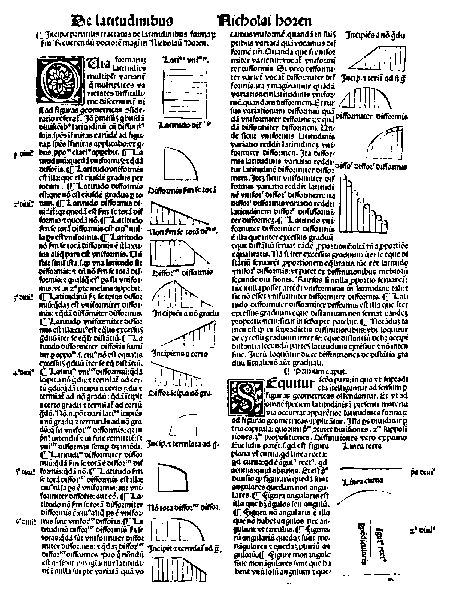
奥里斯姆在勒内·笛卡儿之前发明了一种坐标几何,在De configurationibus qualitatum et motuumⓉ(《论性质的配置与运动》)中发现了制表值与绘图之间的逻辑等价性。他提出使用图表来绘制一个变量的大小,其值取决于另一个变量。勒内·笛卡儿可能受到奥里斯姆工作的影响,因为它在首次出版后的100年里多次重印。奥里斯姆是第一个证明默顿定理的人,即在固定时间内,一个在均匀加速度下运动的物体所走的距离,与物体以等于其在时间段中点的速度的均匀速度运动时所走的距离相同。
奥里斯姆的另一部著作De proportionibus proportionumⓉ(《论比例的比例》)首次使用了分数指数,当然,并非以现代记号表示。他考察了两个天体的周期之比是否为有理数这一问题,并问道:-
……如果有人制造一台机械钟,他难道不会让所有轮子尽可能和谐地运转吗?
然后他回答了自己的问题,论证说比例的irrationality不会剥夺天空的美,也不会与规则运动相矛盾。奥里斯姆还研究了无穷级数,并主张地球之外存在无限的虚空。
Clagett 在3中写道:-
这位才华横溢的学者被归功于……在勒内·笛卡儿之前发明了解析几何,在十九世纪有机化学家之前提出了化合物的结构理论,在伽利略之前发现了自由落体定律,并在尼古拉·哥白尼之前主张地球自转。事实上,这些说法没有一个是真实的,尽管每一条都基于奥里斯姆对某些颇具洞察力和原创性的讨论……
在Livre du ciel et du mondeⓉ(《天与地之书》)(1377年)中,奥里斯姆反对亚里士多德提出的地球静止理论,并在这部著作中提出了地球自转,比尼古拉·哥白尼早了约200年。然而,他在著作结尾否定了自己的想法,从而相当程度地毁掉了这一出色的思想,因此,正如Clagett所写,不能认为他在尼古拉·哥白尼之前主张地球自转。他写了Questiones Super Libros Aristotelis de AnimaⓉ(《关于亚里士多德〈论灵魂〉的问题》),讨论光的本质、光的反射和光速。奥里斯姆关于光的工作在[16]中有详细讨论。
Nicholas Oresme, whose name is given in French as Nicole Oresme, was of Norman origin. Nothing is known of his early life, and the first that is known is that he studied for an Arts Degree in Paris in the early 1340s where he was taught by Jean Buridan at the University of Paris.
Buridan was a philosopher and logician who made contributions to probability, optics and mechanics. He added to Aristotle's theory of motion by understanding that motion was retarded by resistance from the air. Although his views were in many respects close to those of Ockham, he disagreed with some of Ockham's views and attacked them in 1340. About 35 years later the followers of Ockham would retaliate by placing Buridan's works on the Index of Forbidden Books. Buridan had a major influence in interesting Oresme in natural philosophy and in encouraging him to question the ideas of Aristotle.
Oresme's name appears on the list of scholarship holders in theology at the College of Navarre at the University of Paris in the year 1348. He was awarded the degree of Master of Theology in 1355 and, in the following year, he was appointed as Grand Master of the College of Navarre. Not long after this Oresme became friendly with the dauphin Charles who went on to become Charles V of France in 1362. The friendship between Charles and Oresme was one which continued throughout their lives. Charles was in intellectual and religious man who enjoyed the company of scholars such as Oresme.
After six years as the Grand Master of the College of Navarre, Oresme left in 1362 to become canon of the Cathedral of Rouen. The following year he took on the additional duties of canon at the Sainte-Chapelle in Paris. In 1364 he became dean of the Cathedral of Rouen and, his friend Charles becoming King of France on 8 April of that year, Oresme was appointed as Charles' chaplain and councillor. From 1370 he lived mainly in Paris, advising Charles on financial matters as well as translating from Latin into French Aristotle's Ethics, Politics and On the Heavens and the Aristotle style work Economics. These translations were very important, introducing many new technical terms into the French language. As a reward for this work Charles appointed Oresme bishop of Lisieux in 1377 and he was consecrated in the following year.
At a time when Aristotle's ideas were accepted almost without question, Oresme did indeed question them. For example he rejected Aristotle's definition of time, which was based on uniform motion, and proposed a definition independent of motion. Similarly he rejected Aristotle's definition of the position of a body, which was the boundary of the surrounding space, and replaced it with a definition in terms of the space which the body occupies.
Oresme invented a type of coordinate geometry before Descartes, finding the logical equivalence between tabulating values and graphing them in De configurationibus qualitatum et motuum Ⓣ. He proposed the use of a graph for plotting a variable magnitude whose value depends on another variable. It is possible that Descartes was influenced by Oresme's work since it was reprinted several times over the 100 years following its first publication. Oresme was the first to prove Merton's theorem, namely that the distance travelled in a fixed time by a body moving under uniform acceleration is the same as if the body moved at a uniform speed equal to its speed at the midpoint of the time period.
Another work by Oresme De proportionibus proportionum Ⓣ contains the first use of a fractional exponent, although, of course, not in modern notation. He examined the question as to whether the ratio of the periods of two heavenly bodies was a rational number asking:-
... if anyone should make a mechanical clock, would he not make all the wheels move as harmoniously as possible?
He then answered his own question, arguing that the irrationality of ratios will not rob the heavens of their beauty and will also not be inconsistent with regular movement. Oresme also worked on infinite series and argued for an infinite void beyond the Earth.
Clagett writes in [3]:-
This brilliant scholar has been credited with ... the invention of analytic geometry before Descartes, with propounding structural theories of compounds before nineteenth century organic chemists, with discovering the law of free fall before Galileo, and with advocating the rotation of the Earth before Copernicus. None of these claims is, in fact, true, although each is based on discussion by Oresme of some penetration and originality ...
In Livre du ciel et du monde Ⓣ (1377) Oresme opposed the theory of a stationary Earth as proposed by Aristotle and in this work he proposed rotation of the Earth some 200 years before Copernicus. However he rather spoilt this fine piece of thinking by rejecting his own ideas at the end of the work and so, as Clagett writes, cannot be regarded as claiming that the Earth rotated before Copernicus. He wrote Questiones Super Libros Aristotelis de Anima Ⓣ dealing with the nature of light, reflection of light, and the speed of light. Oresme's work on light is discussed in detail in [16].
正文里的方括号编号指向这里,悬停即可直接看到条目。书目保留原文——译了书名反而查不到文献。
原站列出的延伸阅读与外部数据库,照原样保留,目标多为英文页面。
关于尼克尔·奥里斯姆的其它页面:
原站的交叉引用。指向本站已镜像专题的留在站内,其余仍指回原站。