数学家传记
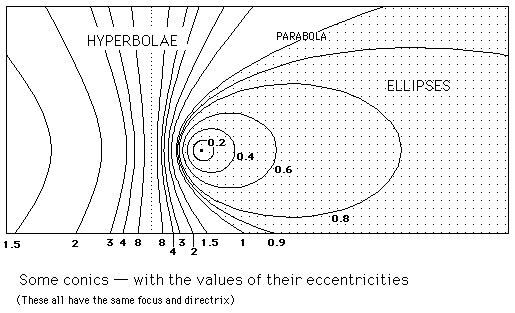
梅内克穆斯是一位希腊数学家,曾教授亚历山大大帝这门学科。他是第一个将椭圆、抛物线和双曲线作为圆锥截面进行研究的人。
普罗克洛提到了梅内克穆斯,他告诉我们梅内克穆斯是欧多克索斯的学生,引文如下(例如见[3]):-
赫拉克利亚的Amyclas,柏拉图的同伴之一,以及梅内克穆斯——欧多克索斯的学生,曾与柏拉图一起学习——和他的兄弟Dinostratus使整个几何学更加完善。
Suda Lexicon(一部10世纪希腊词典编纂者的著作)中还有另一处提及,其中指出梅内克穆斯是(例如见[1]):-
……阿洛佩科尼索斯的柏拉图派哲学家,或者根据某些说法是普罗科尼索斯的,他撰写了哲学著作和三卷关于柏拉图的《理想国》的书……
Alopeconnesus 和 Proconnesus 相当接近,前者在色雷斯,后者在马尔马拉海,两者都离 卡里普斯 不远,而 梅内克穆斯 的老师 欧多克索斯 曾在那里工作。梅内克穆斯 的年代与他作为 欧多克索斯 的学生相符,但也与 斯托拜乌斯 在公元5世纪所讲的一则轶事相符。Stobaeus 讲述了一个相当熟悉的故事,这个故事也被用来讲述其他数学家,如 欧几里得,说 亚历山大大帝 要求 梅内克穆斯 向他展示一种学习几何的简便方法,对此 梅内克穆斯 回答说(例如见 [1]):-
国王啊,穿越乡间有私路和御道,但在几何中只有一条路供所有人通行。
有些人由此推断(例如见 [4]),梅内克穆斯 曾担任亚历山大大帝的导师,这确实并非不可能想象,因为正如 Allman 所暗示的,亚里士多德 可能提供了两者之间的联系。普罗克洛 的著作中也暗示 梅内克穆斯 是一所学校的负责人,Allman 在 [4] 中令人信服地论证了这一点。如果情况确实如此,Allman 论证说,所讨论的学校就是 卡里普斯 上的那所,欧多克索斯 曾在他之前在那里任教。
梅内克穆斯以其对conic sections的发现而闻名,他是第一个证明ellipses、抛物线和双曲线是通过用不平行于底面的平面切割圆锥而得到的。人们普遍认为梅内克穆斯没有发明“抛物线”和“双曲线”这两个词,而是后来由Apollonius发明的。然而,1970年代在阿拉伯语译本中发现的戴可利斯的On burning mirrors中的最新证据,使G J Toomer声称“抛物线”和“双曲线”这两个名称都比Apollonius更早。
梅内克穆斯是在试图解决倍立方问题时对圆锥曲线做出了发现。事实上,他着手解决的具体问题是在两条直线之间找到两个比例中项。他做到了这一点,从而利用这些圆锥曲线解决了倍立方问题。梅内克穆斯的解法由阿什凯隆的欧托基奥斯在其对阿基米德的On the sphere and cylinder的注释中描述。
假设给定 ,我们想找到它们之间的两个比例中项 。那么 ,所以,做一点现代数学,
所以,并且所以。
我们现在看到, 和 的值是通过抛物线 和直角双曲线 的交点找到的。当然,我们必须强调,这绝不表明 梅内克穆斯 解决该问题的方式,但它确实以现代术语展示了抛物线和双曲线如何进入该问题的解。
紧接着这个解之后,阿什凯隆的欧托基奥斯给出了第二个解。现代数学的又一则内容可以说明它:
所以,并且所以。
我们现在看到,和的值是由两条抛物线和的交点求出的。
[1]、[3]和[4]都考虑了一个与这些解法相关的问题。普鲁塔克说,柏拉图不赞成梅内克穆斯使用机械装置的解法,他认为这贬低了被他视为人类心智最高成就的几何学研究。然而,上述紧随阿什凯隆的欧托基奥斯之后的解法似乎并不涉及机械装置。专家们讨论了梅内克穆斯是否可能使用过机械装置来画他的曲线。
Allman [4] 认为,梅内克穆斯可能是通过在曲线上找出许多点来画出这些曲线的,而这或许可以被视为一种机械装置。然而,[1]中对这个问题提出的解答似乎特别有吸引力。如今被称为柏拉图对倍立方问题的解答,被普遍认为并非出自柏拉图,因为它涉及一种机械仪器。托马斯·利特尔·希思 [3] 写道:-
……看来很可能有人面前有梅内克穆斯的第二个解,便着手表明,作为使用圆锥曲线的一种替代,同样的四条直线的表示可以通过机械作图得到。
[1]中提出的看法是,这段引文中的“有人”就是梅内克穆斯本人。
其他提到梅内克穆斯的文献包括士麦那的塞翁的一处,他提出梅内克穆斯是欧多克索斯基于同心球的天体理论的支持者。事实上,士麦那的塞翁声称梅内克穆斯通过添加更多的球面进一步发展了这一理论。关于梅内克穆斯在何处写下这一信息从而使士麦那的塞翁能够获得它,已有一些猜测。一种猜测是,它出现在梅内克穆斯对柏拉图的Republic的注释中,上文引自Suda Lexicon的那段话提到了这部著作。
……例如,他讨论了“元素”一词较宽泛的含义(在这种含义下,任何能推出另一命题的命题都可称为它的元素)与较严格的含义之间的区别,后者指某种简单而基本的东西,它与由之推出的结论处于原理与推论的关系之中,能够普遍适用,并进入各种命题的证明。
梅内克穆斯讨论的另一个与数学结构有关的问题,是定理与问题之间的区别。尽管许多人声称二者不同,梅内克穆斯却主张二者并无根本区别。他声称,二者都是问题,只是在使用这些术语时,它们指向不同的对象。
Menaechmus is mentioned by Proclus who tells us that he was a pupil of Eudoxus in the following quote (see for example [3]):-
Amyclas of Heraclea, one of the associates of Plato, and Menaechmus, a pupil of Eudoxus who had studied with Plato, and his brother Dinostratus made the whole of geometry still more perfect.
There is another reference in the Suda Lexicon (a work of a 10th century Greek lexicographer) which states that Menaechmus was (see for example [1]):-
... a Platonic philosopher of Alopeconnesus, or according to some of Proconnesus, who wrote works of philosophy and three books on Plato's Republic...
Alopeconnesus and Proconnesus are quite close, the first in Thrace and the second in the sea of Marmara, and both are not far from Cyzicus where Menaechmus's teacher Eudoxus worked. The dates for Menaechmus are consistent with his being a pupil of Eudoxus but also they are consistent with an anecdote told by Stobaeus writing in the 5th century AD. Stobaeus tells the rather familiar story which has also been told of other mathematicians such as Euclid, saying that Alexander the Great asked Menaechmus to show him an easy way to learn geometry to which Menaechmus replied (see for example [1]):-
O king, for travelling through the country there are private roads and royal roads, but in geometry there is one road for all.
Some have inferred from this (see for example [4]) that Menaechmus acted as a tutor to Alexander the Great, and indeed this is not impossible to imagine since as Allman suggests Aristotle may have provided the link between the two. There is also an implication in the writings of Proclus that Menaechmus was the head of a School and this is argued convincingly by Allman in [4]. If indeed this is the case Allman argues that the School in question was the one on Cyzicus where Eudoxus had taught before him.
Menaechmus is famed for his discovery of the conic sections and he was the first to show that ellipses, parabolas, and hyperbolas are obtained by cutting a cone in a plane not parallel to the base. It has generally been thought that Menaechmus did not invent the words 'parabola' and 'hyperbola', but that these were invented by Apollonius later. However recent evidence in Diocles' On burning mirrors discovered in Arabic translation in the 1970s, led G J Toomer to claim that both the names 'parabola' and 'hyperbola' are older than Apollonius.
Menaechmus made his discoveries on conic sections while he was attempting to solve the problem of duplicating the cube. In fact the specific problem which he set out to solve was to find two mean proportionals between two straight lines. This he achieved and therefore solved the problem of the duplicating the cube using these conic sections. Menaechmus's solution is described by Eutocius in his commentary to Archimedes' On the sphere and cylinder.
Suppose that we are given and we want to find two mean proportionals between them. Then so, doing a piece of modern mathematics,
so , and so .
We now see that the values of and are found from the intersection of the parabola and the rectangular hyperbola . Of course we must emphasis that this in no way indicates the way that Menaechmus solved the problem but it does show in modern terms how the parabola and hyperbola enter into the solution to the problem.
Immediately following this solution, Eutocius gives a second solution. Again a piece of modern mathematics illustrates it:
so , and so .
We now see that the values of and are found from the intersection of the two parabolas and .
[1], [3] and [4] all consider a problem associated with these solutions. Plutarch says that Plato disapproved of Menaechmus's solution using mechanical devices which, he believed, debased the study of geometry which he regarded as the highest achievement of the human mind. However, the solution described above which follows Eutocius does not seem to involve mechanical devices. Experts have discussed whether Menaechmus might have used a mechanical device to draw his curves.
Allman [4] suggests that Menaechmus might have drawn the curves by finding many points on them and that this might be considered as a mechanical device. The solution proposed to this question in [1], however, seems particularly attractive. What has come to be known as Plato's solution to the problem of duplicating the cube is widely recognised as not due to Plato since it involves a mechanical instrument. Heath [3] writes:-
... it seems probable that someone who had Menaechmus's second solution before him worked to show how the same representation of the four straight lines could be got by a mechanical construction as an alternative to the use of conics.
The suggestion made in [1] is that the 'someone' of this quote was Menaechmus himself.
Other references to Menaechmus include one by Theon of Smyrna who suggests that he was a supporter of Eudoxus's theory of the heavenly bodies based on concentric spheres. In fact Theon of Smyrna claims that Menaechmus developed the theory further by adding further spheres. There have been conjectures made as to where this information was written down by Menaechmus so that it was available to Theon of Smyrna. One conjecture is that it appeared in Menaechmus's commentaries on Plato's Republic referred to in the quote above from the Suda Lexicon.
Proclus writes about Menaechmus saying that he studied the structure of mathematics [4]:-
... he discussed for instance the difference between the broader meaning of the word element (in which any proposition leading to another may be said to be an element of it) and the stricter meaning of something simple and fundamental standing to consequences drawn from it in the relation of a principle, which is capable of being universally applied and enters into the proof of all manner of propositions.
Another matter relating to the structure of mathematics which Menaechmus discussed was the distinction between theorems and problems. Although many had claimed that the two were different, Menaechmus on the other hand claimed that there was no fundamental distinction. Both are problems, he claimed, but in the usage of the terms they are directed towards different objects.
正文里的方括号编号指向这里,悬停即可直接看到条目。书目保留原文——译了书名反而查不到文献。
原站列出的延伸阅读与外部数据库,照原样保留,目标多为英文页面。
原站的交叉引用。指向本站已镜像专题的留在站内,其余仍指回原站。