数学家传记
霍华德·艾肯是早期计算机的先驱设计者。
霍华德·艾肯的父母是Daniel H 艾肯(约生于1870年)和Margaret Emily Mierisch(1874-1961)。Daniel Aiken来自印第安纳州一个富裕家庭,但不幸的是,他酗酒成瘾,这导致了我们下面描述的家庭问题。Margaret Mierisch是定居美国的德国移民的女儿。Daniel和Margaret Aiken于1899年5月16日在曼哈顿结婚。他们唯一的孩子是艾肯,即本传记的主人公。这家人住在霍博肯,直到大约1911年,艾肯、他的父母和外祖父母都搬到了印第安纳州印第安纳波利斯。在那里,他就读于1912年成立的阿森纳技术高中。这所学校之所以如此命名,是因为其建筑最初是美国政府的兵工厂,但当这些建筑不再适合该用途时,它们被改造成了印第安纳波利斯的第三所公立高中。
艾肯在阿森纳技术高中的时光很快被打断了。如上所述,他的父亲有酗酒问题,喝醉时会虐待Margaret,即艾肯的母亲。大约在1912年发生这样一次事件时,艾肯从壁炉里拿起拨火棍,把父亲赶出了家门。Daniel Aiken再也没有回来,他的父母,即艾肯的祖父母,也不再与艾肯和他的母亲有任何来往。在艾肯读完该校八年级后,大约14岁时,他不得不离开学校,挣钱养活母亲和外祖父母。他在印第安纳波利斯找了一份安装电话的工作,但通过函授课程继续接受教育。阿森纳技术高中的老师们很清楚艾肯的潜力,尤其是在数学方面,其中一位老师去见Margaret Aiken,试图说服她让儿子回到高中。艾肯的母亲无法允许,因为她的儿子是家里唯一的收入来源。然而,这位老师坚持不懈,为艾肯找到了一份在印第安纳波利斯照明与供热公司的工作,这份工作涉及夜间工作。这样他就能在正常的白天时间上高中了。
在印第安纳波利斯照明与供热公司的工作是担任接线员,这份工作让艾肯感到非常无聊,以至于他开始织袜子来打发时间。问艾肯如何能日夜工作并非不合理,但年轻且只需几小时睡眠就能应付,使他得以成功。他于1918年完成学业,是首批从高中毕业的学生之一。这仅是在阿森纳技术高中校长Milo H Stewart的帮助下实现的。由于学业中断,艾肯没有获得毕业所需的足够学分,但Stewart为他安排了一次特别考试,以给予他额外的学分。Stewart还协助艾肯申请工作,这导致麦迪逊燃气与电力公司向他发出录用通知。艾肯和他的母亲搬到了麦迪逊,以便他能接受这份夜间电话接线员的工作,从下午4点工作到午夜。这使他得以在威斯康星大学麦迪逊分校注册为电气工程专业的学生。在本科学习期间,他还担任物理学教授的助理。然而,艾肯在整个本科岁月里极其贫困。他为母亲找到了一间公寓居住,并与两三个其他学生合住。他并不喜欢本科课程的某些方面。多年后他说(见[2]):-
我只希望作为本科生,我[没有]把时间浪费在机械制图、机工车间以及传统工程学院新生所需的其他无聊事情上。
在获得威斯康星大学第一个学位后,艾肯继续为麦迪逊燃气与电力公司工作,担任:-
……负责公司发电站设计与重建的电气工程师。
获得学位后,他被提升为总工程师。他在这个职位上工作了四年,在此期间他:-
……彻底重新设计并重建了公司发电厂的电气设备,监督建造了一个三百万立方英尺的储气罐,并对公司的煤气厂进行了许多其他改进。
1927年,他离开麦迪逊,搬到芝加哥,被任命为西屋电气与制造公司中央电站部门的通用工程师。他的工作主要涉及设计发电站。此时他告诉朋友,他想学习更多数学,并正在考虑进一步研究这个课题。然而,为了寻求更高的薪水,他于1931年接受了密歇根州底特律的Line Material公司地区经理的职位。更高的薪水并不能弥补他不再从事科学工作这一事实。他在那个职位上只待了一年,然后于1932年进入芝加哥大学,成为物理学研究生。然而,他不喜欢芝加哥大学建议的学习计划,而且在开始课程后不久,他就与一位教授交谈并寻求建议。有人向他建议,他会更喜欢哈佛教授感兴趣的研究课题。在芝加哥只待了不到一年后,艾肯于1933年转学到哈佛大学文理研究生院。他的母亲搬到了马萨诸塞州剑桥,很快他们就在普林普顿街8号有了一套公寓。
艾肯开始哈佛研究生学习时33岁。他努力适应物理学课程,但当Emory Leon Chaffee(1885-1975)成为他的论文导师后,情况明显改善。艾肯于1937年6月获得物理学A.M.学位,并于1939年2月因论文Theory of space charge conduction获得哈佛博士学位。他于1939年9月被任命为哈佛大学物理学与通信工程系的Faculty Instructor(相当于助理教授)。在这个角色的第一年,他教授应用数学课程。艾肯于1939年与Louise T Mancill结婚;他们有一个女儿Rachel,但于1942年离婚。Louise约1907年出生于费城,父母是Horace L Mancill和他的妻子Rachel Townsend。
当艾肯还是哈佛大学物理系的研究生和讲师时,他开始计划建造一台大型计算机。这些计划是为了一个非常具体的目的,因为艾肯的研究导致了一个微分方程组,该方程组没有精确解,只能用数值技术求解。然而,所涉及的手工计算量几乎令人望而却步,所以艾肯的想法是使用由霍尔瑞斯开发的打孔卡机的改编版。
艾肯写了一份报告,描述了他如何设想这样一台机器,特别是他描述了用于科学研究的机器与穿孔卡片机器的不同之处。他列出了四个要点[6]:-
……而会计机器只处理正数,科学机器必须能够处理负数;科学机器必须能够处理诸如对数、正弦、余弦以及许多其他函数;如果计算机一旦启动,就能在无需干预的情况下,对众多数值反复处理问题,直到计算完成,那么它对科学家最为有用;并且机器应该按行而不是按列计算,这更符合数学事件的顺序。
这份报告足以促使哈佛大学的高级职员联系IBM,并达成协议,艾肯将在IBM工程师的帮助下,在恩迪科特的IBM实验室建造他的计算机。艾肯与三位工程师合作,开发了ASCC计算机(自动序列控制计算器),它可以执行五种操作:加法、减法、乘法、除法和引用先前结果。艾肯的想法深受查尔斯·巴贝奇著作的影响,他将建造ASCC计算机的项目视为完成查尔斯·巴贝奇已经开始但未能完成的任务。
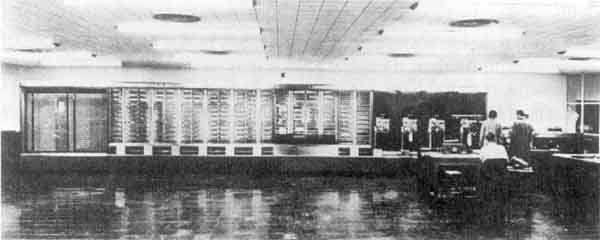
ASCC与查尔斯·巴贝奇的分析机之间的共同点比人们想象的要多。尽管它由电力驱动,但主要部件是电磁操作的开关形式的机电元件。它重35吨,有500英里长的导线,能计算到23位有效数字。有72个存储寄存器和执行乘法与除法的中央单元。要了解这台机器的性能,一次加法大约需要6秒,而一次除法大约需要12秒。ASCC由穿孔纸带上的指令序列控制。穿孔卡片用于输入数据,机器的输出要么在穿孔卡片上,要么由电动打字机产生。
艾肯在计算机方面的工作因第二次世界大战而中断。第二次世界大战期间,艾肯是海军少校,并在海军水雷战学校任教。他后来晋升为中校。Robert Campbell在5中谈到了战争造成的困难:-
所以1941年圣诞节假期我们在纽约。我接到一个我不认识的哈佛教员打来的电话,他叫艾肯。他想见我。于是我们在中央车站见面。他正在前往弗吉尼亚州约克镇的途中,在那里教授磁性水雷技术。他是海军少校,后来是中校,并在海军水雷战学校任教。我们在中央车站见面。他告诉我关于计算机的事。他称之为“计算器”。这是一台他构思的大型计算器,正在IBM建造。然后他被海军征召。他在海军预备役,无法在设计最后阶段继续与IBM合作。机器建造进展顺利。设计的某些方面仍不完整,特别是与LOG、EXP和SIN函数有关的方面。他告诉我哈佛需要有人继续与IBM联络。这听起来有点有趣,所以我说我会做,大概谈了一个小时后。我以前从未见过他。他从物理实验室的档案中挑出了我的名字。
1943年ASCC建成后,决定将计算机搬到哈佛大学,从1944年5月开始使用。格蕾丝·霍珀从1944年起与艾肯在ASCC计算机上工作,该计算机已更名为哈佛Mark I,并由IBM赠送给哈佛大学。这台计算机在哈佛大学的军械局计算项目中占有重要地位,格蕾丝·霍珀被分配到这个项目,美国海军用它进行射击和弹道计算。格蕾丝·霍珀描述了她与艾肯的第一次会面:见THIS LINK。
艾肯的马克一号机器的图片在THIS LINK。
Richard Bloch也在哈佛与艾肯在ASCC上工作。谈到艾肯时他说[3]:-
我认为艾肯在工具稀少的时候取得了很大成就。他显然造出了一台机器,而且可能是今天真正能被称为计算机的第一台机器,一台基本上是自动排序的机器。他还应该因专注于机器做了什么、为谁做以及做的准确性而获得很大赞誉。……就我而言,他确实是一位伟大的先驱,一位严厉的监工。我记得他会在早上或晚上的任何时间进来,有时他会在凌晨四点出现。我可能在那里试图从机器中找出一些错误。而他会出现在那里,我不知道,睡了三四个小时,他的评论是“我们在制造数字吗?”那是一个最喜欢的表达,“我们在制造数字吗?”一旦机器设计好,他最大的满足就是看到输出出现。……他有一种方式,要么让人喜欢他,要么让他绝对凶猛。
艾肯于1943年1月第二次结婚。他的妻子Agnes Montgomery,被称为Monty,是一位高中教师,教拉丁语和法语。艾肯和Agnes Aiken有一个女儿,Elizabeth。Monty曾在哈佛大学拉德克利夫学院学习。艾肯和Agnes于1961年离婚。
1946年,艾肯和格蕾丝·霍珀发表了题为The automatic sequence controlled calculator的三篇联合论文。这些论文被翻译成俄语,并于两年后出版。同样在1946年,艾肯发表了A Manual of Operation for the Automatic Sequence Controlled Calculator。弗瑞兹·约翰 Lee写道[17]:-
艾肯在1937年提出的计算机方案,开头几段专门介绍了机器计算的先驱:布莱兹·帕斯卡、Moreland、哥特弗里德·威廉·莱布尼茨,尤其是查尔斯·巴贝奇。这种对历史的致敬也体现在1946年[与格蕾丝·霍珀合作]发表在《电气工程》上的系列文章中。Mark I《操作手册》的第一章整章都是历史纪事,着重介绍了查尔斯·巴贝奇的工作;其中一幅插图甚至展示了查尔斯·巴贝奇那台从未完成的差分机的一组计算轮。
你可以在THIS LINK读到这本《操作手册》重印版导言的节选。
艾肯 于 1947 年完成了哈佛 Mark II,一台完全电子化的计算机。他继续在哈佛从事这一系列机器的工作,接下来研究 Mark III,最后到 1952 年研究 Mark IV。艾肯 在他用法语写的论文 Le calculateur Mark IV(1953)中描述了 Mark IV。他不仅从事计算机构造工作,还发表了关于电子学和开关理论的著作。
1961年,艾肯从哈佛退休,被任命为劳德代尔堡迈阿密大学的信息学杰出教授。艾肯没有在迈阿密大学任教,而是成为商人,创办了Howard Aiken Industries Incorporated,一家纽约咨询公司。他于1963年与Mary McFarland结婚。Mary曾是波士顿的一名小学教师。Richard Bloch谈到了艾肯晚年的生活[3]:-
在他去世前,我相当频繁地见到他。他对一些新发展感兴趣,有趣的是,他对家用计算机的小型化等等感兴趣。他预见到不仅拥有微型电路,还拥有微型输入和微型输出设备的好处。当时他甚至和我谈到要创办一些公司来探索这一点并进入这个领域。所以,他在这领域里那种进取的思考一直持续到去世。他是一个始终紧跟这个领域的人,直到最后的日子还在构想新想法。
1964年,艾肯获得了Harry M Goode纪念奖,这是计算机学会颁发的一枚奖章和2000美元奖金:-
因其对自动计算机发展的原创性贡献,促成了首台投入运行的大规模通用自动数字计算机;因其作为工程师在数字计算机领域的持续工作;以及作为教师传授给许多人的知识与启发。
这是艾肯因其在计算机发展方面的开创性工作而获得的众多荣誉之一。这些奖项来自许多国家,包括美国、法国、荷兰、比利时和德国。例如,他获得了美国的海军杰出公共服务奖,法国的荣誉军团骑士勋章和法兰西科学院棕榈叶勋章,比利时的王冠勋章军官十字勋章,以及德国达姆施塔特工业大学的荣誉学位。
他于1964年获得了富兰克林研究所的约翰 Price Wetherill奖章,并于1970年获得了IEEE爱迪生奖章:-
……因其在大规模数字计算机的开发与应用方面开创性贡献的卓越职业生涯,以及对数字计算机领域教育的重要贡献。
Howard Aiken's parents were Daniel H Aiken (born about 1870) and Margaret Emily Mierisch (1874-1961). Daniel Aiken came from a wealthy Indiana family but, sadly, he was addicted to alcohol and this led to the family problems that we describe below. Margaret Mierisch was the daughter of German immigrants who had settled in the United States. Daniel and Margaret Aiken were married on 16 May 1899 in Manhattan. Their only child was Howard Aiken, the subject of this biography. The family lived in Hoboken until around 1911 when Howard, his parents and his maternal grandparents all moved to Indianapolis, Indiana. There he attended Arsenal Technical High School which was founded in 1912. This school is so named because the buildings were originally a U.S. Government arsenal but, when they became obsolete for that purpose, they were converted into the third public high school in Indianapolis.
Now Aiken's time at the Arsenal Technical High School was soon interrupted. His father had, as we mentioned above, a drink problem and when drunk he would abuse Margaret, Aiken's mother. When one such episode occurred around 1912, Aiken picked up the poker from the fireplace and drove his father out of the house. Daniel Aiken never returned and his parents, Aiken's paternal grandparents, would have nothing further to do with Aiken and his mother. After Aiken had completed the eighth grade at the school, when he was around 14 years old, he had to leave in order to earn money to support his mother and his maternal grandparents. He took a job installing telephones in Indianapolis but he continued his education by taking correspondence courses. His teachers at the Arsenal Technical High School were well aware of Aiken's potential, particularly in mathematics, and one of the teachers went to see Margaret Aiken to try to persuade her to let her son return to the high school. Aiken's mother could not allow this since her son was providing the only income for the family. However, the teacher persisted and found a job for Aiken with the Indianapolis Light and Heat Company which involved night work. He was then able to attend the High School during the normal daytime hours.
The work with the Indianapolis Light and Heat Company was as a switchboard operator, a job that bored Aiken so much that he took up knitting socks to pass the time. It is not unreasonable to ask how Aiken could work both day and night but, being young and able to get by with a few hours sleep, allowed him to succeed. He completed his studies in 1918 and was among the first students to graduate from the High School. This was only achieved with the help of the Principal of Arsenal Technical High School, Milo H Stewart. Because of his interrupted studies, Aiken did not have the necessary number of credits to graduate but Stewart set a special examination for him to give him the extra credits. Stewart also assisted Aiken in applying for a job and this led to an offer from the Madison Gas and Electric Company. Aiken and his mother moved to Madison so that he could take up the job as a nighttime telephone operator working from 4pm to midnight. This enabled him to enroll as a student in electrical engineering at the University of Wisconsin, Madison. During his undergraduate studies he also worked as an assistant to the professor of physics. Aiken, however, was extremely poor throughout his undergraduate years. He had found an apartment for his mother to live in and he shared with two or three other students. He did not enjoy certain aspects of his undergraduate course. He said many years later (see [2]):-
I only wish that as an undergraduate I [hadn't] wasted my time on mechanical drawing, machine shop, and other tommy-rot required of a freshman in a conventional engineering school.
After obtaining a first degree from the University of Wisconsin, Aiken continued to work for the Madison Gas and Electric Company as an:-
... electrical engineer responsible for design and reconstruction of the company's electrical generating station.
He had been promoted to Chief Engineer after receiving his degree. He spent four years in this post during which time he:-
... completely redesigned and rebuilt the electrical equipment in the company's power house, supervised the construction of a three million cubic foot gas holder, and made many other improvements in the company's gas works.
He left Madison in 1927 and moved to Chicago when he was appointed as a general engineer in the Central Station Division of the Westinghouse Electrical and Manufacturing Company. His work was mainly involved in designing electric generation stations. At this time he told his friends that he wanted to study more mathematics and was considering further studies in the topic. However, looking for a better salary, he accepted the post of district manager of the Line Material Company in Detroit, Michigan in 1931. The better salary did not compensate for the fact that now he was no longer involved in scientific work. He only spent a year in that post before entering the University of Chicago in 1932 as a graduate student in physics. However, he did not like the programme of study that Chicago suggested and, quite soon after he had begun the course, he spoke to one of the professors and asked for advice. It was suggested to him that he would prefer the research topics that interested the Harvard professors. After only part of a year at Chicago, Aiken transferred to the Graduate School of Arts and Sciences at Harvard in 1933. His mother moved to Cambridge, Massachusetts, and soon they had an apartment at 8 Plympton Street.
Aiken was 33 years old when he began his graduate studies at Harvard. He struggled to fit in with the physics programme but things improved markedly when Emory Leon Chaffee (1885-1975) became his thesis advisor. Aiken was awarded an A.M. in physics in June 1937 and obtained a doctorate from Harvard in February 1939 for his thesis Theory of space charge conduction. He was appointed as a Faculty Instructor (the Harvard equivalent of Assistant Professor) in Physics and Communication Engineering at Harvard in September 1939. In his first year in that role he taught the Applied Mathematics course. Aiken married Louise T Mancill in 1939; they had one daughter Rachel but they were divorced in 1942. Louise had been born around 1907 in Philadelphia to Horace L Mancill and his wife Rachel Townsend.
While he was a graduate student and an instructor in the Department of Physics at Harvard, Aiken began to make plans to build a large computer. These plans were made for a very specific purpose, for Aiken's research had led to a system of differential equations which had no exact solution and which could only be solved using numerical techniques. However, the amount of hand calculation involved would have been almost prohibitive, so Aiken's idea was to use an adaptation of the punched card machines which had been developed by Herman Hollerith.
Aiken wrote a report on how he envisaged such a machine, and in particular he described how a machine designed to be used in scientific research would differ from a punched card machine. He listed four main points [6]:-
... whereas accounting machines handle only positive numbers, scientific machines must be able to handle negative ones as well; that scientific machines must be able to handle such functions as logarithms, sines, cosines and a whole lot of other functions; the computer would be most useful for scientists if, once it was set in motion, it would work through the problem frequently for numerous numerical values without intervention until the calculation was finished; and that the machine should compute lines instead of columns, which is more in keeping with the sequence of mathematical events.
The report was sufficient to prompt senior staff at Harvard to contact IBM and an agreement was made that Aiken would build his computer at the IBM laboratories at Endicott, helped by IBM engineers. Working with three engineers, Aiken developed the ASCC computer (Automatic Sequence Controlled Calculator) which could carry out five operations, addition, subtraction, multiplication, division and reference to previous results. Aiken was much influenced in his ideas by Babbage's writings and he saw the project to build the ASCC computer as completing the task which Babbage had set out on but failed to complete.
The ASCC had more in common with Babbage's analytical engine that one might imagine. Although it was powered by electricity, the major components were electromechanical in the form of magnetically operated switches. It weighed 35 tons, had 500 miles of wire and could compute to 23 significant figures. There were 72 storage registers and central units to perform multiplication and division. To gain an idea of the performance of the machine, a single addition took about 6 seconds while a division took about 12 seconds. The ASCC was controlled by a sequence of instructions on punched paper tapes. Punched cards were used to enter data and the output from the machine was either on punched cards or produced by an electric typewriter.
The work by Aiken on the computer was interrupted by World War II. During World War II, Aiken was a Lieutenant Commander in the Navy and taught at the Naval Mine Warfare School. He was later promoted to Commander. Robert Campbell spoke about the difficulties caused by the war in [5]:-
So we were in New York over Christmas holidays in 1941. I got a call from a faculty member at Harvard I didn't know by the name of Howard Aiken. He wanted to see me. So we met in Grand Central Station. He was on his way to Yorktown, Virginia where he was teaching magnetic mine technology. He was a Lieutenant Commander in the Navy, later a Commander, and was teaching in the Naval Mine Warfare School. We met in Grand Central Station. He told me about the computer. He called it "Calculator". It was a large scale calculator which he had conceived and was being built at IBM. Then he had been called up by the Navy. He was in Naval Reserve, and wasn't able to continue working with IBM during the final stages of design. The machine construction was well along. Some aspects of the design were still incomplete, especially those relating to the LOG, EXP and SIN functions. He told me Harvard needed someone to continue the liaison with IBM. This sounded sort of intriguing so I said I'd do it, after perhaps about an hour's conversation. I had never met him before. He had picked my name out of a file at the physics laboratories.
Having completed construction of ASCC in 1943 it was decided to move the computer to Harvard University where it began to be used from May 1944. Grace Hopper worked with Aiken from 1944 on the ASCC computer which had been renamed the Harvard Mark I and given by IBM to Harvard University. The computer figured highly in the Bureau of Ordnance's Computation Project at Harvard University, to which Hopper had been assigned, being used by the US navy for gunnery and ballistics calculations. Hopper described her first meeting with Aiken: see THIS LINK.
A picture of Aiken's Mark I machine is at THIS LINK.
Richard Bloch also worked with Aiken at Harvard on the ASCC. Speaking of Aiken he said [3]:-
I think that Howard Aiken accomplished a great deal at a time when the tools were few and far between. He clearly came up with a machine, and probably the first machine really that could be called a computer today, one which was essentially automatically sequenced. He also should be given a great deal of credit for concentrating on what the machine did and for whom it did it and the accuracy with which it did it. ... He certainly was, as far as I am concerned, a great pioneer, a tough task master. I remember that he'd come in at any hour of the morning or night and sometimes he'd show up at four in the morning. I might be there trying to get some bug out of the machine. And he'd show up having had, I don't know, three or four hours of sleep and his comment was "are we making numbers?" That was a favourite expression, "are we making numbers?" His big satisfaction, once the machine was designed was to see this output coming forth. ... He had a way about him which either endeared him to somebody or made him absolutely ferocious.
Aiken was married for a second time in January 1943. His wife Agnes Montgomery, known as Monty, was a high school teacher who taught Latin and French. Howard and Agnes Aiken had one daughter, Elizabeth. Monty had studied at Radcliffe College of Harvard University. Howard and Agnes were divorced in 1961.
In 1946 Aiken and Hopper published three joint papers with the title The automatic sequence controlled calculator. These were translated into Russian and published two years later. Also in 1946 Aiken published A Manual of Operation for the Automatic Sequence Controlled Calculator. John Lee writes [17]:-
Aiken's 1937 proposal for a calculating machine began with a series of paragraphs devoted to an account of the pioneers in machine calculation: Pascal, Moreland, Leibniz, and, above all, Babbage. This same historical homage characterizes the series of articles [with Grace Hopper] in 'Electrical Engineering' in 1946. The whole of the first chapter of the 'Manual of Operations' for Mark I was a historical chronicle, stressing the work of Charles Babbage; one of the illustrations even showed a set of calculating wheels from Babbage's never-completed Difference Engine.
You can read an excerpt from the Introduction to a reprint of this Manual at THIS LINK.
Aiken completed the Harvard Mark II, a completely electronic computer, in 1947. He continued to work at Harvard on this series of machines, working next on the Mark III and finally the Mark IV up to 1952. Aiken described the Mark IV in the paper which he wrote in French: Le calculateur Mark IV (1953). He not only worked on computer construction, but he also published on electronics and switching theory.
In 1961 Aiken retired from Harvard and was appointed as Distinguished Professor of Information at the University of Miami at Fort Lauderdale. Aiken did not teach at the University of Miami but rather became a businessman starting up Howard Aiken Industries Incorporated, a New York consulting firm. He married Mary McFarland in 1963. Mary had been an elementary school teacher in Boston. Richard Bloch spoke about the later part of Aiken's life [3]:-
I saw him before his death fairly frequently. He had interests in some new developments, interestingly enough in miniaturization of computers for home use and so on. He foresaw the advantages of having not only mini-circuits, but mini-input and mini-output devices. He was talking to me about even setting up some companies to probe this and move into this area at the time. So he kept his aggressive thinking in the field going all the way really to his death. He was a man that kept up with the field all the way through and to his last days was still conjuring up new ideas.
In 1964 Aiken received the Harry M Goode Memorial Award, a medal and $2,000 awarded by the Computer Society:-
For his original contribution to the development of automatic computers that led to the first large-scale, general-purpose, automatic digital computer ever to be put in operation; for his continuous work in the field of digital computers as an engineer; and for the knowledge and inspiration imparted to many as a teacher.
This was one of many honours which Aiken received for his pioneering work on the development of computers. These awards were from many countries including the United States, France, The Netherlands, Belgium, and Germany. For example he received the Navy Distinguished Public Service Award from the United States, Chevalier, Legion of Honour, and Palmes de l'Academie Francais from France, Officer's Cross of the Order of the Crown from Belgium, and an honorary degree from Technische Hochschule, Darmstadt, Germany.
He received the John Price Wetherill Medal from the Franklin Institute in 1964 and the IEEE Edison Medal in 1970:-
... for a meritorious career of pioneering contributions to the development and application of large-scale digital computers and important contributions to education in the digital computer field.
正文里的方括号编号指向这里,悬停即可直接看到条目。书目保留原文——译了书名反而查不到文献。
原站列出的延伸阅读与外部数据库,照原样保留,目标多为英文页面。
关于霍华德·艾肯的其它页面:
原站的交叉引用。指向本站已镜像专题的留在站内,其余仍指回原站。