数学家传记
罗伯特·雷科德是一位威尔士医生和数学家,他发明了“等于”符号“=”,该符号出现在他的著作《智慧的磨刀石》(1557年)中。
罗伯特·雷科德的父母是Thomas Recorde和Rose Jones。Thomas Recorde的父亲来自威尔士,Rose Jones是来自蒙哥马利郡Machynlleth的Thomas Jones的女儿。雷科德是Thomas和Rose的次子,虽然日期不确定,但据认为他大约在1525年进入牛津大学。我们同样不知道他学习的科目,但我们知道他于1531年获得学士学位,并在那一年被选为牛津大学万灵学院的会士。
万灵学院当时是一所研究生学院,为研究教堂音乐而设立。它培养神学、法律和医学方面的人才。我们确实知道他在牛津学习医学,是一个受过高等教育的人。晚年他对历史感兴趣,收集英国古物和手稿,并且是盎格鲁-撒克逊语言的专家。可以合理推测,他在万灵学院培养了对古物的热爱,因为弗瑞兹·约翰 Leyland,1531年时任国王亨利八世的 chaplain 和图书管理员,受雇于国王因其在古物和手稿方面的专长,与雷科德同时或稍早在万灵学院学习。
很可能在1531年当选为雷科德会士后,他在牛津教了几年书,但没有记录证明这一点。我们确切知道的是,他去了剑桥并在那里攻读医学博士学位。剑桥有一份记录称,雷科德十二年前在牛津获得了医学执照,这几乎肯定意味着雷科德从牛津获得了医学学士学位,尽管同样没有找到这方面的记录。他于1545年从剑桥毕业,获得医学博士学位。他可能在获得学位后在剑桥任教,但我们确切知道的是,在1545年之后的两年内某个时候,他搬到了伦敦,在那里行医。
亨利八世于1547年1月28日去世,他的儿子爱德华,由他的第三任妻子简·西摩所生,继承了王位。爱德华只有十岁,爱德华·西摩,萨默塞特公爵,被任命为摄政王,头衔为护国公。雷科德在爱德华继位时正在伦敦行医。次年,枢密院要求雷科德审查一个被关押在伦敦塔的人,此人被指控自称是假先知。1549年,雷科德被任命为布里斯托尔铸币厂的审计官。
西摩有效地治理国家直到1549年10月,他被约翰达德利,沃里克伯爵推翻,后者后来获得了诺森伯兰公爵的头衔。威廉·赫伯特爵士是年轻国王爱德华六世的导师,并在1549年帮助镇压了威尔特郡、德文郡和康沃尔郡的叛乱。他试图将资金转用于支持他的军队在这次行动中,但雷科德拒绝,理由是这些命令不是来自国王。赫伯特指控雷科德叛国,解除了他对布里斯托尔铸币厂的控制,该厂停止了生产。雷科德被软禁在宫廷六十天。
1551年,雷科德重新得宠,因为国王任命他为爱尔兰矿山和货币的总勘测员。在这个职位上,他负责韦克斯福德的银矿,并担任都柏林铸币厂的技术监督。白银在国王的财政战略中很重要,因为爱德华六世恢复了英国的银币。有趣的是,他引入了五先令的银冠币,这是第一种用阿拉伯数字而非罗马数字标注日期的英国硬币。当我们说雷科德重新得宠时,必须理解他与威廉·赫伯特爵士的争执从未解决,两人之间继续存在敌意。赫伯特在国内越来越重要,并于1551年10月被封为加的夫赫伯特男爵和彭布罗克伯爵。
韦克斯福德的银矿对雷科德来说并没有成为一项成功的冒险。有许多问题,都超出了他的控制,这意味着该项目从未有机会成功。开采白银所需的技术是与操作矿山的德国矿工争议的主题。此外,财政部需要在该冒险中投入大量资金才能看到回报,而他们无法,或者也许不愿意这样做。彭布罗克伯爵当然没有给予雷科德支持,到1553年,由于矿山出现亏损,该项目被关闭,雷科德被召回英国。
还有其他困难是由爱德华六世的疾病引起的。他在1553年1月显示出肺结核的最初迹象,各种派系试图影响他的继任者,特别是在5月之后,当所有人都清楚他离死亡很近时。爱德华六世于7月6日去世,诺森伯兰公爵的儿媳简·格雷夫人从7月10日统治到7月19日,然后被亨利八世国王的女儿玛丽一世推翻。英国国教于1534年由玛丽的父亲建立,雷科德是宗教改革的支持者。然而,玛丽试图在英国重建罗马天主教会,并在1554年与西班牙的菲利普二世结婚后,他们恢复了反对异端的法律。在接下来的三年里,超过300名异端被烧死在火刑柱上,为她赢得了“血腥玛丽”的称号。
彭布罗克伯爵,雷科德的敌人,在伦敦参加了玛丽一世的宣告仪式。玛丽为奖赏他的忠诚,任命他为枢密顾问。当玛丽将嫁给菲利普一事变得明朗时,爆发了一场叛乱,彭布罗克于1554年初率领玛丽的军队对抗叛军。因此,当雷科德在1556年试图指控彭布罗克行为不当以重获宫廷职位时,这实在是非常愚蠢的举动。当然,几乎可以肯定雷科德对彭布罗克的指控是有根据的,但一个如此接近玛丽和菲利普的人,绝不可能让像雷科德这样的小公务员占上风。
彭布罗克以诽谤罪起诉雷科德,以此反击雷科德的指控,诉状于1556年10月16日送达。听证会于1557年1月举行,几乎不可避免地,彭布罗克伯爵赢得了对雷科德的诉讼。2月10日裁定雷科德须向彭布罗克支付1000英镑。要么雷科德付不起这笔钱,要么他选择不付,因为他被监禁了。如果他确实付不起,这对雷科德来说是双重不幸,因为他在爱尔兰的服务恰好应得这个数额,却从未收到。事实上,他在爱尔兰工作的1000英镑于1570年支付给了他的遗产,但这对他没什么用,因为此时他已去世十二年。在南华克的王座监狱中,他于1558年6月28日立下遗嘱,给四个儿子和五个女儿留下少量钱财。他死在狱中,可能不过几周之后。
雷科德在与彭布罗克伯爵的争论中表现出很少的常识,这与他所有学术工作中表现出的非凡见识和学识形成鲜明对比。雷科德实际上建立了英国数学学派,并首次将代数引入英格兰。
他写了许多初等教科书,这样做是出于一种非常深思熟虑的策略。首先,他想编写一套完整的数学教学课程,并按照他认为数学课程中应该学习的顺序来写书。他希望这套课程对所有人开放,而不仅仅是少数能读拉丁语或希腊语的有教养的人。因此,他用英语写了所有的书,此外,他尽量使用清晰简单的表达。为了做到这一点,他不得不引入许多新的英语词汇,以对应当时使用的拉丁语或希腊语术语。如果这些精心挑选的术语中有些能流传下来,那将是件好事,但遗憾的是,它们一个都没有留存。
任何读过雷科德著作的人都会相信,尽管没有证据留存,他一定教过一段时间书,因为他对如何教学有深刻的理解。思想被清晰地一步步展开,难点留到学生获得足够经验能够理解它们时再讲。尽管他以他人的著作为基础进行大部分工作,但他肯定不是盲目遵循,而是挑选最好的思想,舍弃其他。很明显,当他读一本书时,他总是批判性地阅读,这在今天虽然不算什么,但在16世纪肯定很了不起,当时教育在很大程度上仍然基于盲目无疑地遵循经典作家。
雷科德于1543年出版了The Grounde of Artes,这是一本非常成功的商业算术书:-
……教授算术的完美工作和实践等。
用雷科德自己的话来说。这本书讨论了阿拉伯数字运算、筹码计算、比例、‘三率法’,所有算术在第一版中都是针对自然数研究的,该版在1549年和1550年有第二版和第三版。1552年,雷科德出版了The Grounde of Artes的第二版增订本,将第一版的工作扩展到有理的以及整数,并包括‘假位法’等主题。
1551年,雷科德写了Pathwaie to Knowledge,有些人认为这是欧几里得的Elements的删节版。这是他的书中唯一一本不是以大师和学者之间对话的形式写成的。这本书没有给出证明,而是雷科德解释了为什么这些定理是真的,并给出例子,以帮助学生不仅理解所教的内容,而且理解为什么要教这些内容。
The Castle of Knowledge于1556年首次出版,对克劳狄乌斯·托勒密版本的天文学作了入门介绍。因此,它本质上是一部关于球体的数学著作,而雷科德在撰写他的文本之前肯定读过克劳狄乌斯·托勒密、普罗克洛、约翰尼斯·德·萨克罗博斯科和奥文斯·菲内的著作。我们知道他读过这些著作,因为他在文本中说明了这一点,并且还给出了批判性的叙述,纠正了其中的文本错误。正是在这部著作中提到了尼古拉·哥白尼的日心说,尽管雷科德没有说他本人相信这一理论,但许多历史学家认为他很可能相信。我们上面提到玛丽一世如何在1554年重建天主教会和异端法律,以及许多异端分子被烧死。也许在这里,雷科德在1556年的彭布罗克事件上表现出比平时更多的常识,并选择不承诺支持尼古拉·哥白尼的理论。他写道:-
尼古拉·哥白尼 是一位博学、经验丰富且在观察上极为勤勉的人,他更新了 阿里斯塔克斯 Sainius 的观点,并断言地球不仅绕其自身中心作圆周运动,而且还可能、甚至确实持续偏离世界精确中心达三千八百万英里;但由于理解这一争议所依赖的知识比本导论中能方便阐述的更为深奥,我将把它留到其他时候再谈。
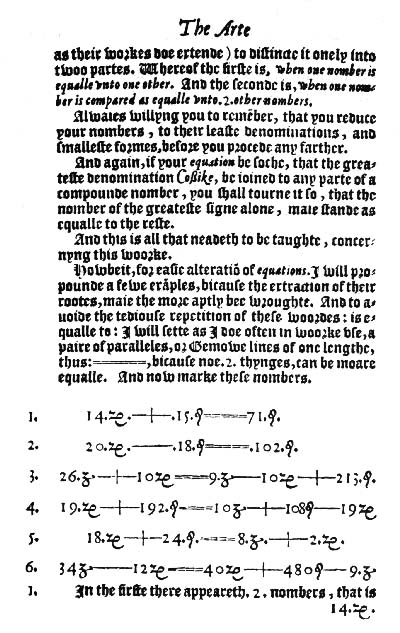
等号“=”出现在 雷科德 于 1557 年出版的著作 The Whetstone of Witte 中。他用两条平行线段来证明其合理性:-
……因为没有两样东西能更加相等。
符号 = 并未立即流行。有些人使用符号 ||,而 ae(或 oe),源自意为相等的词“aequalis”,则被广泛使用到 18 世纪。
当然,The Whetstone of Witte不仅仅有等号。首先让我们评论一下这个让许多人极为困惑的标题。它实际上是雷科德的一个巧妙双关,遗憾的是,今天的人如果不加解释就无法理解。Cosa在拉丁语中意为“东西”,在早期代数中用来表示未知量。代数学家被称为cossists,代数多年来被称为cossic技艺。例如,1525年Rudolff出版了Coss一书,这是第一部德语代数教科书。cos一词在拉丁语中意为whetstone,即磨剃刀和工具的石头。因此这个双关就是——这是一本用来磨砺数学才智的代数书!
这本书献给了莫斯科公司,这是一个由探险家塞巴斯蒂安·卡博特于1555年创立的商人冒险家协会,并被授予英俄贸易垄断权。该公司的一个目标也是寻找东北航道。看来雷科德曾就航海问题向莫斯科公司提供建议。
这本书是《算术》的第二部分,The Grounde of Artes 是第一部分,涵盖开方、方程理论和根式算术。在对二次方程的研究中,雷科德 不允许负解,但他允许负系数。他很好地利用了根的和与积,强调对于方程
其根的和为 ,根的积为 。
关于这本代数书还有一点评论。多年来,米夏埃尔·施蒂费尔被认为是雷科德的主要来源,但在[5]中,Hughes令人信服地论证,J Scheubel于1551年在巴黎出版的Algebrae compendiosa是雷科德的主要来源。
最后我们注意到,雷科德确实写了一部医学文本The Urinal of Physick(1547年),该书是[1]:-
一部关于尿液判断的传统医学著作,充满了合理的护理实践,[但]不如他的数学著作那样现代,对权威的批判也较少。
Robert Recorde's parents were Thomas Recorde and Rose Jones. Thomas Recorde's father was from Wales and Rose Jones was the daughter of Thomas Jones from Machynlleth in Montgomeryshire. Robert was the second son of Thomas and Rose and, although the date is not definitely known, it is thought that he entered the University of Oxford in about 1525. Again we do not know the topics he studied but we do know that he graduated with a B.A. in 1531 and was elected a Fellow of All Souls College, Oxford in that year.
All Souls was a graduate College at this time endowed for the study of Church music. It trained men in theology, law and medicine. Certainly we know that he studied medicine at Oxford and was a highly educated man. In later life he was interested in history, collecting British antiquities and manuscripts, and he was an expert in the Anglo-Saxon language. It is reasonable to suppose that he gained his love of antiquities at All Souls College for John Leyland, who was in 1531 chaplain and librarian to King Henry VIII employed by the King for his expertise in antiquities and manuscripts, had studies at All Souls at the same time as, or slightly before, Recorde.
It is likely that following his election to a fellowship in 1531 Recorde taught at Oxford for a few years but there are no records to prove this. The next that we know for certain is that he went to Cambridge and studied there for his M.D. There is a record at Cambridge which states that Recorde received a license in medicine in Oxford twelve years earlier and this almost certainly means that Recorde received the degree of B.M. from Oxford although again no record of this has been found. He graduated from Cambridge in 1545, receiving the degree of M.D. He may have taught at Cambridge following the award of his degree but all we know for certain is that some time during two years following 1545 he moved to London where he practised medicine.
Henry VIII died on 28 January 1547 and his son Edward, by his third wife Jane Seymour, succeeded to the throne. Edward was only ten years old and Edward Seymour, duke of Somerset, was appointed regent with the title of protector. Recorde was in London, practicing medicine at the time of Edward's succession. In the following year the privy council asked Recorde to examine someone who had been imprisoned in the Tower of London charged with claiming to be a false prophet. In 1549 Recorde was appointed controller of the Bristol mint.
Seymour effectively governed the country until October 1549 when he was overthrown by John Dudley, earl of Warwick who later received the title duke of Northumberland. Sir William Herbert was a governor to the young king Edward VI, and helped to suppress the rebellion in Wiltshire, Devon, and Cornwall in 1549. He tried to get money diverted to support his army in this venture but Recorde refused on the grounds that the orders were not from the King. Herbert accused Recorde of treason, removed him from control of the Bristol mint which ceased production. Recorde was confined to the court for sixty days.
In 1551 Recorde was back in favour for he was appointed by the King to be general surveyor of the mines and monies in Ireland. In this capacity he was in charge of silver mines in Wexford and technical supervisor of the Dublin mint. Silver was important in the King's financial strategy for Edward VI restored an English coinage of silver. It is interesting that he introduced the silver crown of five shillings which was the first English coin to have a date written in Arabic numerals rather than Roman numerals. When we say that Recorde was back in favour, it must be understood that his quarrel with Sir William Herbert had never been settled and there continued to be animosity between the two. Herbert became of increasing importance in the country and, in October 1551, was created Baron Herbert of Cardiff and Earl of Pembroke.
The silver mines in Wexford did not become a successful venture for Recorde. There were a great many problems, all outside his control, which meant that the project never had a chance to succeed. The technology needed to mine the silver was the subject of a dispute with German miners who operated the mines. In addition the treasury would have needed to invest a great deal of money in the venture before they would have seen a return and this they were not able, or perhaps not willing, to do. The Earl of Pembroke certainly did not give Recorde support and by 1553, with the mines showing a loss, the project was closed down and Recorde was recalled to England.
There were other difficulties which were caused by the illness of Edward VI. He showed the first signs of tuberculosis in January 1553 and various factions sought to influence his successor, particularly after May when it was clear to everyone that he was quite close to death. Edward VI died on 6 July and Lady Jane Grey, the duke of Northumberland's daughter-in-law, ruled from 10 July to 19 July before being overthrown by Mary I, a daughter of King Henry VIII. The Church of England had been established in 1534 by Mary's father and Recorde was a supporter of the Reformation. However, Mary sought to reestablish the Roman Catholic Church in England and after she married Philip II of Spain in 1554 they brought back the laws against heresy. During the next three years over 300 heretics were burned at the stake earning her the title "bloody Mary".
The Earl of Pembroke, Recorde's enemy, attended the proclamation of Mary I in London. Mary rewarded his loyalty by making him a privy councillor. When it became clear that Mary would marry Philip there was a rebellion and Pembroke led Mary's troops against the rebels in early in 1554. It was really a very stupid move on Recorde's part, therefore, when in 1556 he attempted to charge Pembroke with misconduct in order to regain his court position. Of course it is almost certain that Recorde had a valid case against Pembroke but there was no way that someone so close to Mary and Philip would allow a minor civil servant like Recorde to get the better of him.
Pembroke countered Recorde's charges by suing Recorde for libel, the bill being served on 16 October 1556. The hearing took place in January 1557 and, almost inevitably, the Earl of Pembroke won his action against Recorde. The award of £1000 which Recorde was ordered to pay to Pembroke was made on 10 February. Either Recorde could not pay this sum, or he chose not to, for he was imprisoned. If indeed he could not pay it was doubly unfortunate for Recorde since he was owed exactly this amount for his services in Ireland which he had never received. In fact the £1000 for his work in Ireland was paid to his estate in 1570, but this was not much use to him as, by this time, he had been dead for twelve years. In the King's Bench prison in Southwark, he made a will on 28 June 1558 leaving small amounts of money to his four sons and five daughters. He died in the prison, probably no more than a few weeks later.
If Recorde showed little common sense in his argument with the Earl of Pembroke, this was in stark contrast to the remarkable good sense and learning which he showed in all his academic work. Recorde virtually established the English school of mathematics and first introduced algebra into England.
He wrote many elementary textbooks and he did this with a very deliberate policy in mind. Firstly he wanted to produce a complete course of mathematical instruction and he wrote his books in the order in which he thought that they should be studied in a mathematics course. It was a course of study which he wanted to be available to everyone, not just the few educated men who could read Latin or Greek. He therefore wrote all his books in English and, in addition, he tried to use clear and simple expressions. In order to do this he had to introduce many new English words to be the equivalent of the Latin or Greek terms in use at that time. It would be nice to think that some of these carefully chosen terms might have survived, but sadly none of them have.
Anyone who reads Recorde's works will be led to believe that, although no evidence survives, he must have taught for some time since he has a deep understanding of how to teach. Ideas are developed clearly step by step, with difficult points being left until the student has gained enough experience to understand them. Although he used the works of others as a basis for much of his work, he certainly did not follow these slavishly, rather picking the best ideas and discarding others. It is clear that when he read a book he always did so critically which, although not remarkable today, certainly was in the 16th century when education was still largely based on slavishly following the classic writers without question.
Recorde published The Grounde of Artes in 1543 which was a very successful commercial arithmetic book:-
... teaching the perfect work and practice of Arithmeticke etc.
in Recorde's own words. The book discusses operations with Arabic numerals, computation with counters, proportion, the 'rule of three', all arithmetic being studied for the natural numbers in the first version which had second and third editons in 1549 and 1550. In 1552 Recorde published a second enlarged version of The Grounde of Artes extending the work of the first edition to rational as well as whole numbers and including such topics as 'false position'.
In 1551 Recorde wrote Pathwaie to Knowledge which some consider an abridged version of Euclid's Elements . It is the only one of his books not written in the form of a dialogue between a master and scholar. No proofs are given in this book but instead Recorde explains why the theorems are true and gives examples to aid a student to understand not only what was being taught, but also why it was being taught.
The Castle of Knowledge was first published in 1556 and gives an elementary introduction to Ptolemy's version of astronomy. It is therefore essentially a mathematical work on the sphere and Recorde certainly read works by Ptolemy, Proclus, Sacrobosco and Oronce Fine before writing his text. We know that he had read these works for he states this in the text and also gives a critical account of the works correcting textural errors in them. It is in this work that Copernicus's heliocentric theory is mentioned, and although Recorde does not say that he himself believes the theory, many historians feel that he probably did. We mentioned above how Mary I had reestablished the Catholic Church and the laws of heresy in 1554 and that many heretics were burned. It may be that here Recorde showed more common sense than he did over the Pembroke affair of 1556, and chose not to commit himself to Copernicus's theory. He wrote:-
Copernicus a man of great learning, of much experience, and of wonderful diligence in observation, hath renewed the opinion of Aristarchus Sainius, and affirmith that the earth not only moveth circularly about his own centre, but also may be, yea and is, continually out of the precise centre of the world 38 hundred thousand miles: but because the understanding of that controversy dependeth upon profounder knowledge than in this Introduction may be uttered conveniently, I will let it pass till some other time.
The 'equals' symbol '=' appears in Recorde's book The Whetstone of Witte published in 1557. He justifies using two parallel line segments:-
... bicause noe 2 thynges can be moare equalle .
The symbol = was not immediately popular. The symbol || was used by some and ae ( or oe), from the word 'aequalis' meaning equal, was widely used into the 1700s.
There is more to The Whetstone of Witte than the equals sign of course. First let us comment on the title which greatly puzzles many people. It is actually a clever pun by Recorde which, sadly, is incomprehensible to people today without explanation. Cosa is Latin for a 'thing' which was used for the unknown in early algebra. Algebraists were called cossists and algebra was known as the cossic art for many years. For example in 1525 Rudolff published the book Coss which was the first German algebra text. The word cos is Latin for whetstone, a stone for sharpening razors and tools. Hence the pun - it was an algebra book on which to sharpen one's mathematical wit!
The book was dedicated to the Muscovy Company which was an association of merchant adventurers founded by the explorer Sebastian Cabot in 1555 and given a monopoly of Anglo-Russian trade. The Company also had as one of its aims to the search for the Northeast Passage. It seems that Recorde advised the Muscovy Company on navigation.
The book was the Second Part of Arithmetic, The Grounde of Artes being the first, covering the extraction of roots, the theory of equations and arithmetic with surds. In his study of quadratic equations, Recorde does not allow solutions which are negative, but he does allow negative coefficients. He makes good use of the sum and product of the roots stressing that for the equation
the sum of the roots is and their product is .
One further comment on this algebra book. For many years Stifel was considered as Recorde's major source, but in [5] Hughes argues convincingly that Algebrae compendiosa by J Scheubel published in Paris in 1551 is Recorde's major source.
Finally we note that Recorde did write a medical text The Urinal of Physick (1547) which is [1]:-
A traditional medical work on the judgement of urines, full of sensible nursing practice, [but] less modern than his mathematical works and less critical of authority.
正文里的方括号编号指向这里,悬停即可直接看到条目。书目保留原文——译了书名反而查不到文献。
原站列出的延伸阅读与外部数据库,照原样保留,目标多为英文页面。
关于罗伯特·雷科德的其它页面:
原站的交叉引用。指向本站已镜像专题的留在站内,其余仍指回原站。