数学家传记
埃德蒙·朗道首次系统阐述了分析数论,并撰写了关于单变量分析函数理论的重要著作。
埃德蒙·朗道的父亲Leopold Landau是一名妇科医生,他既是一位爱国的德国人,又是一位积极支持犹太事业的政治活动家。埃德蒙·朗道的母亲Johanna Jacoby来自领先银行家Jacoby家族。埃德蒙·朗道出生在一个富裕且人脉广泛的家庭,因此他在成长过程中结识了柏林的重要人物。他在犹太信仰中长大,并且像他的父亲一样,成为一位具有犹太复国主义信仰的德国民族主义者。埃德蒙·朗道从小就表现出非凡的才能。有一个故事说他是一个神童[3]:-
传说在他三岁时,当母亲把伞忘在马车上时,他回答说:“那是354号,”伞很快就被找回了。
埃德蒙·朗道在柏林就读法国中学,16岁毕业,比正常年龄早两年。随后他在柏林大学学习数学。他的博士工作由费迪南德·格奥尔格·弗罗贝尼乌斯指导,埃德蒙·朗道于1899年获得博士学位,学位论文关于数论。埃德蒙·朗道一直对数学谜题感兴趣,甚至在获得博士学位之前,他就出版了两本关于国际象棋数学问题的书。1900年6月9日,他从巴黎(他在那里学习)写信给大卫·希尔伯特,概述了他证明代数数域的素理想定理的想法。
他于1901年提交了这篇教授资格论文(Habilitation)学位论文,距他获得博士学位仅两年,内容是他关于约翰·彼得·古斯塔夫·勒热纳·狄利克雷级数的工作,这是解析数论中的一个主题。费迪南德·格奥尔格·弗罗贝尼乌斯对埃德蒙·朗道所研究的领域有些批评,并不时评论说,如果黎曼假设被证明,埃德蒙·朗道的工作将不再重要。几乎毫无疑问,费迪南德·格奥尔格·弗罗贝尼乌斯对埃德蒙·朗道数学才能的评估相当错误,但这丝毫没有影响埃德蒙·朗道的自信。
埃德蒙·朗道从1899年到1909年在柏林大学担任privatdozent。在此期间,他的出版物迅速增加,到1904年,他的出版物数量超过了他的年龄27岁,到1909年,他已发表了近70篇论文。在柏林期间,他的教学能力变得显而易见。他教授初学者课程,这不是他必须做的,还讲授他自己的专业数论。此外,他还开设了关于数学基础、irrational numbers和集合论的讲座课程。然而,Schappacher在[9]中指出:-
……还应该说,他往往与学生关系不融洽,是一个相当冷漠的人。
1909年,他被任命为哥廷根大学的普通教授,接替赫尔曼·闵可夫斯基。他在哥廷根与大卫·希尔伯特和菲利克斯·克莱因同事,直到菲利克斯·克莱因于1913年退休。菲利克斯·克莱因的继任者并不容易找到。康斯坦丁·卡拉西奥多里来了又走,不到三年,接替他的是埃里希·赫克,后者也在1919年迅速离开。埃德蒙·朗道努力让伊赛·舒尔填补这个讲席,但违背埃德蒙·朗道的意愿,理查·科朗特被任命了。然而,尽管作为教师和研究员都有杰出的才能,埃德蒙·朗道还是设法以他有些傲慢的态度惹恼了哥廷根的许多同事。尔文·席格在[3]中写道:-
埃德蒙·朗道也有点愤世嫉俗和势利。众所周知的故事是,他常常告诉那些在哥廷根问他地址的人:“你很容易找到它;它是城里最壮观的房子。”
我们举一些他如何惹恼同事的例子。通常是因为他私下,而且常常公开地批评他们的结果,尽管不得不说埃德蒙·朗道知识极其渊博,而且在数学上几乎总是正确的[3]:-
埃德蒙·朗道在其专业领域内对文献有着百科全书式的知识,细致到近乎苛刻,并且始终致力于寻找尽可能简单的结果。
在保罗·克伯和路德维希·比贝尔巴赫于1921年就各自发表的某些结果的意义发生争执后,埃德蒙·朗道于次年通过给他们两人写了一封联名信而加入了争论,他在信中说保罗·克伯是两人中更正确的一方,但仍不够正确。他还发表了路德维希·比贝尔巴赫某些定理的简化证明,并给出了更强的结果。当然,通常数学家们乐于看到别人使用自己的结果来推进工作,并且如果某人发表了自己结果的新证明,会将其视为一种恭维,但似乎正是埃德蒙·朗道做这类事情时那种傲慢的方式惹恼了他的同事们。埃德蒙·朗道也批评了威海姆·布拉希开发表的定理证明,同样说这些证明不必要地复杂。他声称其中一个证明是平凡的,另一个则可以从约斯塔·米塔格-莱弗勒的一个定理平凡地推导出来。威海姆·布拉希开在1921年寄给路德维希·比贝尔巴赫的一封信以这样一句话结尾:-
你难道不想让哥廷根摆脱埃德蒙·朗道吗?
尽管埃德蒙·朗道有一些朋友清楚地了解纳粹上台后可能会做什么,但他未能认识到危险。1932年,一位朋友Fritz Rathenau拜访了他,告诉他如果纳粹获得控制权,他们会建立集中营来关押犹太人。据说埃德蒙·朗道回答说[3]:-
那样的话,我应该立刻为自己预订一个带阳台且朝南的房间。
1933年1月30日,由希特勒领导的纳粹党确实在德国上台,Fritz Rathenau的预言很快成真。1933年4月7日通过了《公务员法》,该法提供了将犹太教师从大学中清除的手段。事实上,在任何官方工作从部里到达哥廷根之前,系主任于4月28日写信给埃德蒙·朗道,要求他不要讲授夏季学期的课程,这些课程改由埃德蒙·朗道的助手讲授。由于没有收到大学当局的进一步通知,埃德蒙·朗道决定按公告讲授秋季学期的课程。Schappacher在[10]中引用了埃德蒙·朗道的一封信,他在信中不动感情地描述了讲课第一天发生的事情:-
11月2日大约11点15分,当我想要离开办公室去大讲堂开始讲课时,门厅里挤满了大约80到100名学生,他们让我毫无阻碍地通过。讲堂里只有一个人。因此很明显,这是一场抵制,门口有哨兵(没有使用武力)阻止那些想要学习的学生踏入讲堂。
所发生的事情——而且是在许多曾是我的学生的人的合作下发生的——使我相信,唯一的后果必然是我申请成为荣誉退休教授或领取养老金。
奥斯瓦尔德·泰希米勒作为学生的领袖,组织了抵制埃德蒙·朗道讲课的活动。事实上,抵制之后奥斯瓦尔德·泰希米勒去了埃德蒙·朗道的办公室,解释说这不是任何有组织团体的行动。埃德蒙·朗道随后要求奥斯瓦尔德·泰希米勒将此写成书面材料,并将其连同他向部里提出的退休请求一起提交。尽管奥斯瓦尔德·泰希米勒有所断言,但人们认为,冲锋队(Sturmabteilung)的学生成员组织了这次抵制。埃德蒙·朗道于11月19日获准在荷兰的格罗宁根工作,该许可后来被延长,允许他在那里度过冬季学期。他于1934年2月7日正式退休,搬到柏林,此后只在德国以外讲课,在剑桥和荷兰度过了一些时间。他领取全额工资直到1934年7月1日,之后领取养老金,直到因心脏病发作去世。他的遗孀继续领取养老金,但在1939年3月,她被告知如果移居美国,她的养老金将被终止。
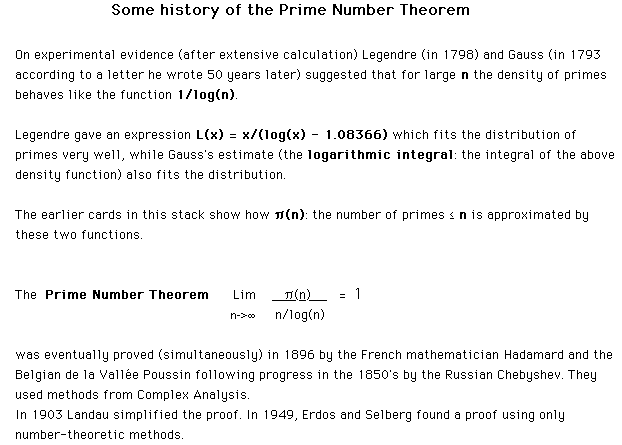
埃德蒙·朗道的主要工作是在解析数论和primes的分布方面。他在1903年给出了素数定理的一个证明,这个证明比夏尔-让·德拉瓦莱·普桑和雅克·阿达马在1896年给出的证明要简单得多。他的更简单证明的一个结果是,它使他能够获得关于代数数域中素理想分布的结果。他1909年的杰作是一部论著Handbuch der Lehre von der Verteilung der PrimzahlenⓉ(素数分布理论手册),这是一部两卷本的著作,首次系统介绍了解析数论。他还写了关于单变量解析函数理论的重要著作。Darstellung und Begründung einiger meuerer Ergebnisse der FunktiontheorieⓉ(复分析某些结果的描述与论证)[1]:-
……包含单变量解析函数理论中一系列有趣而优雅的定理。埃德蒙·朗道本人发现了其中一些定理,并以新的、更简单的方式论证了另一些定理。
Schoeneberg写道[1]:-
埃德蒙·朗道的著作写作极为用心,其特点是论证完整且尽可能简单。必要的预备知识均有提供,读者被稳妥地一步步引向目标。
埃德蒙·朗道写了250多篇关于数论的论文,对该学科的发展产生了重大影响。
Edmund Landau's father Leopold Landau was a gynaecologist who was both a patriotic German and someone who was politically active in support of the Jewish cause. Edmund Landau's mother, Johanna Jacoby, was from the Jacoby family of leading bankers. Edmund was born into a wealthy family who were well connected, so he grew up knowing the important people in Berlin. He was brought up in the Jewish faith and, like his father, came to be a German nationalist with Zionist beliefs. From a young age Edmund showed remarkable talents. There is a story that he was a child prodigy [3]:-
Legend has it that at the age of three, when is mother forgot her umbrella in a carriage, he replied, "It was number 354," and the umbrella was quickly re-acquired.
Landau attended the French Lycée in Berlin, graduating at the age of 16 which is two years earlier than was normal. He then studied mathematics at the University of Berlin. His doctoral work there was supervised by Frobenius, and Landau received his doctorate in 1899 for a thesis on number theory. Landau was always interested in mathematical puzzles and even before he received his doctorate he had published two books on mathematical problems in chess. On 9 June 1900 he wrote a letter from Paris, where he was studying, to Hilbert giving an outline of his ideas for proving the prime ideal theorem for algebraic number fields.
He submitted this habilitation thesis in 1901, only two years after his doctorate, consisted of his work on Dirichlet series, a topic in analytic number theory. Frobenius was somewhat critical of the area that Landau worked in, and remarked at times that Landau's work would cease to become important if the Riemann hypothesis were proved. There is little doubt that Frobenius was quite wrong in his assessment of Landau's mathematical talents, but this did not affect Landau's self-confidence in any way.
Landau taught at the University of Berlin as a privatdozent from 1899 until 1909. During this period his publication list grew rapidly, so that by 1904 his publications exceeded his age of 27 and by 1909 he had nearly 70 papers in print. While at Berlin his ability to teach became clearly evident. He taught courses for beginners, which he did not have to do, and also lectured on his own speciality of number theory. In addition he gave lecture courses on the foundations of mathematics, irrational numbers, and set theory. Schappacher notes in [9] however:-
... it should also be said that he tended not to have cordial relationships with his students, being rather an aloof person.
In 1909 he was appointed to an ordinary professorship at Göttingen as successor to Minkowski. He had Hilbert and Klein as colleagues at Göttingen until Klein retired in 1913. The successor to Klein was not easily found. Carathéodory came and went in less than three years while he was followed by Hecke who also left quickly in 1919. Landau worked hard to have Schur fill the chair but, against Landau's wishes, Courant was appointed. However, despite his outstanding talents as both a teacher and researcher, Landau managed to annoy many of his colleagues at Göttingen with his somewhat arrogant manner. Segal writes in [3]:-
Landau was also something of a cynical snob. The story is well known that he used to tell people who would ask for his address in Göttingen, "You'll find it easily; it's the most splendid house in the city."
We give some examples of how he annoyed his colleagues. Usually it was because he privately, and often publicly, criticised their results, although one would have to say that Landau was extremely knowledgeable and was almost always mathematically correct [3]:-
Landau was a mathematician of encyclopaedic knowledge of the literature in his special areas of expertise, meticulous to a fault, and always devoted to finding the simplest possible result.
After Koebe and Bieberbach had disputed in 1921 the significance of certain results each had published, Landau entered the argument the following year by writing a joint letter to the two of them in which he said that Koebe was the more correct of the two, but still not correct enough. He also published simplified proofs of some theorems of Bieberbach, and gave stronger results. Of course usually mathematicians are delighted to see others using their results to push forward, and consider it a compliment if someone publishes a new proof of their results, but it seems to be the arrogant way that Landau did such things that annoyed his colleagues. Landau also criticised proofs of theorems published by Blaschke, again saying that the proofs were unnecessarily complicated. One he claimed was trivial and another could be trivially deduced from a theorem of Mittag-Leffler. A letter which Blaschke sent to Bieberbach in 1921 ends with the sentence:-
Wouldn't you like to free Göttingen from Landau?
Despite having friends who were well informed as to what the Nazis might do if they came to power, Landau failed to recognise the danger. In 1932 he was visited by a friend Fritz Rathenau who told him that if the Nazis gained control they would build concentration camps in which to put Jews. Landau is said to have replied [3]:-
In that case I should immediately reserve for myself a room with a balcony and a southern exposure.
On 30 January 1933 the National Socialist party led by Hitler did come to power in Germany and Fritz Rathenau's predictions soon came true. The Civil Service Law was passed on 7 April 1933 which provided the means of removing Jewish teachers from the universities. In fact before any official work reached Göttingen from the Ministry, the Dean wrote to Landau on 28 April asking him not to give his summer lecture courses and these were given instead by Landau's assistant. Having received no further advice from the university authorities, Landau decided to give his autumn lectures as advertised. Schappacher, in [10], quotes a letter from Landau in which he described in unemotional terms what happened on the first day of lectures:-
On 2 November, about 11.15, as I wished to leave my office and go to the large lecture theatre to begin my lecture, the entrance hall was filled with about 80 to 100 students who let me pass through unhindered. In the lecture hall was one person. Clearly therefore, there was a boycott with sentries at the door who had prevented (without force) those students who wanted to work from setting foot in the lecture room.
What happened - and it happened with the collaboration of many who were my pupils - leads me to believe that the only consequence must be my application to become emeritus or pensioned.
Teichmüller, as leader of the students, had organised the boycott of Landau's lectures. In fact Teichmüller went to Landau's office after the boycott and explained that it was not the work of any organised group. Landau then asked Teichmüller to put this in writing and he included it with his request to the Ministry that he be retired. Despite Teichmüller's assertions, it is believed that student members of the Sturmabteilung (Stormtroopers) organised the boycott. Landau was given permission on 19 November to work at Groningen, in the Netherlands, and the permission was later extended to allow him to remain there for the winter semester. He was officially retired on 7 February 1934, moved to Berlin and after this only lectured outside Germany, spending some time in Cambridge and in Holland. He received full pay until 1 July 1934, then a pension until his death from a heart attack. His widow continued to receive a pension but in March 1939 she was informed that her pension would be terminated if she emigrated to the United States.
Landau's main work was in analytic number theory and the distribution of primes. He gave a proof of the prime number theorem in 1903 which was considerably simpler that the ones given in 1896 by Vallée Poussin and Hadamard. One consequence of his simpler proof was that it enabled him to obtain results concerning the distribution of prime ideals in algebraic number fields. His masterpiece of 1909 was a treatise Handbuch der Lehre von der Verteilung der Primzahlen Ⓣ a two volume work giving the first systematic presentation of analytic number theory. He also wrote important works on the theory of analytic functions of a single variable. Darstellung und Begründung einiger meuerer Ergebnisse der Funktiontheorie Ⓣ [1]:-
... contains a collection of interesting and elegant theorems of the theory of analytic functions of a single variable. Landau himself discovered some of the theorems and demonstrated others in a new and simpler fashion.
Schoeneberg writes [1]:-
Written with the greatest care, Landau's books are characterised by argumentation which is complete, and as simple as possible. The necessary prerequisite knowledge is provided, and the reader is led securely, step by step, to the goal.
Landau wrote over 250 papers on number theory which had a major influence on the development of the subject.
正文里的方括号编号指向这里,悬停即可直接看到条目。书目保留原文——译了书名反而查不到文献。
原站列出的延伸阅读与外部数据库,照原样保留,目标多为英文页面。
关于埃德蒙·朗道的其它页面:
原站的交叉引用。指向本站已镜像专题的留在站内,其余仍指回原站。