数学家传记
茹利亚是现代动力系统理论的奠基人之一,最著名的是现在所谓的茹利亚集。
茹利亚的父母是Delorès Delavent和Joseph Julia。两代人之前,这个家庭离开了西班牙比利牛斯山脉,在法国殖民该地区后定居于阿尔及利亚。Joseph Julia是一名机械师,他的儿子出生时他正在Sidi-bel-Abbès工作。茹利亚年轻时对数学和音乐产生了兴趣。他五岁入学,由Théoduline修女教导。她给年幼的茹利亚灌输了某些他终生遵循的原则,特别是始终以在所做的事情上做到最好为目标。她还鼓励茹利亚的母亲提供经济支持,让她的儿子接受良好的教育,鉴于这个家庭非常贫穷,这是很难实现的。茹利亚从七岁起在基督教学校兄弟会学习。他的杰出才能很快被发现,他的老师鼓励茹利亚的父母设法获得奖学金,让他能上高中。
1901年,茹利亚八岁时,全家搬到了奥兰,这是阿尔及利亚西北部地中海沿岸的一座城市,位于Sidi-bel-Abbès以北70公里。在那里,茹利亚的父亲靠修理农业机械谋生。茹利亚进入奥兰的公立中学,他的父母希望他从五年级开始学习。然而,老师们指出,该年级的学生已经学了一年德语,而茹利亚对这门语言一无所知。但是,茹利亚请求让他在班里待一个月,以证明他能赶上。他通过书本自学,很快就赶上了,并被允许留在这个班级。到一年结束时,他在德语以及他所学的所有其他科目中都是最好的学生。他以优异成绩通过了科学、现代语言、哲学和数学的中学毕业会考。
茹利亚获得了一笔奖学金,这使他得以前往巴黎,在1910-11学年于让松-德-萨伊中学学习高等数学课程。尽管能力出众,茹利亚的生活并不轻松。首先,他年纪尚轻,离开了熟悉的成长环境,来到法国截然不同的生活中。其次,他甚至还没开始学业就染上了伤寒,被送进了医院。直到1910年11月,他才康复到足以开始一门通常需要两年完成的课程,而他必须在剩下的八个月内完成。尽管有这些困难,他仍然达到了比其他任何学生都更高的水平。不知怎的,他还能继续他对音乐的兴趣,用母亲给他的小提琴演奏,也正是在这段时间里,他爱上了巴赫、舒伯特和舒曼的音乐。终其一生,这些作曲家始终是他的最爱。他参加了巴黎高等师范学校和巴黎综合理工学院的入学考试,并在两场考试中都名列第一。他可以选择其中任何一所大学,但决定进入巴黎高等师范学校,理由是该校在数学方面实力更强。
1911年进入巴黎高等师范学校时,茹利亚刚刚完成数学第一学位的考试,欧洲的政治事件便打断了他的学业。1914年7月,随着各种宣战声明,事态发展到紧要关头,8月3日德国对法国宣战。事件进展迅速,茹利亚在一天后收到了征召令。他在利布恩的第57步兵团接受训练,很快被任命为下士,随后是少尉。当他被派往贵妇小径时,他在西线随第144步兵团参战。德国皇帝威廉二世的生日是1月27日,德军希望以胜利来庆祝这一时刻。因此,1月25日,他们对茹利亚及其部下刚刚抵达的法国防线发动了猛烈攻击。以下是关于那天茹利亚遭遇的报告:-
1915年1月25日,他表现出对危险的完全蔑视。在极其猛烈的炮击下,尽管年轻(22岁),他仍成功地为部下树立了真正的榜样。一颗子弹击中他的面部中央,造成严重伤害,他无法再说话,但在一张纸条上写道他不会撤离。直到进攻被击退后,他才前往救护站。这是这位军官第一次遭受炮火。
你可以在THIS LINK阅读茹利亚关于他受伤后如何接受治疗的叙述。
在这场被称为“克勒特农庄进攻”的行动中,双方都有许多人受伤,德军在此攻占了高原上剩余的盟军阵地。茹利亚的伤势极其痛苦,为了修复损伤进行了许多不成功的手术。最终,在1918年,他接受了失去鼻子的现实,余生不得不在脸上戴一条皮带。在这些痛苦的手术之间,他常常在病床上继续进行数学研究。他从1916年开始在法兰西学院进行研究,并于1917年提交了他的博士论文Étude sur les formes binaires non quadratiques à indéterminées réelles ou complexes, ou à indéterminées conjuguées Ⓣ(爱德华·斯图迪,关于非二次实不定或不定共轭二元型)。他的论文答辩委员是埃米尔·皮卡、昂利·勒贝格和Pierre Humbert,埃米尔·皮卡担任答辩委员会主席。
1918年,茹利亚与玛丽安·肖松结婚,玛丽安是他在医院期间照顾他的护士之一。玛丽安是浪漫主义作曲家埃内斯特·肖松的女儿,肖松于1899年因自行车上的离奇事故去世。茹利亚和玛丽安茹利亚有六个孩子:热罗姆、克里斯托夫、让-巴蒂斯特、马克、丹尼尔和西尔维斯特。
年仅25岁时,茹利亚发表了他199页的杰作Mémoire sur l'iteration des fonctions rationelles Ⓣ(关于有理函数迭代的回忆录),这使他在当时的数学中心声名鹊起。这篇优美的论文发表在Journal de Math. Pure et Appl. 8 (1918), 47-245上,涉及有理函数的迭代。茹利亚精确描述了集合,即中那些使得第次迭代在趋于无穷时保持有界的。他因这项卓越工作获得了科学院大奖。
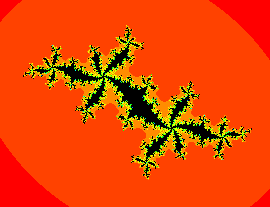
你可以在THIS LINK看到一个茹利亚集的例子。
1919年11月,他受邀在法兰西学院举办享有盛誉的佩科基金会讲座,并被任命为巴黎高等师范学校的会议讲师。同时,他被任命为巴黎综合理工学院的分析学辅导教师、海军学校的考官以及索邦大学的教授。这次索邦大学教授任命没有特定讲席,但1925年他被任命为索邦大学分析在几何中的应用讲席。1931年,他被任命为微分与积分学讲席,随后在1937年Maurice d'Ocagne退休时,他被任命为巴黎综合理工学院的几何与代数讲席。
1925年在柏林组织了讨论班,研究茹利亚关于迭代的工作,参加者包括理查德·布饶尔、海因茨·霍普夫和Kurt Reidemeister。H Cremer写了一篇关于他工作的文章,其中包括对茹利亚集的首次可视化。尽管他在1920年代很有名,但他关于迭代的工作基本上被遗忘了,直到曼德尔布罗在1970年代通过他基础的计算机实验使其重新受到重视。然而,茹利亚在广泛的不同主题上在数学上非常活跃,这也许可以通过简要查看他1968年至1970年间由雅克·迪克斯米耶和Michel Hervé编辑出版的全集六卷来最好地概括。当然,这些卷是在茹利亚去世之前出版的,因此他能够亲自为这些卷撰写前言。除了前言之外,第1卷还包含茹利亚从1913年到1965年的232篇出版物清单。这232篇出版物包括157篇研究论文、30本书和45篇关于科学史或杂项主题的文章。
第1卷包含关于迭代及其应用的工作。
第2卷分为三部分,包括关于(i)一元函数的点、(ii)多元函数的点和(iii)迭代级数的文章。
第3卷包含四个部分:(i)函数方程和共形映射;(ii)共形映射;(iii)一般讲座;以及(iv)分析中关于由活跃函数消失定义的隐函数以及关于某些级数的孤立工作。
第4卷同样分为四个部分:(i)泛函演算和积分方程;(ii)准解析性;(iii)各种分析技术;以及(iv)关于大卫·希尔伯特空间的工作。
第5卷包含关于(i)数论;和(ii)几何、力学和电学的工作。
第6卷包含茹利亚的杂项著作。
那30本书呢?让我们提及Eléments de géométrie infinitésimale Ⓣ(无穷小几何原理)(1927年)、Cours cinématique Ⓣ(运动学教程)(1928年)和Exercices d'Analyse Ⓣ(分析习题)(4卷)(1928-38年)。在评论Exercices d'Analyse四卷本中的第一卷时,Einar Hille写道:-
这本书是法国《无穷小微积分习题》长期传统的当之无愧的后继者。这类问题集主要面向准备执照考试或教师资格会考(Agrégation)的学生,包含这些考试中设置的题型。要求对理论有透彻的了解以及计算技巧,训练旨在培养学生这两方面的能力。本书包含少量精心挑选的问题,每个问题后附有一个或多个完整解答。第一卷约三分之二的内容致力于分析在几何中的应用。对Fourier series理论的精彩论述(第120-190页)非常适合作为一年级研究生的课外阅读。这本书的这一部分可能会被法国以外的普通数学公众发现是最有用的。
经典著作Principes Géométriques d'Analyse Ⓣ(几何分析原理)(1930年)由Virgil Snyder评论,他写道:-
本卷的目的是发展和解释那些与复变量 z 的有理变换、特别是线性变换,以及由此产生的 z 的单值函数和多值函数的变换有关的几何概念。
两年后,茹利亚 推出了 Principes Géométriques d'Analyse Ⓣ(《几何分析原理》)的第二卷,由 W Seidel 撰写书评:-
本书是作者第一卷的续篇,论述现代复变量函数论中可由简单几何原理导出的那些方面。正如作者本人在这第一卷前言中所指出的,其中最重要的原理是由解析函数实现的两个平面区域或两个 波恩哈德·黎曼 曲面之间的共形对应。本书极好地通过几何概念统一了此前散见于文献中的函数论各个分支。全书叙述清晰、严谨而优雅。
另一部经典著作 Introduction Mathématique aux Theories Quantiques Ⓣ(《量子理论的数学导论》)也分两卷出版,第一卷于 1936 年问世,第二卷于 1938 年问世。Francis Murnaghan 在评述第一卷时写道:-
本书是著名丛书“Cahiers Scientifiques”的第十六种,也是旨在为量子力学提供数学基础的系列中的第一种。在这第一卷中,量子力学的基本困难(其中一些涉及 Hubert 空间并非有限维这一事实)仅被预示,注意力主要指向有限维空间中的向量分析。然而,论述是精深的,并尽可能设计得能够推广到无穷维情形。
第二卷由 Marshall Stone 评述:-
书中包含的主题以纯数学的视角呈现,风格清晰生动。对于矩阵和方程理论的应用,在若干较为抽象的处理中很大程度上是隐含的,这里则以丰富的细节加以阐述,使学生们格外易于理解。作者对现代算子理论的处理显然是谨慎的,大概是因为他希望让读者在每一阶段都尽可能站在看似熟悉的基础上。
茹利亚的其他著作包括L'espace hilbertien Ⓣ(希尔伯特空间)(1949)和Eléments d'algèbre Ⓣ(代数基础)(1959)。
茹利亚因其杰出的数学贡献获得了许多荣誉。他于1934年3月5日当选为科学院院士,填补了前一年保罗·潘勒韦去世后留下的空缺。1950年,他当选为科学院院长。他还当选为瑞典乌普萨拉科学院、Pontifical Academy of Sciences以及许多其他欧洲科学院的院士。他还担任过法国数学会的主席。1950年,他被授予荣誉军团军官勋章。
Gaston Julia's parents were Delorès Delavent and Joseph Julia. Two generations before, the family had left the Spanish Pyrenees to become established in Algeria after the French colonised the area. Joseph Julia, who was a mechanic, was working in Sidi-bel-Abbès when his son was born. Gaston became interested in mathematics and music when he was young. He entered school when he was five years old, and was taught by Sister Théoduline. She gave young Gaston certain principles which he followed throughout his life, in particular to always aim at being top in everything he did. She also encouraged Gaston's mother to provide financial support to allow her son to have a good schooling, something that was very difficult to achieve given that the family were very poor. Gaston studied with the Frères des Écoles Chrétiennes (Brothers of the Christian Schools) from the age of seven. His outstanding abilities were quickly spotted, and his teachers encouraged Gaston's parents to try to get a scholarship to allow him to study at high school.
In 1901, when Gaston was eight, the family moved to Oran, a city on the Mediterranean coast in northwest Algeria 70 km north of Sidi-bel-Abbès. There Gaston's father earned his living repairing agricultural machinery. Gaston entered the Lycée in Oran, and his parents wanted him to begin his studies in grade 5. However, the teachers pointed out that pupils in that grade had already studied German for one year while Gaston had no knowledge of the language. However, Gaston requested that they give him a month in the class to prove that he could catch up. Learning on his own from books, he soon caught up and was allowed to remain in this class. By the end of one year he was the best pupil in German as well as in every other subject that he studied. He graduated with distinction in the baccalaureate examinations in science, modern languages, philosophy and mathematics.
Julia won a scholarship which allowed him to go to Paris and spend the year 1910-11 at the Lycée Janson-de-Sailly where he took classes in higher mathematics. Despite his outstanding abilities, Julia did not find life easy. First, he was still young and had left the familiar country in which he was brought up for the very different life in France. Second, he contracted typhoid fever before he had even begun his studies and was taken to hospital. It was November of 1910 before he was well enough to embark on a course which normally took two years but which he had to complete in the remaining eight months. Despite these difficulties he was still able to reach a higher standard than any other student. Somehow, he was also able to continue his interest in music, playing on a violin he mother had given him, and it was during this time that he fell in love with the music of Bach, Schubert, and Schumann. Throughout his life these continued to be his favourite composers. He sat the entrance examinations for the École Normale Supériore and the École Polytechnique and was placed first in both entrance examinations. He could choose either university but decided to enter the École Normale on the grounds that it was the stronger of the two establishments for mathematics.
Entering the École Normale Supériore in 1911, Julia had just completed the examinations for his first degree in mathematics when political events in Europe interrupted his studies. Matters came to a head in July 1914 with various declarations of war, and on 3 August Germany declared war on France. Events had been moving quickly and Julia received his call up papers one day later. He trained with the 57th Infantry Regiment at Libourne and was soon made a corporal, then a sub-lieutenant. He saw action on the western front with the 144th Infantry Regiment when sent to the Chemin des Dames ridge. Kaiser Wilhelm II of Germany had his birthday on 27th January and the German troops wished to mark the occasion with successes. Accordingly, on 25 January they launched a strong attack on the French lines where Julia and his men had just arrived. The following is a report of what happened to Julia that day:-
January 25, 1915, showed complete contempt for danger. Under an extremely violent bombardment, he succeeded despite his youth (22 years) to give a real example to his men. Struck by a bullet in the middle of his face causing a terrible injury, he could no longer speak but wrote on a ticket that he would not be evacuated. He only went to the ambulance when the attack had been driven back. It was the first time this officer had come under fire.
You can read Julia's account of how he was treated after his injury at THIS LINK.
Many on both sides were wounded in the action called the 'attack of the Creute farm' in which the Germans captured the remaining allied positions on the plateau. Julia's injury was an extremely painful one and many unsuccessful operations were carried out in an attempt to repair the damage. Eventually, in 1918, he resigned himself to the loss of his nose and he had to wear a leather strap across his face for the rest of his life. Between these painful operations he had carried on his mathematical researches often in his hospital bed. He undertook research at the Collège de France, beginning in 1916, and in 1917 he submitted his doctoral dissertation Étude sur les formes binaires non quadratiques à indéterminées réelles ou complexes, ou à indéterminées conjuguées Ⓣ. The examiners of his thesis were Émile Picard, Henri Lebesgue and Pierre Humbert, with Picard as president of the examining committee.
In 1918 Julia married Marianne Chausson, one of the nurses who had looked after him while he was in hospital. Marianne was the daughter of the romantic composer Ernest Chausson, who had died in 1899 in a freak accident on his bicycle. Gaston and Marianne Julia had six children: Jérôme, Christophe, Jean-Baptiste, Marc, Daniel, and Sylvestre.
When only 25 years of age, Julia published his 199 page masterpiece Mémoire sur l'iteration des fonctions rationelles Ⓣ which made him famous in the mathematics centres of his day. The beautiful paper, published in Journal de Math. Pure et Appl. 8 (1918), 47-245, concerned the iteration of a rational function . Julia gave a precise description of the set of those in for which the th iterate stays bounded as tends to infinity. He received the Grand Prix of the Academy of Sciences for this remarkable piece of work.
You can see an example of a Julia set at THIS LINK.
In November 1919 he was invited to give the prestigious Peccot Foundation lectures at the Collège de France and was appointed as Maître de Conférences at the École Normale Supériore. At the same time he was appointed répétiteur in analysis at the École Polytechnique, examiner at the École Navale, and professor at the Sorbonne. This appointment to a professorship at the Sorbonne came without a specific chair, but in 1925 he was named to the Chair of Applications of Analysis to Geometry at the Sorbonne. In 1931 he was appointed to the Chair of Differential and Integral Calculus, then in 1937 he was appointed to the Chair of Geometry and Algebra at the École Polytechnique when Maurice d'Ocagne retired.
Seminars were organised in Berlin in 1925 to study Julia's work on iteration and participants included Richard Brauer, Heinz Hopf and Kurt Reidemeister. H Cremer produced an essay on his work which included the first visualisation of a Julia set. Although he was famous in the 1920s, his work on iteration was essentially forgotten until Benoit Mandelbrot brought it back to prominence in the 1970s through his fundamental computer experiments. However, Julia was very active mathematically over a wide range of different topics which is perhaps best summarised by looking briefly at the six volumes of his collected works which were published between 1968 and 1970 edited by Jacques Dixmier and Michel Hervé. Of course the volumes were published before Julia's death so he was able to write the Preface to the volumes himself. In addition to the Preface, Volume 1 contains a list of Julia's 232 publications from 1913 to 1965. These 232 publications consist of 157 research papers, 30 books, and 45 articles on the history of science or miscellaneous topics.
Volume 1 contains works on iteration and its applications.
Volume 2, in three parts, consists of articles on (i) points of functions of one variable, (ii) points of functions of several variables, and (iii) Series of iterates.
Volume 3 contains four parts: (i) Functional equations and conformal mapping; (ii) Conformal mapping; (iii) General lectures; and (iv) Isolated works in analysis on Implicit function defined by the vanishing of an active function, and on certain series.
Volume 4 is again in four parts: (i) Functional calculus and integral equations; (ii) Quasianalyticity; (iii) Various techniques of analysis; and (iv) Works concerning Hilbert space.
Volume 5 contains works on (i) Number theory; and (ii) Geometry, mechanics, and electricity.
Volume 6 contains Julia's miscellaneous writings.
What about the 30 books? Let us mention Eléments de géométrie infinitésimale Ⓣ (1927), Cours cinématique Ⓣ (1928), and Exercices d'Analyse Ⓣ (4 vols.) (1928-38). Reviewing the first of the four volumes of Exercices d'Analyse, Einar Hille writes:-
This book is a worthy descendent of a long line of French Exercices sur le calcul infinitésimal. Such collections of problems are intended primarily for the students who prepare themselves for the licence or the agrégation and contain problems of the type set in these examinations. A thorough knowledge of the theory is expected as well as skill in calculation and the training is directed towards developing both qualities in the students. The present book contains a small number of carefully chosen problems, each problem followed by one or more complete solutions. About two-thirds of the first volume is devoted to the applications of analysis to geometry. An admirable account of the theory of Fourier series (pp. 120-190) is eminently suitable as outside reading for first year graduate students. This part of the book will probably be found the most useful one to the general mathematical public outside of France.
The classic Principes Géométriques d'Analyse Ⓣ (1930) was reviewed by Virgil Snyder who wrote:-
The present volume has for its purpose the development and explanation of those geometric concepts which are employed in connection with rational, and particularly linear, transformations of a complex variable z, and the consequent transformations of uniform and of multiform functions of z.
Two years later Julia produced a second volume of Principes Géométriques d'Analyse Ⓣ which was reviewed by W Seidel:-
This book presents a continuation of the first volume of the author dealing with those aspects of the modern theory of functions of a complex variable which are derivable from simple geometrical principles. As the author himself points out in the preface to the first volume, the most important of these principles is the conformal correspondence between two regions of planar character or two Riemann surfaces realized by an analytic function. The book serves the excellent purpose of unifying by means of geometric concepts various branches of the theory of functions which have hitherto been scattered in the literature. The presentation throughout is lucid, rigorous, and elegant.
Another classic text Introduction Mathématique aux Theories Quantiques Ⓣ also appeared in two volumes, the first in 1936 and the second in 1938. Francis Murnaghan, reviewing the first volume, wrote:-
This book is the sixteenth of the well known series, 'Cahiers Scientifiques,' and is the first of a series which proposes to give the mathematical foundation of quantum mechanics. In this first volume the essential difficulties of quantum mechanics (some of which concern the fact that Hubert space is not finite dimensional) are merely foreshadowed, the attention being directed in the main to vector analysis in a space of finite dimensions. However, the treatment is sophisticated and designed, as far as possible, to carry over to the infinite dimensional case.
The second volume was reviewed by Marshall Stone:-
The topics included in the book are presented from a purely mathematical point of view in a clear and lively style. The applications to the theory of matrices and equations, which are largely implicit, in certain of the more abstract treatments, are elaborated here with a wealth of detail which renders them unusually accessible to the student. The author's approach to the modern theory of operators is obviously a cautious one, presumably because of his desire to keep the reader on ground which shall appear as nearly familiar as possible at every stage.
Further books by Julia include L'espace hilbertien Ⓣ (1949) and Eléments d'algèbre Ⓣ (1959).
Julia received many honours for his outstanding mathematical contributions. He was elected to the Academy of Sciences on 5 March 1934, filling the place left vacant by the death of Painlevé in the previous year. He was elected President of the Academy in 1950. He was also elected to the Upsal Academy in Sweden, the Pontifical Academy of Sciences, and many other European Academies. He was also President of the French Mathematical Society. In 1950 he was made an officer of the Légion d'Honneur.
正文里的方括号编号指向这里,悬停即可直接看到条目。书目保留原文——译了书名反而查不到文献。
原站列出的延伸阅读与外部数据库,照原样保留,目标多为英文页面。
原站的交叉引用。指向本站已镜像专题的留在站内,其余仍指回原站。