数学家传记
森姆·莱特是一位美国业余数学家,最著名的是他发明的谜题和国际象棋问题。
森姆·莱特一直以莱特闻名,是著名数学谜题和娱乐游戏的创造者。他出生于费城,父亲是一名房地产经纪人,但他在那里没有住很久,因为在他只有三岁时全家搬到了纽约。莱特的父亲作为房地产经纪人收入不错,家庭富裕。这是一个大家庭,莱特是九个孩子中最小的。他在纽约上学,1858年完成中学教育。此时他已经迷上了国际象棋,14岁时开始与兄弟Thomas和Isaac一起参加象棋俱乐部。还在学校时,莱特就因象棋问题获奖。
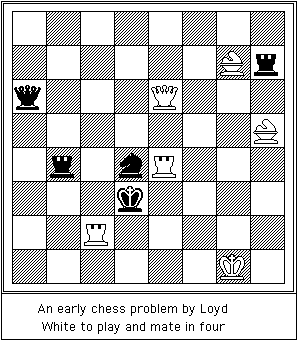
莱特的第一个象棋问题于1855年4月14日发表在New York Saturday Courier上。以下问题使他在New York Clipper举办的比赛中获得一等奖,并于1856年10月11日在该报上发表。
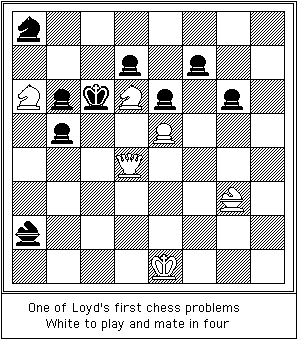
点击THIS LINK查看莱特最早的象棋问题之一,点击THIS LINK查看莱特的另一个早期象棋问题。
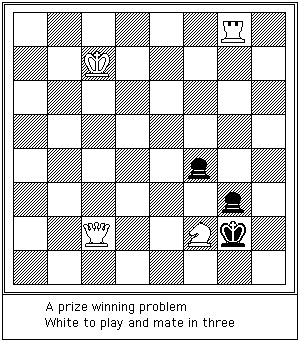
他开始向Chess Monthly提交问题,并在1857年赢得以下问题的一等奖后成为该杂志的问题编辑,你可以在THIS LINK看到。
点击THIS LINK查看解答。
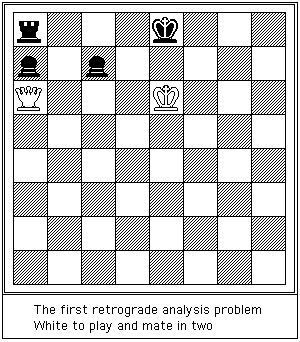
离开学校后,莱特开始学习工程学,打算成为一名蒸汽和机械工程师,但他发现可以靠谜题和象棋问题谋生。他开始开发更不寻常的谜题,例如以下回溯分析问题,他于1859年提交给Musical World。(这是一个回溯分析问题,因为你可以从两步将死的事实推断黑方不能王车易位——然后将死就很容易了。)
点击THIS LINK查看这个第一个回溯分析问题。
莱特的兴趣此时已相当广泛,因为除了作为管道承包商赚钱外,他还购买了一个音乐商店连锁店。事实上,他还有其他技能,比如木刻,这是他自学的,而且他还是一位熟练的漫画家。他继续创作国际象棋问题,撰写报纸专栏,并编辑诸如Sam Loyd's Puzzle Magazine甚至一本力学杂志等刊物。他还参加国际象棋比赛,尽管他不是顶级棋手,这生动地表明国际象棋远不止是解决问题。例如,他于1867年访问欧洲,参加了巴黎的一场锦标赛,但表现不佳。然而,在德国期间,他确实遇到了许多对创作国际象棋问题感兴趣的人。
到1870年,莱特对创作数学谜题比国际象棋问题更感兴趣。他创作了一个著名的问题,由三张卡片组成,两张画有马,第三张画有两名骑师。谜题是重新排列这些卡片,使骑师骑在马上。他将其卖给了表演者P T Barnum,并以P T Barnum's Trick Donkey闻名。
1878 年,他出版了一本包含 500 道题的书,Chess Strategy,其中主要是他此前两年为 Scientific American 的专栏创作的题目。在 [2] 中,他作为国际象棋题目创作者的精湛技艺被描述如下:-
莱特 在发明新颖而令人惊奇的主题并以微妙而隐晦的形式表达它们方面的天才无人能及,他满足于以自己的方式实现自己的想法,很少在意经济性以及避免双解和其他英国和德国创作者所接受的相当人为的优雅准则;毫无疑问,他遵循自己独特的倾向是正确的,因为其他创作者的题目很少能像他的那样经常给解题者带来机智和冷幽默的印象。
除了“白方走棋,三步将死”这类国际象棋题目外,莱特 还创作了涉及棋盘的国际象棋数学题。例如,在 1867 年 4 月的 Le Sphinx 中,他问道:-
把后放在棋盘上,让她经过全部六十四个格子,再回到起点,共走十四步。
试试看——你会发现这并不容易!这里有一条小线索。从后所在的格子出发,用14步经过每一个格子是不可能的。莱特在Sam Loyd's Puzzle Magazine1908年4月号上讨论了这个问题。
莱特向American Chess Journal的第一部分投了以下问题。他写道:——
就实际对局布置的兵力位置所产生的条件局面,举行一次小小的即兴展示,并无不妥。
随后他给出了五个涉及开局时摆好的棋盘的问题。以下是这些问题(我们稍微改动了措辞,使它们不那么专业):——
这些清楚地显示了莱特的天才——尤其是d),那是一项令人难以置信的成就。
莱特最著名的谜题是他在1878年制作的15谜题。莱特在Sam Loyd's Cyclopaedia of 5000 Puzzles, Tricks and Conundrums中写到了这个谜题,该书于1914年他去世后由他的儿子(也叫莱特)出版:-
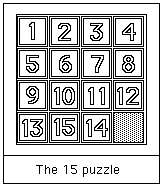
谜题之地的老居民会记得,七十年代我如何用一小盒可移动的方块让全世界发疯,这盒子后来被称为“14-15谜题”。十五个方块按矩形排列在方形盒子里,但14和15是颠倒的,如图所示。
插图见THIS LINK。谜题包括一次移动一个方块,使它们回到当前位置,除了14和15的错误被纠正外,其他方面都相同。
有人为第一个正确解答该问题者悬赏1000美元,但从未有人领取,尽管有成千上万的人声称自己完成了所需的壮举。
人们沉迷于这个谜题,流传着荒谬的故事:店主忘了开店;一位杰出的牧师在寒冬的夜晚站在路灯下,试图回忆他是如何完成这一壮举的。这个谜题的神秘之处在于,似乎没有人能记住他们确信自己成功解谜的移动顺序。据说飞行员因此撞毁了船只,工程师让火车冲过车站。一位著名的巴尔的摩编辑讲述了他如何去吃午饭,结果在午夜过后很久被惊慌失措的员工发现,他正在盘子里推着几块馅饼!据说农民们荒废了他们的犁……
当然,莱特知道他的1000美元是安全的,因为这个谜题无法解开。这股热潮席卷了美国,雇主们张贴告示禁止在办公时间玩这个谜题。在德国,国会议员在帝国议会中玩它,而在法国,它被描述为比酒精或烟草更大的祸害。
莱特另一个著名的谜题叫做“离开地球”,是在15谜题多年之后制作的。以下是莱特自己对这一谜题的描述,摘自1908年1月的Strand杂志:-
它由两块同心纸板组成,固定在一起,使得较小的圆形内块在枢轴上前后轻微移动,从而产生神秘效果。当你看着它们时,上面清晰地画着十三个中国人。将内块稍微移动一下,只剩下十二个中国人。无论你怎么努力,都无法说出另一个中国人去了哪里。科学家们尝试过但未成功,事实上从未有人提交过完全正确的分析。
我们已经讨论了莱特发明的数学谜题。这包括他发明的一种谜题类型——字母算术。
参见THIS LINK
他一如既往地给出了生动的描述(以及一幅我们未复制的漫画)来配合这个谜题:-
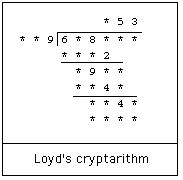
考古学家正在审视一道刻在砂岩巨石上的完整长除法题目。由于岩石风化,大部分数字已无法辨认。幸运的是,八个可辨认的数字提供了足够的信息,使你能够补全缺失的数字。
乍看之下,人们不会期望这个问题有唯一解,但莱特深知,通过逻辑论证能够找到唯一且仅有的一个解。
莱特不仅制作谜题,还表演戏法。他是一位熟练的口技表演者,晚年时与儿子同台演出,他的儿子似乎能读懂他的心思,但实际上是在做哑剧表演,而莱特则运用他的口技技巧让儿子看起来给出了正确答案。
莱特一生中创作了超过10000个谜题,其中许多涉及精妙的数学思想。[2]的作者写道:-
莱特有一种真正的天赋——正如刘易斯·卡罗尔牧师在《Curiosa Mathematica》中所展示的那样……——在数学科学中追求奇妙之事,如果他致力于运用这种天赋,或许能作为纯粹数学那广阔而富有诗意领域的探索者而赢得声誉,成为阿瑟·凯莱和詹姆斯·约瑟夫·西尔维斯特的合格追随者。
Alain C White写了Sam Loyd and his Chess Problems(1913年),在其中他写道:-
想法以极高的丰产性涌向莱特,常常快得让他无法彻底分析它们。然而他迅速分析的能力几乎无人能及。他能同时从多个侧面看待一个想法;首先总是从谜题的角度,然后从幽默的角度,最后从艺术的角度。
Always known as Sam, Samuel Loyd was the creator of famous mathematical puzzles and recreations. He was born in Philadelphia where his father was an estate agent, but he did not live there for very long since when he was only three years old his family moved to New York. Sam's father had a good income from being an estate agent and the family were well off. It was a large family with Sam being the youngest of nine children. He attended school in New York, completing his secondary education in 1858. Already by this time he had become fascinated by the game of chess which he took up when he was 14 years old when he began to attend a chess club with his brothers Thomas and Isaac. While still at school, Loyd won prizes for his chess problems.
Loyd's first chess problem was published in the New York Saturday Courier on 14 April 1855. The following problem won him first prize in a competition run by the New York Clipper and it was published in the paper on 11 October 1856.
Click THIS LINK for one of Loyd's first chess problems and THIS LINK for another early chess problem by Loyd.
He began submitting problems to Chess Monthly and he became the problem editor of the magazine in 1857 after winning first prize for the following problem you can see at THIS LINK.
Click THIS LINK for the solution.
After leaving school Loyd began to study engineering, intending to become a steam and mechanical engineer, but he found he could make his living from his puzzles and chess problems. He began to develop more unusual puzzles such as the following retrograde analysis problem which he submitted to Musical World in 1859. (It is a retrograde analysis problem since you can deduce from the fact that there is a mate in 2 that Black cannot castle - the mate is then easy.)
Click THIS LINK for this first retrograde analysis problem.
Loyd's interests were by now rather diverse for as well as earning money as a plumbing contractor he had purchased a chain of music stores. In fact he had other skills such as that of wood engraver, which he taught himself, and he was also a skilled cartoonist. He continued to compose chess problems, write newspaper columns, and edit papers such as Sam Loyd's Puzzle Magazine and even a mechanics journal. He also played in chess tournaments although he was not a top class chess player which shows vividly that chess involves so much more than problem solving. For example he visited Europe in 1867 and played in a tournament in Paris but performed poorly. He did meet many who were interested in composing chess problems, however, while in Germany.
By 1870 Loyd had become more interested in composing mathematical puzzles than chess problems. He had composed a famous problem consisting of three cards, two with the picture of a horse and the third with a picture of two jockeys. The puzzle was to rearrange the pieces so that the jockeys were riding the horses. He sold it to the showman P T Barnum and it became famous as P T Barnum's Trick Donkey.
In 1878, he published a book of 500 problems, Chess Strategy which consisted in the main in problems which he had composed for columns of Scientific American over the previous two years. In [2] his skill as a composer of chess problems is described as follows:-
Loyd, whose genius for inventing fresh and surprising themes and expressing them in a subtle and cryptic form has never been equalled, was content to work out his own ideas in his own way, caring little for considerations of economy and the avoidance of duals and other rather artificial canons of elegance accepted by English and German composers; and there can be no doubt that he was right to follow his peculiar bent, seeing that no other composer's problems so often give the solver impressions of wit and dry humour.
As well as chess problems of the type "White to play and mate in three", Loyd also produced mathematical problems involving chess boards. For example in Le Sphinx in April 1867 he asked:-
Place the Queen on a chessboard and pass her over the entire sixty-four squares and back again to the point of beginning in fourteen moves.
Try it - you will not find it easy! Here is a small clue. It is impossible to pass the Queen over every square in 14 moves starting from its own square. Loyd discussed this in the April 1908 edition of Sam Loyd's Puzzle Magazine.
Loyd contributed the following problems to the first part of the American Chess Journal. He wrote:-
It will not be amiss to have a little impromptu exhibition, bearing upon conditional positions produced from the position of the forces as arranged for actual play.
He then gave five problems involving the chess board as set up at the start of a game. Here are the problems (we have changed the wording slightly to make them slightly less technical):-
These show Loyd's genius very clearly - particularly d) which is an incredible achievement.
Loyd's most famous puzzle was the 15 Puzzle which he produced in 1878. Loyd wrote about the puzzle in Sam Loyd's Cyclopaedia of 5000 Puzzles, Tricks and Conundrums which was published in 1914 after his death by his son (also called Sam Loyd):-
Older inhabitants of Puzzleland will remember how in the seventies I drove the entire world crazy with a little box of movable blocks which became known as the "14-15 Puzzle". The fifteen blocks were arranged in the square box in rectangular order, but with the 14 and 15 reversed as shown.
See THIS LINK for the illustration.The puzzle consisted of moving the blocks about, one at a time, to bring them back to the present position in every respect except that the error in the 14 and 15 was corrected.
A prize of $1000, offered for the first correct solution to the problem, has never been claimed, although there are thousands of persons who say they have performed the required feat.
People became infatuated with the puzzle and ludicrous tales are told of shopkeepers who neglected to open their stores; of a distinguished clergyman who stood under a street lamp all through a wintry night trying to recall the way he had performed the feat. The mysterious feature of the puzzle is that none seem able to remember the sequence of moves whereby they feel sure they have succeeded in solving the puzzle. Pilots are said to have wrecked their ships, and engineers rush their trains past stations. A famous Baltimore editor tells how he went for his noon lunch and was discovered by frantic staff long past midnight pushing little pieces of pie around on a plate! Farmers are known to have deserted their ploughs ...
Of course, Loyd knew his $1000 was safe for the puzzle cannot be solved. The craze swept America where employers put up notices prohibiting playing the puzzle during office hours. In Germany it was played by Deputies in the Reichstag while in France it was described as a greater scourge than alcohol or tobacco.
Another of Loyd's famous puzzles was called "Get off the Earth" and was produced many years after the 15 Puzzle. Here is Loyd's own description of the puzzle taken from the January 1908 part of the Strand magazine:-
It consisted of two concentric pieces of cardboard, fastened together so that the smaller inner one, which was circular, moved slightly backwards and forward, on a pivot, producing the mystery. As you looked at them, there were thirteen Chinamen plainly pictured. Move the inner card around a little and only twelve Chinamen remained. You couldn't tell what had become of the other Chinaman, try as you would. Scientists tried it without success, and indeed no single absolutely correct analysis was ever submitted.
See THIS LINK.
We have talked about mathematical puzzles invented by Loyd. This includes the cryptarithm, a type of puzzle which he invented.
See THIS LINK
As always he gave a colourful description (and a cartoon which we have not reproduced) to go with the puzzle:-
The archaeologist is examining a completed problem in long division, engraved on a sandstone boulder. due to weathering of the rock, most of the figures are no longer legible. Fortunately the eight legible digits provide enough information to enable you to supply the missing figures.
At first sight one would not expect there to be a unique solution to this problem, but Loyd was well aware that a logical argument would find the one and only one solution.
Not only did Loyd produce puzzles, he also gave performances of tricks. He was a skilled ventriloquist and later in his life performed on stage with his son who appeared able to read his mind, but actually mimed while Loyd used his ventriloquist skills to make his son appear to give correct answers.
Loyd produced over 10 000 puzzles in his lifetime many involving sophisticated mathematical ideas. The author of [2] writes:-
Loyd had a real gift - such as that shown in the 'Curiosa Mathematica' of the Rev C L Dodgson ... - for the fantastic in mathematical science, and had he devoted himself to making use of it, might have earned fame as an investigator in the vast and poetic region of pure mathematics, a worthy follower of Cayley and Sylvester.
Alain C White wrote Sam Loyd and his Chess Problems (1913) and in it he writes:-
Ideas came to [Loyd] with great fecundity, often too rapidly for him to analyse them completely. Yet his powers for rapid analysis were almost unrivalled. He could see an idea from many sides at once; first always from the point of view of a puzzle, then from the humorous standpoint, finally from the artistic aspect.
正文里的方括号编号指向这里,悬停即可直接看到条目。书目保留原文——译了书名反而查不到文献。
原站列出的延伸阅读与外部数据库,照原样保留,目标多为英文页面。
原站的交叉引用。指向本站已镜像专题的留在站内,其余仍指回原站。