数学家传记
海里格·冯·科赫以分形海里格·冯·科赫曲线最为著名。
海里格·冯·科赫的父亲是Richert Vogt 冯·科赫,曾有过军旅生涯,母亲是Agathe Henriette Wrede。Von 冯·科赫在斯德哥尔摩的一所好学校就读,1887年在那里完成学业。随后他进入斯德哥尔摩大学。
斯德哥尔摩大学是瑞典的第三所大学,自1865年开始筹划,1880年开学,约斯塔·米塔格-莱弗勒担任其首位数学教授。我们应当注意,尽管我们在此以其现名斯德哥尔摩大学来称呼它,但在1950年之前,它在瑞典被称为Stockholms Högskola,字面意思是“斯德哥尔摩高等学校”。
冯·科赫从1888年起在乌普萨拉大学度过了一段时间。他是斯德哥尔摩大学约斯塔·米塔格-莱弗勒的学生。冯·科赫的首批成果是关于无穷多个未知数的无穷多个线性方程。1891年,他写了两篇论文中的第一篇,内容是关于将无穷行列式应用于求解具有解析系数的微分方程方程组。他所使用的方法基于大约六年前儒勒·昂利·庞加莱发表的方法。冯·科赫的第二篇论文发表于1892年,同年冯·科赫因其学位论文而获得博士学位,该论文包含了这两篇论文的成果。冯·科赫于1892年5月26日被斯德哥尔摩大学授予数学博士学位。拉斯·戈丁在[2]中写道,他的学位论文是:-
……一部惊人成熟的著作……
然而,Bernkoff在[1]中写道,冯·科赫的这部著作:-
……不能被称为开创性的。他的成果都相当容易理解,尽管许多计算冗长。他通过了解儒勒·昂利·庞加莱的工作,意识到有可能获得病态结果,但几乎没有去探索它们。然而,这部著作可以说是通往最终导向泛函分析的漫长道路上的第一步,因为它为埃里克·伊瓦尔·弗雷德霍姆提供了解决其积分方程的关键。
Garding在[2]中写道:-
在学位论文之后,冯·科赫写了许多论文,其中包括一些关于无穷行列式的论文,例如在1901年,但这个主题没有多少扩展和发展的可能性,目前的兴趣为零。
在1893年至1905年间,冯·科赫曾多次担任数学助理教授。他在乌普萨拉大学申请代数与数论讲席失败。1905年,Bendixson,他也曾是约斯塔·米塔格-莱弗勒的学生,辞去了KTH(瑞典语为Kungliga Tekniska Högskolan;英语为斯德哥尔摩皇家理工学院)的教授职位,接受了斯德哥尔摩大学的讲席。随后,Von 冯·科赫被任命为KTH的纯粹数学讲席。1911年7月,冯·科赫接替约斯塔·米塔格-莱弗勒成为斯德哥尔摩大学的数学教授。
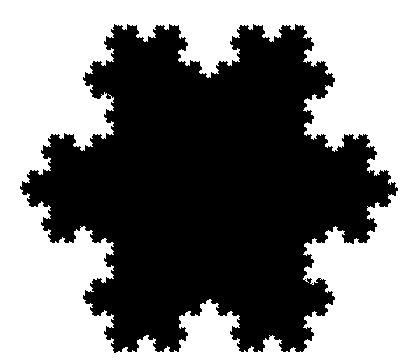
插图:VonKoch.gif ↗
冯·科赫雪花。
冯·科赫以冯·科赫曲线闻名,该曲线出现在他1904年发表的论文Sur une courbe continue sans tangente, obtenue par une construction géométrique élémentaire Ⓣ(关于一条没有切线的连续曲线,通过初等几何构造获得)中。这是通过将一条线段分成三等份,并用在中段上构造的等边三角形的另外两条边替换中间段来构造的。对每个(现在为4个)线段重复此操作。无限重复。它给出了一条连续曲线,其长度为无限且处处不可微。如果从等边三角形开始并应用该构造,则得到冯·科赫雪花(有时称为冯·科赫星)作为构造的极限。
冯·科赫雪花是一条连续曲线,在任何点都没有切线。Von 冯·科赫的1906年论文主要包含这一事实的证明。他还在论文中表明,有两个函数和都处处不可微,使得雪花曲线是
其中。
第一个给出连续但处处不可微函数的解析构造例子的人是卡尔·魏尔斯特拉斯。在其论文末尾,冯·科赫基于冯·科赫曲线给出了这种函数的一个几何构造,并且他也用解析方式表达了它。
冯·科赫还撰写了关于数论的论文,特别是他写了几篇关于素数定理的论文,如1901年的Sur la distribution des nombres premiers Ⓣ(论素数的分布)和1910年的Contribution à la théorie des nombres premiers Ⓣ(对素数理论的贡献)。
Helge von Koch's father was Richert Vogt von Koch, who had a military career, and his mother was Agathe Henriette Wrede. Von Koch attended a good school in Stockholm, completing his studies there in 1887. He then entered Stockholm University.
Stockholm University was the third university in Sweden and it was planned from 1865, opening in 1880 with Mittag-Leffler as its first professor of mathematics. We should note that although we shall refer to it here by its present name of Stockholm University, it was known in Sweden as Stockholms Högskola until 1950 which literally means "Stockholm High School".
Von Koch spent some time at Uppsala University from 1888. He was a student of Mittag-Leffler at Stockholm University. Von Koch's first results were on infinitely many linear equations in infinitely many unknowns. In 1891 he wrote the first of two papers on applications of infinite determinants to solving systems of differential equations with analytic coefficients. The methods he used were based on those published by Poincaré about six years earlier. The second of von Koch's papers was published in 1892, the year in which von Koch was awarded a doctorate for his thesis which contained the results of the two papers. Von Koch was awarded a doctorate in mathematics by Stockholm University on 26 May 1892. Gårding writes in [2] that his doctoral thesis was:-
... a fantastically mature work ...
Bernkoff writes in [1], however, that this work by von Koch:-
... cannot be called pioneering. His results were all fairly accessible, although many of the calculations are lengthy. He was aware, through a knowledge of Poincaré's work, of the possibility of obtaining pathological results but did little to explore them. Yet this work can be said to be the first step on the long road which eventually led to functional analysis, since it provided Fredholm with the key for the solution of his integral equation.
Garding writes in [2]:-
After the thesis von Koch wrote many papers, among others some on infinite determinants, for instance in 1901, but the subject did not have many possibilities for extension and growth and present interest is nil.
Between the years 1893 and 1905 von Koch had several appointements as an assistant professor of mathematics. He failed in his application for the chair of algebra and number theory at Uppsala University. In 1905 Bendixson, who had also been a student of Mittag-Leffler, resigned his professorship at KTH, (in Swedish Kungliga Tekniska Högskolan; in English the Royal Institute of Technology in Stockholm), when he accepted a chair at Stockholm University. Von Koch was then appointed to the chair of pure mathematics at the KTH. In July 1911 von Koch succeeded Mittag-Leffler as professor of mathematics at Stockholm University.
插图:VonKoch.gif ↗
Von Koch's snowflake.
Von Koch is famous for the Koch curve which appears in his paper Sur une courbe continue sans tangente, obtenue par une construction géométrique élémentaire Ⓣ published in 1904. This is constructed by dividing a line into three equal parts and replacing the middle segment by the other two sides of an equilateral triangle constructed on the middle segment. Repeat on each of the (now 4) segments. Repeat indefinitely. It gives a continuous curve which is of infinite length and nowhere differentiable. If one starts with an equilateral triangle and applies the construction, one gets the von Koch snowflake (sometimes called the von Koch star) as the limit of the construction.
The von Koch snowflake is a continuous curve which does not have a tangent at any point. Von Koch's 1906 paper mainly consists of a proof of this fact. He also shows in the paper that there are two functions and which are both nowhere differentiable such that the snowflake curve is
where .
The first person to give an example of an analytic construction of a function which is continuous but nowhere differentiable was Weierstrass. At the end of his paper, von Koch gives a geometric construction, based on the von Koch curve, of such a function which he also expresses analytically.
Von Koch also wrote papers on number theory, in particular he wrote several papers on the prime number theorem such as Sur la distribution des nombres premiers Ⓣ in 1901 and Contribution à la théorie des nombres premiers Ⓣ in 1910.
正文里的方括号编号指向这里,悬停即可直接看到条目。书目保留原文——译了书名反而查不到文献。
原站列出的延伸阅读与外部数据库,照原样保留,目标多为英文页面。
关于海里格·冯·科赫的其它页面:
原站的交叉引用。指向本站已镜像专题的留在站内,其余仍指回原站。