数学家传记
库尔特·弗雷德里希·哥德尔证明了关于公理系统的基本结果,表明在任何公理数学系统中,都存在无法在该系统公理内证明或证伪的命题。
库尔特·弗雷德里希·哥德尔的父亲是Rudolf Gödel,其家族来自维也纳。鲁道夫年轻时没有接受高等教育,但他事业有成,成为布尔诺一家大型纺织公司的常务董事和部分所有者。哥德尔的母亲玛丽安·汉德舒来自莱茵兰,是古斯塔夫·汉德舒的女儿,后者也在布尔诺从事纺织业。鲁道夫比玛丽安大14岁,与鲁道夫不同,玛丽安受过文学教育,并在法国完成了部分学业。鲁道夫和玛丽安哥德尔有两个孩子,都是男孩。长子随父亲取名鲁道夫,幼子是哥德尔。
哥德尔的童年相当幸福。他非常依恋母亲,但母亲不在家时,他似乎相当胆怯和不安。他六岁时患了风湿热,但康复后生活一如往常。然而,他八岁时开始阅读关于他所患疾病的医学书籍,并了解到心脏虚弱是一种可能的并发症。尽管没有证据表明他确实心脏虚弱,哥德尔却确信自己如此,对健康的担忧成了他日常的忧虑。
哥德尔在布吕恩上学,于1923年完成学业。他的兄弟Rudolf说:-
甚至在中学时,我的兄弟就比我更为偏科,令他的老师和同学惊讶的是,到中学最后文理中学年时他已掌握了大学数学。……数学和语言远高于文学和历史。当时有传言说,在他整个中学期间,他的拉丁文作业不仅总是得最高分,而且他从未犯过一个语法错误。
哥德尔于1923年进入维也纳大学,仍未明确决定是专攻数学还是理论物理。他受教于菲利浦·富特文勒、汉斯·哈恩、威廉·维廷格、卡尔·门格尔、爱德华·赫吕等人。菲利浦·富特文勒的讲座对哥德尔影响最大,正因如此他决定以数学为主修。原因有二:菲利浦·富特文勒是一位杰出的数学家和教师,但此外他从颈部以下瘫痪,因此坐在轮椅上授课,由一名助手在黑板上书写。这会对任何学生产生很大影响,但对非常在意自身健康的哥德尔来说,这产生了重大影响。作为本科生,哥德尔参加了Schlick主持的一个研讨班,该研讨班研读伯特兰·罗素的书Introduction to mathematical philosophy。哥德尔的同学奥尔加·陶斯基-托德写道:-
逐渐变得明显的是,他会坚持逻辑,他将成为汉斯·哈恩的学生而不是Schlick的学生,他极具天赋。人们非常需要他的帮助。
1929年,他在汉斯·哈恩的指导下完成了学位论文,提交了一篇证明一阶函数演算完备性的论文。1930年,他成为维也纳大学的一名教员,并在那里一直属于逻辑实证主义学派,直到1938年。哥德尔的父亲于1929年去世,由于生前生意成功,家人经济上有了保障。丈夫去世后,哥德尔的母亲在维也纳购置了一套大公寓,两个儿子都和她住在那里。此时哥德尔的哥哥已是一名成功的放射科医生。我们上文提到,哥德尔的母亲受过文学教育,如今她得以享受维也纳的文化生活,尤其是看戏,由Rudolf和哥德尔陪同。
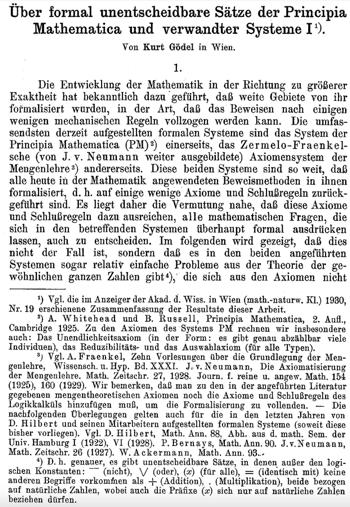
哥德尔最著名的是他证明了“哥德尔的不完备性定理”。1931年,他在Über formal unentscheidbare Sätze der Principia Mathematica und verwandter SystemeⓉ(《论〈数学原理〉及其相关系统中的形式不可判定命题》)中发表了这些结果。
见THIS LINK。
他证明了关于公理系统的基本结果,表明在任何公理化数学系统中,都存在无法在系统公理内证明或证伪的命题。特别是,公理的一致性无法证明。这结束了长达百年的试图建立公理以使整个数学建立在公理基础上的努力。一项重大尝试是伯特兰·罗素的Principia Mathematica(1910-13)。另一项是大卫·希尔伯特的形式主义,受到哥德尔结果的严重打击。该定理并未摧毁形式主义的基本思想,但确实表明任何系统都必须比大卫·希尔伯特所设想的更全面。哥德尔的结果是20世纪数学的里程碑,表明数学并非如人们所相信的那样是一个已完成的对象。它还意味着计算机永远无法被编程来回答所有数学问题。
1931年,哥德尔在巴特埃尔斯特遇到了恩斯特·策梅洛。参加了同一次会议的奥尔加·陶斯基-托德写道:
恩斯特·策梅洛的问题在于,他觉得自己早已独立得出了哥德尔最受赞赏的那个结果。Scholz似乎认为事实确实如此,但恩斯特·策梅洛并未公布,也许永远不会公布。……恩斯特·策梅洛与哥德尔在巴特埃尔斯特的平和会面,并未成为两位逻辑学家之间科学友谊的开端。
他将关于不完备性的论文提交给维也纳大学,作为他的教授资格论文(Habilitation),该论文于1932年12月1日被汉斯·哈恩接受。1933年3月,哥德尔成为维也纳大学的编外讲师。
1933年是希特勒上台的那一年。起初这并未影响哥德尔在维也纳的生活;他对政治兴趣不大。1934年,哥德尔在普林斯顿做了一系列题为On undecidable propositions of formal mathematical systems的讲座。在奥斯瓦尔德·维布伦的建议下,刚在普林斯顿完成博士论文的克林记录了这些讲座,这些笔记后来得以出版。然而,哥德尔在回到欧洲时精神崩溃,从巴黎打电话给他的兄弟鲁道夫说自己病了。他接受了一位精神科医生的治疗,并在疗养院待了几个月,从抑郁中恢复。
尽管有健康问题,哥德尔的研究进展顺利,并于1935年证明了选择公理与集合论其他公理相容性的重要结果。然而,施利克的讨论班曾激起哥德尔对逻辑的兴趣,1936年施利克被一名国家社会主义学生谋杀后,哥德尔深受影响,再次精神崩溃。他的哥哥Rudolf写道:
这一事件无疑是我弟弟有一段时间经历严重精神危机的原因,这当然令人极为担忧,尤其对我母亲而言。他康复后不久,就收到了去美国担任客座教授的第一次邀请。
1938年夏天,他访问了哥廷根,并在那里就他的集合论研究作了演讲。他回到维也纳,于1938年秋天与Adele Porkert结婚。事实上,他于1927年在维也纳的Der Nachtfalter夜总会与她相识。她比哥德尔大六岁,曾结过婚,他的父母,尤其是他的父亲,反对他们结婚的想法。她并不是哥德尔的父母反对的第一个女孩,他上大学前后遇到的第一个女孩比他大十岁。
1938年3月,奥地利成为德国的一部分,但哥德尔对此不太感兴趣,生活基本照常。他第二次访问普林斯顿,在1938-39学年的第一学期在高等爱德华·斯图迪研究所度过。该学年的第二学期,他在圣母大学讲授了一门精彩的课程。在奥地利,大多数拥有privatdozent头衔的人在该国成为德国一部分后成为带薪讲师,但哥德尔没有,他于1939年9月25日提出的申请得到了不热情的回应。似乎有人认为他是犹太人,但事实上这完全错误,尽管他确实有许多犹太朋友。其他人也误以为他是犹太人,有一次他和妻子在维也纳外出散步时,一群年轻人以为他是犹太人而袭击了他。
战争开始时,哥德尔担心自己可能被征入德国军队。当然,他也确信自己健康状况太差,无法服役,但如果他被误认为犹太人,也可能被误认为健康人。他不愿冒这个险,经过长时间谈判获得美国签证后,他幸运地得以返回美国,尽管不得不途经俄罗斯和日本。他的妻子陪同他。
1940年,哥德尔抵达美国,1948年成为美国公民(事实上,他相信自己发现了美国宪法中的不一致之处,但法官在面试时更有理智,没有听信!)。1940年至1946年,他是高等斯图迪研究所的普通成员(持有每年续签的为期一年的任命),之后成为永久成员直至1953年。1953年起直至去世,他在普林斯顿担任讲席,持有的合同明确说明他没有教学任务。哥德尔在普林斯顿最亲密的朋友之一是阿尔伯特·爱因斯坦。他们彼此高度尊重,经常交谈。尚不清楚阿尔伯特·爱因斯坦在多大程度上影响了哥德尔研究相对论,但他确实对该主题有所贡献。
他于1951年获得阿尔伯特·爱因斯坦奖,1974年获得国家科学奖章。他是美国国家科学院成员、Royal Society会士、法国研究所成员、英国科学院院士以及伦敦数学会荣誉会员。然而,这充分说明了他对奥地利的感情:他拒绝了维也纳科学院院士资格,后来当选荣誉会员时再次拒绝这一荣誉。他还拒绝接受奥地利授予他的科学和艺术成就最高国家奖章。他无疑对自己的遭遇感到痛苦,但对其家人的遭遇同样如此。
哥德尔的母亲比他先离开维也纳,因为1937年她回到了布尔诺的别墅,在那里她公开批评国家社会主义政权。哥德尔的兄弟鲁道夫留在了维也纳,但到1944年两人都预计德国会战败,鲁道夫的母亲便到维也纳与他同住。根据战后奥地利人与捷克人谈判达成的条约,她只获得了布尔诺别墅价值的十分之一。这种不公令哥德尔极为愤怒;事实上,他总是把这类不公视为针对个人的,尽管有大量的人遭受着同样的待遇。
定居美国后,哥德尔再次做出了极其重要的工作。他的杰作Consistency of the axiom of choice and of the generalized 连续统假设 with the axioms of set theory(1940)是现代数学的经典。在其中他证明了,如果伯特兰·罗素和阿尔弗雷德·诺思·怀特海在Principia Mathematica中提出的那类集合论公理系统是一致的,那么当把选择公理和广义连续统假设加入该系统时,它仍将保持一致。这并未证明这些公理独立于集合论的其他公理,但当科恩于1963年最终确立这一点时,他正是基于哥德尔的这些想法。
随着岁月流逝,哥德尔对自身健康的担忧日益加剧。哥德尔的兄弟Rudolf是一名医生,因此下文由他提供的医学细节是准确的。他写道:-
我的兄弟对一切事物都有非常个人化且固定的看法,几乎无法被说服改变。不幸的是,他一生都相信自己在数学上,甚至在医学上,总是正确的,因此对医生来说,他是个非常难对付的病人。在十二指肠溃疡严重出血之后……余生中他坚持极其严格(过于严格?)的饮食,这导致他慢慢体重减轻。
哥德尔的妻子给予了他极大的支持,她做了很多来缓解困扰他的紧张情绪。然而,她自己也开始了健康问题,经历了两次中风和一次大手术。在他生命的最后阶段,哥德尔开始确信自己被人下毒,并拒绝进食以避免中毒,实质上绝食而死[3]:-
哥德尔身材瘦小,非常挑剔,晚年普遍担心自己的健康,没有广泛旅行或演讲。他没有博士生,但通过通信和与普林斯顿不断来访者的个人接触,许多人受益于他极其敏捷而敏锐的头脑。作为阿尔伯特·爱因斯坦、冯·诺伊曼和Morgenstern的朋友,他特别喜欢哲学讨论。
他去世了[18]:-
……1978年1月14日下午,他坐在普林斯顿医院病房的椅子上。
可以公允地说,哥德尔的思想改变了数学的进程[3]:-
……显然,他的思想富有成果,将继续激发新的工作。很少有数学家能获得这种不朽。
Kurt Gödel's father was Rudolf Gödel whose family were from Vienna. Rudolf did not take his academic studies far as a young man, but had done well for himself becoming managing director and part owner of a major textile firm in Brünn. Kurt's mother, Marianne Handschuh, was from the Rhineland and the daughter of Gustav Handschuh who was also involved with textiles in Brünn. Rudolf was 14 years older than Marianne who, unlike Rudolf, had a literary education and had undertaken part of her school studies in France. Rudolf and Marianne Gödel had two children, both boys. The elder they named Rudolf after his father, and the younger was Kurt.
Kurt had quite a happy childhood. He was very devoted to his mother but seemed rather timid and troubled when his mother was not in the home. He had rheumatic fever when he was six years old, but after he recovered life went on much as before. However, when he was eight years old be began to read medical books about the illness he had suffered from, and learnt that a weak heart was a possible complication. Although there is no evidence that he did have a weak heart, Kurt became convinced that he did, and concern for his health became an everyday worry for him.
Kurt attended school in Brünn, completing his school studies in 1923. His brother Rudolf said:-
Even in High School my brother was somewhat more one-sided than me and to the astonishment of his teachers and fellow pupils had mastered university mathematics by his final Gymnasium years. ... Mathematics and languages ranked well above literature and history. At the time it was rumoured that in the whole of his time at High School not only was his work in Latin always given the top marks but that he had made not a single grammatical error.
Gödel entered the University of Vienna in 1923 still without having made a definite decision whether he wanted to specialise in mathematics or theoretical physics. He was taught by Furtwängler, Hahn, Wirtinger, Menger, Helly and others. The lectures by Furtwängler made the most impact on Gödel and because of them he decided to take mathematics as his main subject. There were two reasons: Furtwängler was an outstanding mathematician and teacher, but in addition he was paralysed from the neck down so lectured from a wheel chair with an assistant who wrote on the board. This would make a big impact on any student, but on Gödel who was very conscious of his own health, it had a major influence. As an undergraduate Gödel took part in a seminar run by Schlick which studied Russell's book Introduction to mathematical philosophy. Olga Taussky-Todd, a fellow student of Gödel's, wrote:-
It became slowly obvious that he would stick with logic, that he was to be Hahn's student and not Schlick's, that he was incredibly talented. His help was much in demand.
He completed his doctoral dissertation under Hahn's supervision in 1929 submitting a thesis proving the completeness of the first order functional calculus. He became a member of the faculty of the University of Vienna in 1930, where he belonged to the school of logical positivism until 1938. Gödel's father died in 1929 and, having had a successful business, the family were left financially secure. After the death of her husband, Gödel's mother purchased a large flat in Vienna and both her sons lived in it with her. By this time Gödel's older brother was a successful radiologist. We mentioned above that Gödel's mother had a literary education and she was now able to enjoy the culture of Vienna, particularly the theatre accompanied by Rudolf and Kurt.
Gödel is best known for his proof of "Gödel's Incompleteness Theorems". In 1931 he published these results in Über formal unentscheidbare Sätze der Principia Mathematica und verwandter Systeme Ⓣ.
See THIS LINK.
He proved fundamental results about axiomatic systems, showing in any axiomatic mathematical system there are propositions that cannot be proved or disproved within the axioms of the system. In particular the consistency of the axioms cannot be proved. This ended a hundred years of attempts to establish axioms which would put the whole of mathematics on an axiomatic basis. One major attempt had been by Bertrand Russell with Principia Mathematica (1910-13). Another was Hilbert's formalism which was dealt a severe blow by Gödel's results. The theorem did not destroy the fundamental idea of formalism, but it did demonstrate that any system would have to be more comprehensive than that envisaged by Hilbert. Gödel's results were a landmark in 20th -century mathematics, showing that mathematics is not a finished object, as had been believed. It also implies that a computer can never be programmed to answer all mathematical questions.
Gödel met Zermelo in Bad Elster in 1931. Olga Taussky-Todd, who was at the same meeting, wrote:-
The trouble with Zermelo was that he felt he had already achieved Gödel's most admired result himself. Scholz seemed to think that this was in fact the case, but he had not announced it and perhaps would never have done so. ... The peaceful meeting between Zermelo and Gödel at Bad Elster was not the start of a scientific friendship between two logicians.
Submitting his paper on incompleteness to the University of Vienna for his habilitation, this was accepted by Hahn on 1 December 1932. Gödel became a Privatdozent at the University of Vienna in March 1933.
Now 1933 was the year that Hitler came to power. At first this had no effect on Gödel's life in Vienna; he had little interest in politics. In 1934 Gödel gave a series of lectures at Princeton entitled On undecidable propositions of formal mathematical systems. At Veblen's suggestion Kleene, who had just completed his Ph.D. thesis at Princeton, took notes of these lectures which have been subsequently published. However, Gödel suffered a nervous breakdown as he arrived back in Europe and telephoned his brother Rudolf from Paris to say he was ill. He was treated by a psychiatrist and spent several months in a sanatorium recovering from depression.
Despite the health problems, Gödel's research was progressing well and he proved important results on the consistency of the axiom of choice with the other axioms of set theory in 1935. However after Schlick, whose seminar had aroused Gödel's interest in logic, was murdered by a National Socialist student in 1936, Gödel was much affected and had another breakdown. His brother Rudolf wrote:-
This event was surely the reason why my brother went through a severe nervous crisis for some time, which was of course of great concern, above all for my mother. Soon after his recovery he received the first call to a Guest Professorship in the USA.
He visited Göttingen in the summer of 1938, lecturing there on his set theory research. He returned to Vienna and married Adele Porkert in the autumn of 1938. In fact he had met her in 1927 in Der Nachtfalter night club in Vienna. She was six years older than Gödel and had been married before and both his parents, but particularly his father, objected to the idea that they marry. She was not the first girl that Gödel's parents had objected to, the first he had met around the time he went to university was ten years older than him.
In March 1938 Austria had became part of Germany but Gödel was not much interested and carried on his life much as normal. He visited Princeton for the second time, spending the first term of session 1938-39 at the Institute for Advanced Study. The second term of that academic year he gave a beautiful lecture course at Notre Dame. Most who held the title of privatdozent in Austria became paid lecturers after the country became part of Germany but Gödel did not and his application made on 25 September 1939 was given an unenthusiastic response. It seems that he was thought to be Jewish, but in fact this was entirely wrong, although he did have many Jewish friends. Others also mistook him for a Jew, and he was once attacked by a gang of youths, believing him to be a Jew, while out walking with his wife in Vienna.
When the war started Gödel feared that he might be conscripted into the German army. Of course he was also convinced that he was in far too poor health to serve in the army, but if he could be mistaken for a Jew he might be mistaken for a healthy man. He was not prepared to risk this, and after lengthy negotiation to obtain a U.S. visa he was fortunate to be able to return to the United States, although he had to travel via Russia and Japan to do so. His wife accompanied him.
In 1940 Gödel arrived in the United States, becoming a U.S. citizen in 1948 (in fact he believed he had found an inconsistency in the United States Constitution, but the judge had more sense than to listen during his interview!). He was an ordinary member of the Institute for Advanced Study from 1940 to 1946 (holding year long appointments which were renewed every year), then he was a permanent member until 1953. He held a chair at Princeton from 1953 until his death, holding a contract which explicitly stated that he had no lecturing duties. One of Gödel's closest friends at Princeton was Einstein. They each had a high regard for the other and they spoke frequently. It is unclear how much Einstein influenced Gödel to work on relativity, but he did indeed contribute to that subject.
He received the Einstein Award in 1951, and National Medal of Science in 1974. He was a member of the National Academy of Sciences of the United States, a fellow of the Royal Society, a member of the Institute of France, a fellow of the British Academy and an Honorary Member of the London Mathematical Society. However, it says much about his feelings towards Austria that he refused membership of the Academy of Sciences in Vienna, then later when he was elected to honorary membership he again refused the honour. He also refused to accept the highest National Medal for scientific and artistic achievement that Austria offered him. He certainly felt bitter at his own treatment but equally so about that of his family.
Gödel's mother had left Vienna before he did, for in 1937 she returned to her villa in Brno where she was openly critical of the National Socialist regime. Gödel's brother Rudolf had remained in Vienna but by 1944 both expected German defeat, and Rudolf's mother joined him in Vienna. In terms of the treaty negotiated after the war between the Austrians and the Czechs, she received one tenth of the value for her villa in Brno. It was an injustice which infuriated Gödel; in fact he always took such injustices as personal even although large numbers suffered in the same way.
After settling in the United States, Gödel again produced work of the greatest importance. His masterpiece Consistency of the axiom of choice and of the generalized continuum-hypothesis with the axioms of set theory (1940) is a classic of modern mathematics. In this he proved that if an axiomatic system of set theory of the type proposed by Russell and Whitehead in Principia Mathematica is consistent, then it will remain so when the axiom of choice and the generalized continuum-hypothesis are added to the system. This did not prove that these axioms were independent of the other axioms of set theory, but when this was finally established by Cohen in 1963 he built on these ideas of Gödel.
Concerns with his health became increasingly worrying to Gödel as the years went by. Rudolf, Gödel's brother, was a medical doctor so the medical details given by him in the following will be accurate. He wrote:-
My brother had a very individual and fixed opinion about everything and could hardly be convinced otherwise. Unfortunately he believed all his life that he was always right not only in mathematics but also in medicine, so he was a very difficult patient for doctors. After severe bleeding from a duodenal ulcer ... for the rest of his life he kept to an extremely strict (over strict?) diet which caused him slowly to lose weight.
Adele, Gödel's wife, was a great support to him and she did much to ease the tensions which troubled him. However she herself began to suffer health problems, having two strokes and a major operation. Towards the end of his life Gödel became convinced that he was being poisoned and, refusing to eat to avoid being poisoned, essentially starved himself to death [3]:-
A slight person and very fastidious, Gödel was generally worried about his health and did not travel or lecture widely in later years. He had no doctoral students, but through correspondence and personal contact with the constant succession of visitors to Princeton, many people benefited from his extremely quick and incisive mind. Friend to Einstein, von Neumann and Morgenstern, he particularly enjoyed philosophical discussion.
He died [18]:-
... sitting in a chair in his hospital room at Princeton, in the afternoon of 14 January 1978.
It would be fair to say that Gödel's ideas have changed the course of mathematics [3]:-
... it seems clear that the fruitfulness of his ideas will continue to stimulate new work. Few mathematicians are granted this kind of immortality.
正文里的方括号编号指向这里,悬停即可直接看到条目。书目保留原文——译了书名反而查不到文献。
原站列出的延伸阅读与外部数据库,照原样保留,目标多为英文页面。
关于库尔特·弗雷德里希·哥德尔的其它页面:
关于库尔特·弗雷德里希·哥德尔的其它网站:
原站的交叉引用。指向本站已镜像专题的留在站内,其余仍指回原站。