数学家传记
约翰·皮斯普·埃克特 Jr. 是一位美国计算机先驱。他与约翰·莫克利一起发明了ENIAC:第一台通用电子数字计算机。
小约翰·皮斯普·埃克特就读于日耳曼敦的威廉·佩恩·卡特学校。1937年,他毕业后进入宾夕法尼亚大学的摩尔电气工程学院,并于1941年从那里毕业。埃克特是一位出色的电气工程专业学生,毕业后不久就被聘为摩尔学院的讲师。
此时,摩尔学院已深度参与专门面向战争努力的研究。埃克特在摩尔学院教授一门国防课程,他班上的一名学生是约翰·莫克利。约翰·莫克利比埃克特大十二岁,却成了他的学生,这似乎有些奇怪。约翰·莫克利已经是一位教授物理学的资深学者,但他参与了国防培训,作为对战争努力的贡献。埃克特很快对约翰·莫克利关于计算机发展的想法产生了兴趣,有一段时间两人频繁讨论这些想法。然而不久,埃克特转而承担学院的其他军事工作。Ashurst [2]讲述了埃克特如何:-
……最终参与了紫外光以及测量金属疲劳手段的开发工作。后来,他继续开发了一种测量小磁场的方法,用于探测水雷。接着,他又从事雷达以及目标定位与跟踪设备的电子学研究;这些装置在武器中发挥了决定性作用,其开发和制造被认为具有最高优先级。
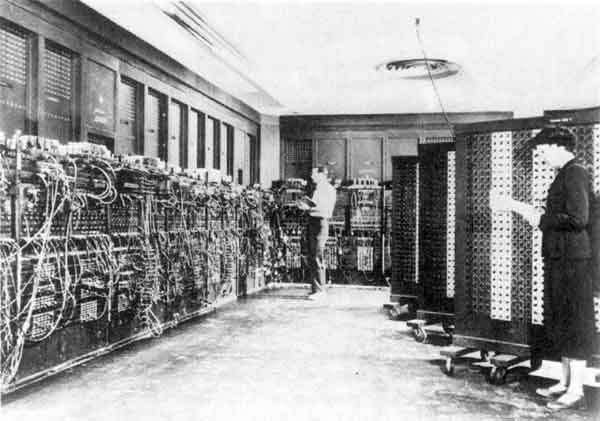
在约翰·莫克利关于建造计算机的报告被接受后,埃克特与他合作建造了电子积分器和计算机(ENIAC)。此时,1943年5月,埃克特几乎完成了他的硕士学位工作,并被任命为该项目的总工程师,具体任务是设计电子电路。必须解决的主要问题之一是,当18000个电子管相对不可靠时,一台有18000个电子管的机器如何能运行。这是埃克特必须解决的众多问题之一,他最终使每个电子管的寿命达到2500小时,从而使计算机的运行可行。
ENIAC计算机原本打算作为通用计算机,但它也是为一项非常具体的任务而设计的,即为炸弹和炮弹的弹道编制表格。ENIAC在[1]中有描述:-
ENIAC于1946年2月完成,是第一台通用电子数字计算机。它包含大约18000个真空管,高约2.5米,长24米。这台机器比其机电 predecessors 快1000多倍,每秒可执行多达5000次加法。它的操作由一个程序控制,该程序通过插板上的电线在外部设置。ENIAC是当时最复杂、最有影响力的电子计算机……
电子计算机今天是基于二进制算术的机器,但ENIAC计算机并非如此。埃克特为ENIAC设计了以10为基数的电子计算器,减少了相对于二进制机器的组件数量,但当然代价是更大的复杂性。
当然,到1946年ENIAC完成时,第二次世界大战已经结束,但这台计算机仍被密集使用,特别是用于与核武器发展相关的绝密问题。冯·诺伊曼正在从事这个项目,并参与了ENIAC计算机的工作,用它来求解偏微分方程方程组,这些方程组对洛斯阿拉莫斯的原子武器工作至关重要。
埃克特于1946年10月离开宾夕法尼亚大学摩尔学院,约翰·莫克利也是如此。他们创办了电子控制公司,并接到诺斯罗普飞机公司的订单,要求制造二进制自动计算机(BINAC)。这台机器从1950年8月开始使用,其重大进步之一是数据存储在磁带上,而不是穿孔卡片上。
电子控制公司变成了埃克特-约翰·莫克利计算机公司,并接到国家标准局的订单,要求制造通用自动计算机(UNIVAC)。这是美国第一台商业化生产的计算机,共制造了46台UNIVAC。UNIVAC引入的重大进步之一是能够同样成功地处理数字和字母信息。
埃克特和约翰·莫克利在计算机设计方面比在经营公司的经济方面更擅长。问题实际上在于这是一个如此新的领域,以至于生产成本极难估计。因此,埃克特-莫克利计算机公司很快陷入财务困难。
1950年,雷明顿兰德公司收购了埃克特-约翰·莫克利计算机公司,并将其更名为雷明顿兰德公司UNIVAC分部。埃克特留在雷明顿兰德公司,并成为该公司的高管。随着公司与伯勒斯公司合并成为Unisys,他继续留在公司。1989年,埃克特从Unisys退休,但继续担任该公司的顾问。
在1948年至1966年间,埃克特获得了85项发明的专利,几乎所有都是电子性质的。他因在计算机方面的开创性工作而获得了许多奖项。1966年,他获得了Harry M Goode纪念奖,这是计算机协会颁发的奖章和2000美元:-
由于他在参与设计和建造世界上第一台全电子计算机ENIAC以及BINAC和UNIVAC的过程中对自动计算做出的开创性贡献,以及他在电子计算系统设计方面的持续工作。
埃克特因其在计算机方面的开创性工作获得了许多奖项。他于1967年当选为美国国家工程院院士,但也许最负盛名的荣誉是在1969年被授予美国国家科学奖章。埃克特和约翰·莫克利都于1980年获得了IEEE计算机学会先驱奖。
埃克特死于与白血病相关的并发症。
J Presper Eckert Jr attended the William Penn Carter School in Germanstown. In 1937, after graduating from school, he entered the Moore School of Electrical Engineering at the University of Pennsylvania from where he graduated in 1941. Eckert, an outstanding electrical engineering student, was given a post as an instructor at the Moore School soon after his graduation.
The Moore School was by this time heavily involved with research specifically directed towards the war effort. Eckert taught a defence course at the Moore School and one of his students on the course was John Mauchly. It might seem strange that Mauchly, who was twelve years older than Eckert, should be his student. Mauchly was already an established academic teaching physics but he became involved in defence training as part of his contribution to the war effort. Eckert quickly became interested in Mauchly's ideas for the development of computers and for a while the two discussed these ideas frequently. Soon, however, Eckert moved on to undertake other military work at the School. Ashurst [2] relates how Eckert was:-
.... eventually involved with work on ultraviolet light and the development of the means to measure metal fatigue. Later, he went on to develop a method for measuring small magnetic fields to be used in detecting marine mines. He then went on to work on the electronics of radar and target locating and following equipment; these devices played a decisive part in weaponry, and their development and construction was considered to be of the very highest priority.
After Mauchly's report on the construction of a computer was accepted, Eckert collaborated with him in the construction of the Electronic Integrator and Computer (ENIAC). At this time, May 1943, Eckert had almost completed the work for his masters degree and he was appointed as chief engineer on the project with the specific task of designing the electronic circuits. One of the major problems which had to be solved was how a machine with 18000 valves could function when the valves were relatively unreliable. This was one of the many problems which Eckert had to solve and he eventually achieved a lifetime of 2500 hours for each individual valve which made the operation of the computer viable.
The ENIAC computer was intended to be a general purpose one, but it was also designed for a very specific task, namely compiling tables for the trajectories of bombs and shells. ENIAC is described in [1]:-
Completed by February 1946, the ENIAC was the first general-purpose electronic digital computer. It contained roughly 18000 vacuum tubes and measured about 2.5 metres in height and 24 metres in length. The machine was more than 1000 times faster than its electromechanical predecessors and could execute up to 5000 additions per second. Its operation was controlled by a program that was set up externally by wires on plugboards. The ENIAC was the most complex and influential electronic computer of its time ...
Electronic computers are today machines based on binary arithmetic but this was not so for the ENIAC computer. Eckert designed electronic calculators which worked to base 10 for the ENIAC, reducing the number of components over a binary machine, but of course at the price of greater complexity.
Of course by 1946 when the ENIAC was completed World War II was over but the computer was used intensively, particularly on top secret problems associated with the development of nuclear weapons. Von Neumann was working on this project and became involved with the ENIAC computer and used it to solve systems of partial differential equations which were crucial in the work on atomic weapons at Los Almos.
Eckert left the Moore School at the University of Pennsylvania in October 1946, as did Mauchly. They started up the Electronic Control Company which they received an order from Northrop Aircraft Company to build the Binary Automatic Computer (BINAC). One of the major advances of this machine, which was used from August 1950, was that data was stored on magnetic tape rather than on punched cards.
The Electronic Control Company become the Eckert-Mauchly Computer Corporation and it received an order from the National Bureau of Standards to build the Universal Automatic Computer (UNIVAC). This was the first computer to be produced commercially in the United States with 46 UNIVACs being built. One of the major advances which the UNIVAC introduced was an ability to handle both numerical and alphabetical information with equal success.
Eckert and Mauchly were better at computer design than they were at the economics of running a company. The problem really lay in the fact that this was such a new area that costs of production were extremely hard to estimate. As a consequence the Eckert-Mauchly Computer Corporation soon hit financial difficulties.
In 1950 the Remington Rand Corporation acquired the Eckert-Mauchly Computer Corporation and changed its name to the Univac Division of Remington Rand. Eckert remained with Remington Rand and became an executive of the corporation. He continued with the company as it merged with the Burroughs Corporation to become Unisys. In 1989 Eckert retired from Unisys but continued to act as a consultant for the company.
Between 1948 and 1966 Eckert took out patents on 85 inventions, almost all electronic in nature. He received many awards for his pioneering work on computers. In 1966 he received the Harry M Goode Memorial Award, a medal and $2,000 awarded by the Computer Society:-
For his pioneering contributions to automatic computing by participating in the design and construction of the ENIAC, the world's first all-electronic computer, and of the BINAC and the UNIVAC, and for his continuing work in the design of electronic computing systems.
Eckert received many awards for his pioneering work on computers. He was elected to the National Academy of Engineering in 1967 but perhaps the most prestigious honour was being awarded the US National Medal of Science in 1969. Both Eckert and Mauchly received the IEEE Computer Society Pioneer Award in 1980.
Eckert died from complications relating to leukaemia.
正文里的方括号编号指向这里,悬停即可直接看到条目。书目保留原文——译了书名反而查不到文献。
原站列出的延伸阅读与外部数据库,照原样保留,目标多为英文页面。
原站的交叉引用。指向本站已镜像专题的留在站内,其余仍指回原站。