数学家传记
哈罗德·斯科特·麦克唐纳·考克斯特的工作主要在几何学方面。特别是在多胞形理论、非欧几何、群论和组合数学方面做出了重大贡献。
考克斯特 一直被称为 考克斯特,这来自他的第三个名字 考克斯特。这需要稍作解释。他最初被取名为 考克斯特 考克斯特 考克斯特,但一位教父建议应加上他父亲的名字,于是 考克斯特 被加在了前面。另一位亲戚指出,H M S 考克斯特 让他听起来像一艘船。名字的排列组合产生了 哈罗德·斯科特·麦克唐纳·考克斯特。然而,他在官方文件上给出自己的名字时并不总是一致,见下文。
考克斯特 的父亲是 考克斯特 Samuel Coxeter(1878-1936),他是一家外科器械制造商。他曾想当医生,但家庭压力使他加入了 考克斯特 & Son,这是一家由他祖父创立的公司。他是一位知识广博的聪明人,雕刻和唱歌是他的爱好。考克斯特 的母亲是 Lucy Gee,她是会计师 William Gee 和 Charlotte Scott 的女儿,Charlotte Scott 约于1872年出生在林肯的波士顿。她是一位杰出的画家,1900年绘制的 亚伯拉罕·阿德里安·艾伯特 Gunther 肖像现藏于国家肖像馆。
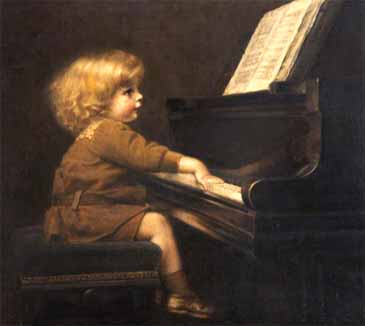
1901年人口普查显示,考克斯特 Samuel Coxeter 与他的父母 皮埃尔·萨米埃尔 和 Ada Coxeter 住在伦敦霍恩西的海格特。考克斯特 的两个姐妹,Constance 和 Ethel,也在家中,两人都是艺术家,而 Lucy Gee,也被描述为艺术家,是家中的访客。考克斯特 和 Lucy 于1903年结婚,住在肯辛顿和切尔西的荷兰公园路34号。考克斯特,他们唯一的孩子,出生于1907年2月9日,并于1907年4月7日在肯辛顿的圣巴拿巴教堂受洗。Lucy 在 考克斯特 大约两三岁时画了他弹钢琴的样子,这幅画现在在剑桥大学三一学院。
你可以在 THIS LINK 看到这幅画
遗憾的是,考克斯特 并非在一个幸福的家庭中长大,因为他的父母经历了一段艰难的婚姻。Lucy 想以艺术家为职业,但 考克斯特 想要更多孩子。紧张的关系导致 考克斯特 在皇家心理学会的会议上寻求婚姻困难的帮助,在那里他遇到了 Rosalie Gabler。(注意这是 Gabler 的正确拼写,但在其他几个来源中拼写不正确,例如在 [1] 和 [11] 中。)Rosalie 是一位德国离婚者,她与她的女儿 Katharina(约1901年出生)被称为 Katie,成为了 Coxeter 一家的朋友。考克斯特 的父母开始谈论离婚,这让年幼的男孩几乎无法忍受。
1914年第一次世界大战爆发后不久,考克斯特便与他的保姆梅·亨德森一起搬到考克斯特位于肯特-萨里边界附近的第二处住所居住,而他的父母则留在伦敦。这是为了他的安全,因为伦敦从1915年1月起开始遭到齐柏林飞艇的轰炸。对考克斯特来说,这是一段较为快乐的时光,由梅辅导他学习。1919年,他的保姆梅离开考克斯特家去结婚,他的父母决定送他去寄宿学校,以减少他因父母安排离婚而遭受的创伤。他被送到伦敦北部的哈彭登圣乔治学校,但他在那里非常不快乐。他的母亲和父亲会到学校看望他,但从未一起来过。当考克斯特告诉考克斯特,他离婚后将娶凯蒂·加布勒时,这个小男孩更加不快乐了。然而,他正在成为一名有造诣的钢琴家,并展现出惊人的想象力,发明了一个名为阿梅莱比安的想象世界,拥有自己的语言、数字系统、度量衡。考克斯特也开始对几何学着迷。他读了查尔斯·霍华德·欣顿的书The fourth dimension(1904年)和其他此类著作,并写了一篇学校论文Dimensional Analogy。他在其中写道[1]:-
在我们所知的空间中,只能想象三条相互垂直的线。第四条线,垂直于所有其他三条线,对我们来说将是完全不可见和不可想象的。我们自己,以及我们周围的所有物质事物,可能拥有一个第四维度,而我们对此完全不知道。……但第四维度中的这个厚度,如果存在的话,必定极其微小。……如果第四维度和更高维度存在,我们可以通过一种我称之为维度类比的过程,发现一些关于它们条件的信息,而不必确定它们存在。
Dimensional Analogy为考克斯特赢得了一个学校论文奖,他填满了五个笔记本,记录了进一步的想法、图表和计算。
考克斯特 于1922年与 Katie,即 Katharina T K Gabler 结婚。他43岁,她21岁;他们有三个孩子(考克斯特 的同父异母姐妹)Joan Melody 考克斯特(生于1923年)、Nesta Pamela 考克斯特(生于1927年)和 Eve C 考克斯特(生于1928年)。考克斯特 在伦敦的几次拒服兵役者会议上见过 伯特兰·罗素,他向 伯特兰·罗素 请教关于他儿子 考克斯特 的建议,因为儿子展现出非凡的数学才能。Russell 建议 考克斯特 写信给 Eric Harold Neville,他于1923年9月11日这样做了。Neville 的回信促成了在 St George's School, Harpenden 安排的一次会面。当 Neville 问 考克斯特 在学校学了什么数学时,他发现他所接受的数学教学非常糟糕。他建议 考克斯特 离开学校,在开始剑桥的学习之前接受数学私人辅导。
找到了一位合适的导师 Alan Robson,Marlborough College 的数学主任,于是 考克斯特 离开了 St George's School, Harpenden,在 Marlborough 租了一个房间,骑自行车去学院接受辅导。由于他所经历的糟糕教学,他到达时在 Robson 的所有学生中排名垫底,但两年后的1925年,他排名第一。他于1925年参加了剑桥大学入学考试,并获得了国王学院的录取名额。Robson 建议他再等一年,再试一次,希望他能被三一学院录取。他这样做了,并于1926年在剑桥大学三一学院注册入学。
考克斯特 被指派 利特尔伍德 作为他在三一学院的学业导师,导师建议他学习解析几何、射影几何、微分几何、拓扑学、group theory 和数论的纯数学课程。他还学习了一些数学物理课程,如电学、天体力学和相对论。他于1928年获得学士学位,成为高级 数学荣誉学位考试一等及格者(Wrangler)。在剑桥期间,他出现了胃病并成为素食者;他余生一直保持素食。
在这个阶段,考克斯特 很害羞,很少社交。他没有交过女朋友,他的父亲开始担心,他的离婚以及娶了一个比他儿子大不了多少的女孩,产生了心理后果。现在我们在上面注意到,考克斯特 在皇家心理学会的会议上遇到了 Rosalie Gabler。现在这些会议上有 Wilhelm Stekel,一位奥地利心理学家,他的一些书已被 Rosalie Gabler 翻译成英文,例如 Conditions of nervous anxiety and their treatment(1923)。考克斯特 在1928年的三个夏季月份在维也纳度过,在那里他受到 Stekel 的询问,并被要求记录他的梦境日记。这种精神分析是否对 考克斯特 有任何好处(或伤害)值得怀疑,但在维也纳期间,他花时间在维也纳大学数学图书馆的阅览室里,并在那里发现了 路德维希·施莱夫利 的著作。这些给 考克斯特 留下了深刻印象,他将 路德维希·施莱夫利 的一些思想带入了即将进行的研究中。
获得研究奖学金后,他继续在剑桥大学跟随亨利·弗雷德里克·贝克攻读博士学位,并于1931年因他的学位论文Some contributions to the theory of regular polytopes而获得该学位。他在引言中写道:-
尽管从实用角度看,没有必要考虑超过五维的正斜多边形,但数学家作为人的弱点迫使他考察一般情形,尽管所涉及的三角学极其复杂。……这部分工作唯一的理由只能是其内在的美。
在攻读博士学位期间,他当然深受亨利·弗雷德里克·贝克的影响,后者创办了周六下午讨论班或“茶会”,它成为几何活动的中心。另外两人对他作为数学家的成长也特别有影响,即艾丽西亚·布尔·斯托特和戈弗雷·哈罗德·哈代。
考克斯特随后成为会士,继续在剑桥进行研究。在此期间,他作为研究访问者在普林斯顿大学工作两年,师从奥斯瓦尔德·维布伦。这件事的起因是所罗门·莱夫谢茨于1931年访问剑桥,并鼓励考克斯特申请洛克菲勒研究奖学金。他提出申请,被接受,但随后担心会失去一年的剑桥会士资格。他向三一学院院务委员会请求将会士资格延长一年,以补偿在普林斯顿的一年,请求获得批准。1932年8月,他没有去维也纳度家庭假期,而是乘船前往纽约,在那里待了一段时间后再前往普林斯顿。他乘坐丘纳德公司的Aquitania号船,于8月20日离开南安普顿,8月26日抵达。有趣的是,他登记的名字是考克斯特,但最常使用的是考克斯特。
他喜欢在纽约观光,但主要事件是日全食,他在新罕布什尔州观看。一到普林斯顿,他就住在研究生院,并参加奥斯瓦尔德·维布伦、冯·诺伊曼、尤金·维格纳和乔治·波利亚等人的讲座。在普林斯顿期间,他收到G de B Robinson的邀请,前往多伦多作讲座。他就自己最喜欢的话题多胞形作了两次讲座。他的父亲考克斯特于1933年6月乘American Banker号船前往纽约,在儿子返回英格兰之前与他共度时光。
回到剑桥后,考克斯特意识到,尽管剑桥提供了种种机会,他刚刚在普林斯顿度过了人生中最好的一年。受到鼓励后,他申请普洛克特奖学金,以资助1934—35年在普林斯顿的一年,很快又回到美国。他乘坐Majestic号船从法国瑟堡前往纽约,于1934年9月4日抵达。在普林斯顿,他参加了赫尔曼·外尔开设的“连续群的结构与表示”课程。他们很快意识到,考克斯特的有限群与赫尔曼·外尔的无限群之间存在惊人的联系。赫尔曼·外尔让考克斯特记录讨论班内容,并作为系列的一部分,就自己的工作作五次报告。考克斯特很高兴看到自己的工作作为附录出现在赫尔曼·外尔出版的笔记中。
当时并不是寻找永久职位的好时机,因此当佛蒙特州一所寄宿学校向他提供教职时,考克斯特非常想接受。在普林斯顿期间,戈弗雷·哈罗德·哈代曾推荐他编辑Rouse Ball的Mathematical Recreations新版,他认为这为他从事学校教学做好了准备。许多人,特别是奥斯瓦尔德·维布伦,强烈建议他不要离开研究去教书。三一学院院务委员会拒绝了他再延长一年会士资格的请求,因此他非常不情愿地拒绝了学校职位的聘约。回到三一学院后,他被任命为那里的讲师,但不久之后,他收到多伦多大学助理讲师职位的聘约。
由于他认为在英国工作比在加拿大工作更好,他拒绝了多伦多,并申请了因亨利·弗雷德里克·贝克退休而空缺的朗迪恩天文学与几何学讲席。决定有利于威廉·瓦兰斯·道格拉斯·霍奇,考克斯特开始担心自己的未来。在与父亲、亨利·弗雷德里克·贝克、戈弗雷·哈罗德·哈代和利特尔伍德商议后,他决定联系多伦多,询问能否推翻自己最近的拒绝,接受他们的聘约。多伦多很高兴他接受。
1936年3月,他遇到了Hendrina Johanna Brouwer(1910-1999),她是办公室职员Leonards Gerrit 勒伊岑·布劳威尔(1873-1923)和Barbara 't Hoen(1876-1934)的女儿,她刚到达英格兰做互惠生。Hendrina,人称Rien,1910年9月18日出生于荷兰弗拉尔丁恩。考克斯特在5月向她求婚,他们将婚礼日期定在9月1日,仅在他们启航前往加拿大的前两天。8月15日,他收到了可怕的消息,他的父亲在度假时去世了。觉得有众多受邀宾客在场他们无法举行幸福的婚礼,他们在原定日期之前的8月20日在剑桥的圣墓教堂,又称圆教堂,私下结婚。9月3日,这对新婚夫妇从南安普顿乘坐加拿大太平洋公司的Duchess of Richmond号船启航,前往加拿大蒙特利尔。考克斯特和Rien 考克斯特有两个孩子:Edgar H 考克斯特(约1939年出生)和Susan J 考克斯特(约1941年出生)。
考克斯特接受了多伦多大学的任命,他在该校任教直至去世。他于1936-43年任数学助理教授,1943-48年任副教授,1948-80年任教授。1996年,系里举行了一场庆祝活动,以庆祝他在多伦多大学60年。
考克斯特的工作主要在几何学。特别是他在多胞形理论、非欧几里得几何、群论和组合数学中做出了重大贡献。考克斯特多胞形是离散反射群的基本区域,现在称为考克斯特群,它们产生密铺。1934年,考克斯特分类了所有球面和欧几里得考克斯特群。他的工作动力来自数学之美。Robert Moody在提议授予考克斯特多伦多约克大学荣誉学位时说:-
现代科学常常受时尚和潮流驱动,数学也不例外。我要说,考克斯特的风格特别不合时尚。我认为,他几乎完全受一种深刻的美感所引导。
约克大学并不是唯一授予考克斯特荣誉的大学。他获得了九个荣誉博士学位,并于1950年当选为伦敦皇家学会会士,1997年被授予其詹姆斯·约瑟夫·西尔维斯特奖章,并于1948年当选为加拿大皇家学会会士。
1980年采访[9]中,他对关于几何学最重要的未解决问题这一问题的回答,给出了他兴趣的一个有趣例子:-
有一个铺砌问题:把一个凸多边形拿来重复,得到与它全等的复制品,这些复制品拼合起来填满并覆盖平面,有哪些可能的方式?就连五边形的铺砌,本来以为已经解决了,其实仍然没有解决。没有人完全知道,一个五边形有哪些可能的形状,能够通过全等变换重复而覆盖平面。人们似乎不断想出新的形状。多丽丝·沙特施奈德女士刚刚写了一篇很好的文章,赞扬对这个问题的解决做出贡献的业余爱好者。
然后你可以在空间中做同样的事:想一个凸多面体;你能重复它来填满并覆盖整个三维空间吗?当然,有一些小地方必须小心。在平面情形中,你要求两块砖相遇时,它们相遇的地方要么是一个顶点,要么是两者的一条完整的边,而不是像墙上的砖那样错开。我认为有趣的情形是一条边恰好是两点之间的边,而且它是两块砖的边。
他最著名的几何著作包括The real projective plane(1955)、Introduction to geometry (1961)、Regular polytopes(1963)、Non-euclidean geometry(1965),以及与S L Greitzer合著的Geometry revisited(1967)。他还出版了一部关于群的表现的著名著作,那是与他的第一位博士生W O J Moser合著的Generators and relations for discrete groups。
关于考克斯特的书籍的更多信息以及序言摘录,请参见THIS LINK。
关于考克斯特著作的更多信息及《评论》摘录,见THIS LINK。
他的12本书和167篇已发表文章涵盖的远不止数学研究。考克斯特于1954年结识莫里茨·科内利斯·埃舍尔,两人成为终身挚友。另一位朋友巴克敏斯特·福乐在其建筑设计中运用了考克斯特的思想。1938年,考克斯特修订并更新了Rouse Ball的Mathematical recreations and essays,该书由Rouse Ball于1892年首次出版。
考克斯特有许多艺术天赋,尤其是在音乐方面。事实上,在他成为数学家之前,他想成为一名作曲家。然而他对对称的兴趣把他引向数学,并使他进入了一个他终生热爱的职业。考克斯特写道:
我极其幸运,因为我做我本来无论如何都会做的事,还能得到报酬。
他把自己的长寿归功于素食主义、有规律的锻炼——他89岁时每天做50个俯卧撑——以及也许最重要的,正如他自己所说:
我从不感到无聊。
请允许我[EFR]加一段个人回忆:-
1976年,我和一位同事在多伦多拜访了考克斯特,我将永远记得他那摆满数学模型的书房。我记得考克斯特和他的荷兰妻子Rien极为友善、热情好客。当我说我以前从未吃过南瓜派时,考克斯特消失在厨房里,然后踉踉跄跄地抱回一个巨大的南瓜,他那瘦弱的身形看上去几乎搬不动它。
他教我如何写数学论文。他在构建论文方面是个工匠,会数符号以确保公式不会跨行断开。
当考克斯特在圣安德鲁斯拜访我和一位同事时,我们带他沿着港口码头散步。令我们十分忐忑的是,他执意要爬上码头尽头一架不牢靠的生锈梯子。他肯定不像看上去那么瘦弱!
1997年,考克斯特被授予加拿大勋章同伴级。这是加拿大三级荣誉中的最高一级。授奖词写道:-
通过他的研究,他推动了几何学在数学、科学、艺术、音乐、建筑和晶体学中的应用,为几何学研究作出了巨大贡献。……[他]半个多世纪以来影响了一代又一代教师和学生。
Rien患上了阿尔茨海默病,但考克斯特在妻子日益艰难的时期照料着她。直到她摔倒并摔断了髋部,她才搬进护理院度过最后几个月。她于1999年去世,在女儿Susan的帮助和陪伴下,考克斯特重新开始了参加会议的行程。在多年身体健康之后,他的健康最终开始衰退。他努力坚持参加会议和撰写论文。他对自己一生为健康做了一切“正确的事”却健康衰退感到愤怒。
让我们以引用Erich Ellers在[5]中的回忆作为结束:-
考克斯特是多伦多大学几何讨论班中最热忱、最重要、最受尊敬的成员。讨论班过去每周二聚会。考克斯特从未错过一次讨论班,也从未错过一次就他正在进行的研究发表演讲的机会。他学识渊博,喜欢提出引人入胜的几何问题,这些问题对大多数人来说似乎是新的,但他通常知道答案。
考克斯特 是素食者,他积极参与保护环境,并倡导和平。他的妻子 Rien 三年前去世。此后,他的女儿 Susan Thomas 一直照顾他。他还有一个儿子 Edgar,以及几个孙辈和曾孙辈。
一个人的受欢迎程度或许可以通过关于他的轶事数量来衡量。媒体上充满了关于 考克斯特 的轶事。这里有一个典型且非常迷人的例子:当他的研究生 Asia Ivic Weiss(现在在约克大学任教)告诉他,由于即将分娩,她将无法参加他们每周的例会时,他给了她一份 50 页的论文预印本。“他说,如果我在产房里无事可做,可以看看这个。”
Donald Coxeter was always known as Donald which came from his third name MacDonald. This needs a little explanation. He was first given the name MacDonald Scott Coxeter, but a godparent suggested that his father's name should be added, so Harold was added at the front. Another relative noted that H M S Coxeter made him sound like a ship. A permutation of the names resulted in Harold Scott MacDonald Coxeter. He was not always consistent in giving his name on official documents, however, see below.
Donald Coxeter's father was Harold Samuel Coxeter (1878-1936) who was a manufacturer of surgical instruments. He had wanted to be a doctor but family pressure saw him join Coxeter & Son, a company founded by his grandfather. An intelligent man with a broad general knowledge, he sculpted and sang as a hobby. Donald's mother was Lucy Gee, the daughter of the accountant William Gee and Charlotte Scott, who was born in Boston, Lincoln, about 1872. She was a painter of distinction with the portrait of Albert Gunther painted in 1900 being in the National Portrait Gallery.
The 1901 Census has Harold Samuel Coxeter living with his parents Samuel and Ada Coxeter in Highgate, Hornsey, London. Two of Harold's sisters, Constance and Ethel are in the house, both being artists, and Lucy Gee, also described as an artist, is a visitor in the house. Donald and Lucy married in 1903 and lived at 34 Holland Park Road in Kensington and Chelsea. Donald, their only child, was born on 9 February 1907 and was baptised at St Barnabas Church in Kensington on 7 April 1907. Lucy painted Donald playing the piano when he was about 2 or 3 years old and the painting is now in Trinity College, Cambridge.
You can see the painting at THIS LINK
Sadly, Donald was not brought up in a happy home since his parents experienced a difficult marriage. Lucy wanted a career as an artist but Harold wanted further children. Strained relations led Harold to seek help with the marital difficulties at meetings of the Royal Psychological Society where he met Rosalie Gabler. (Note that this is the correct spelling of Gabler but the spelling is incorrect in several other sources, for example in [1] and [11].) Rosalie was a German divorcée who, along with her daughter Katharina (born around 1901) known as Katie, became friends of the Coxeters. Donald's parents began to talk about a divorce which the young boy found almost unbearable.
Soon after the start of World War I in 1914 Donald went with his nanny May Henderson to live in the Coxeter's second home near the Kent-Surrey border while his parents remained in London. This was for his safety since London began to be hit by Zeppelin bombing raids in January 1915. This was a happier time for Donald who was tutored by May. When his nanny May left the Coxeters' employment to get married in 1919, his parents decided to send him to boarding school to reduce the trauma he was suffering with his parents arranging their divorce. He was sent to St George's School, Harpenden, north of London, but he was very unhappy there. His mother and father would visit him at the school but never together. When Harold told Donald that after he was divorced he would marry Katie Gabler, the young boy was even more unhappy. He was becoming an accomplished pianist, however, and showing an amazing imagination inventing an imaginary world called Amellaibian with its own language, number system, weights and measures. Donald was also becoming fascinated by geometry. He read the Charles Howard Hinton's book The fourth dimension (1904) and other such works, and wrote a school essay Dimensional Analogy. In it he writes [1]:-
In space as we know it only three lines can be imagined perpendicular to each other. A fourth line, perpendicular to all the other three would be quite invisible and unimaginable to us. We ourselves, and all the material things around us probably possesses a fourth dimension, of which we are quite unaware. ... But this thickness in the fourth dimension must be exceedingly minute, if it exists at all. ... we can find out something about the conditions of the fourth and higher dimensions if they exist, without being certain they exist, by a process which I have termed Dimensional Analogy.
Dimensional Analogy won a school essay prize for Donald and he filled five notebooks with further ideas, diagrams and calculations.
Harold Coxeter married Katie, Katharina T K Gabler, in 1922. He was 43 years old and she was 21; they had three children (Donald's half-sisters) Joan Melody Coxeter (born 1923), Nesta Pamela Coxeter (born 1927) and Eve C Coxeter (born 1928). Harold had met Bertrand Russell at several conscientious objector meetings in London and he asked Russell for advice about his son Donald who was showing remarkable mathematical talent. Russell suggested that Donald write to Eric Harold Neville which he did on 11 September 1923. A reply from Neville led to a meeting being set up at St George's School, Harpenden. When Neville asked Donald what mathematics he was being taught at school he saw that the mathematics teaching he was receiving was very poor. He advised that Donald leave school and receive private tutoring in mathematics before beginning studies at Cambridge.
A suitable tutor was found in Alan Robson, head of mathematics at Marlborough College, so Coxeter left St George's School, Harpenden, rented a room in Marlborough and cycled to the College for tutoring. Because of the poor teaching he had experienced, he was ranked bottom of all Robson's pupils when he arrived but two years later in 1925 he was ranked top. He sat the Cambridge University entrance examinations in 1925 and was offered a place in King's College. Robson advised him to wait another year and try again in the hope that he would be offered Trinity College. This he did and matriculated at Trinity College, Cambridge in 1926.
Coxeter was assigned J E Littlewood as his director of studies at Trinity College who advised him to take pure mathematics courses on analytic geometry, projective geometry, differential geometry, topology, group theory, and number theory. He also took some mathematical physics courses such as electricity, celestial mechanics, and relativity. He received his B.A. in 1928 as Senior Wrangler. During his time at Cambridge he had stomach problems and became a vegetarian; he remained a vegetarian for the rest of his life.
At this stage Coxeter was shy having little social interaction. He had not had a girlfriend and his father began to worry that his divorce and marriage to a girl not much older than his son had had psychological consequences. Now we noted above that Harold Coxeter had met Rosalie Gabler at meetings of the Royal Psychological Society. Now at these meetings was Wilhelm Stekel, an Austrian psychologist some of whose books had been translated into English by Rosalie Gabler, for example Conditions of nervous anxiety and their treatment (1923). Coxeter spent the three summer months of 1928 in Vienna where he was questioned by Stekel and asked to keep a diary of his dreams. It is doubtful if the psychoanalysis did Coxeter any good (or harm) but while in Vienna he spent time in the reading room of the University of Vienna's mathematics library and there discovered the works of Ludwig Schläfli. These made a big impression on Coxeter who carried some of Schläfli's ideas into the research he was about to undertake.
Awarded a research scholarship, he continued to study for a doctorate at Cambridge under H F Baker, and this was awarded in 1931 for his thesis Some contributions to the theory of regular polytopes. He wrote in the Introduction:-
Although it is unnecessary, from a practical point of view, to consider regular skew polygons of more than five dimensions, the human weakness of a mathematician compels him to examine the general case, although the trigonometry involved is extraordinarily complicated. ... The only excuse for this part of the work must be its intrinsic beauty.
While studying for his Ph.D. he was, of course, extremely influenced by Henry Baker who founded the Saturday afternoon seminar or 'tea party' which became the focus of activity in geometry. Two others were also particularly influential in his development as a mathematician, Alicia Boole Stott and G H Hardy.
Coxeter then became a Fellow continuing his researches at Cambridge. During this period he spent two years as a research visitor at Princeton University working under Oswald Veblen. This came about because Solomon Lefschetz visited Cambridge in 1931 and encouraged Coxeter to apply for a Rockefeller research fellowship. He applied, was accepted, but then worried he would lose a year of the Cambridge fellowship. His request to the council of Trinity College to have the fellowship extended by a year to compensate for a year in Princeton was accepted. Rather than going to Vienna for a family holiday in August 1932, he sailed to New York to spend time there before going on to Princeton. He sailed on the Cunard ship Aquitania, leaving Southampton on 20 August, arriving 26 August. Interestingly, he gave his name as Macdonald Coxeter but most often he gave Harold Coxeter.
He enjoyed sightseeing in New York but the main event was a total eclipse of the sun which he watched from New Hampshire. Once in Princeton he lived in Graduate College and attended lectures by Veblen, von Neumann, Wigner and Pólya among others. While at Princeton he received an invitation from G de B Robinson to give a lecture at Toronto. He gave a couple of lectures on his favourite topic of polytopes. His father Harold sailed to New York on the ship American Banker in June 1933 to spend time with his son before he returned to England.
Returning to Cambridge, Coxeter realised that despite the opportunities that Cambridge offered, he had just spent the best year of his life at Princeton. Encouraged to apply for a Procter Fellowship to fund the year 1934-35 at Princeton he was soon back in the United States. He sailed from Cherbourg, France, to New York on the Majestic, arriving on 4 September 1934. At Princeton he attended the course "The structure and representation of continuous groups" given by Hermann Weyl. They quickly realised that there were surprising connections between Coxeter's finite groups and Weyl's infinite groups. Weyl had Coxeter take notes of the seminars as well as delivering five on his own work as part of the series. Coxeter was delighted to have his work appear as an Appendix to Weyl's published notes.
This was not an easy time to be looking for a permanent post, so when he was offered a teaching post in a boarding school in Vermont, Coxeter was very tempted to accept. While at Princeton G H Hardy had recommended him to edit a new edition of Rouse Ball's Mathematical Recreations which he thought set him up well for school teaching. Various people, particularly Veblen, strongly advised him not leave research for teaching. The Trinity College council refused his request to extend his fellowship for another year so he, very reluctantly, refused the offer of the school position. After he returned to Trinity College he was appointed as a lecturer there, but soon after that he received an offer of an assistant lectureship at the University of Toronto.
Since he thought a job in Britain was preferable to one in Canada, he refused Toronto and applied for the Lowndean Chair of Astronomy and Geometry which became vacant on Henry Baker's retiral. The decision went in favour of William Hodge and Coxeter began to worry about his future. After discussions with his father, with Baker, with Hardy and with Littlewood, he decided to contact Toronto and ask if he could reverse his recent refusal, and accept their offer. Toronto were pleased to have him accept.
In March 1936 he met Hendrina Johanna Brouwer (1910-1999), the daughter of the office clerk Leonards Gerrit Brouwer (1873-1923) and Barbara 't Hoen (1876-1934), who had just arrived England to work as an au pair. Hendrina, known as Rien, was born in Vlaardingen, Holland, on 18 September 1910. Coxeter asked her to marry him in May and they set their wedding date for 1 September, only two days before they would sail to Canada. On 15 August he received the terrible news that his father had died while on holiday. Feeling they could not have a happy wedding with the many invited guests, they married in private before the intended date on 20 August at the Holy Sepulchre Church, Cambridge, known as the Round Church. On 3 September the newly married couple set sail from Southampton on the Canadian Pacific ship the Duchess of Richmond, bound for Montreal, Canada. Donald and Rien Coxeter had two children: Edgar H Coxeter (born about 1939) and Susan J Coxeter (born about 1941).
Coxeter took up an appointment at the University of Toronto where he remained on the faculty until his death. He was an Assistant Professor of Mathematics 1936-43, Associate Professor 1943-48, and Professor 1948-80. A celebration was held in the department in 1996 to celebrate his 60 years at the University of Toronto.
Coxeter's work was mainly in geometry. In particular he made contributions of major importance in the theory of polytopes, non-euclidean geometry, group theory and combinatorics. Coxeter polytopes are the fundamental domains of discrete reflection groups, now called Coxeter groups, and they give rise to tesselations. In 1934 Coxeter classified all spherical and euclidean Coxeter groups. His work was motivated by the beauty of mathematics. Robert Moody, proposing Coxeter for an honorary degree from York University in Toronto, said:-
Modern science is often driven by fads and fashions, and mathematics is no exception. Coxeter's style, I would say, is singularly unfashionable. He is guided, I think, almost completely by a profound sense of what is beautiful.
York was not the only university to honour Coxeter. He received nine honorary doctorates and was elected a Fellow of the Royal Society of London (1950), awarded its Sylvester Medal in 1997, and elected a Fellow of the Royal Society of Canada (1948).
An interesting example of his interests is given in his reply in the 1980 interview [9] to the question about the most significant unsolved problems of geometry:-
There is the tiling problem: What are the possible ways in which you can take a convex polygon and repeat it so as to get congruent replicas of it which when fitted together fill and cover the plane? Even tiling with pentagons, which was supposed to be solved, still isn't. Nobody knows quite what are all the possible shapes of pentagon that can be repeated by congruent transformations to cover the plane. People seem to keep on thinking of new ones. Mrs Doris Schattschneider has just written a very nice essay in praise of amateurs who have contributed to this problem.
And then you can have the same thing in space: Think of a convex polyhedron; can you repeat it to fill and cover the whole three-dimensional space? Of course, there are little things of which one has to be careful. You insist in the planar case that where two tiles meet they have either a vertex or a complete edge of both as their only place of meeting, rather than being staggered, like bricks on a wall. I think the interesting cases are where an edge is just the edge between two points, and it's an edge of both the tiles.
Among his most famous geometry books are The real projective plane (1955), Introduction to geometry (1961), Regular polytopes (1963), Non-euclidean geometry (1965) and, written jointly with S L Greitzer, Geometry revisited (1967). He also published a famous work on group presentations, which was written jointly with his first doctoral student W O J Moser, Generators and relations for discrete groups.
For more information about Coxeter's books with extracts from Prefaces, see THIS LINK.
For more information about Coxeter's books with extracts from Reviews, see THIS LINK.
His 12 books and 167 published articles cover more than mathematical research. Coxeter met Escher in 1954 and the two became lifelong friends. Another friend, R Buckminister Fuller, used Coxeter's ideas in his architecture. In 1938 Coxeter revised and updated Rouse Ball's Mathematical recreations and essays, a book which Rouse Ball first published in 1892.
Coxeter had many artistic gifts, particularly in music. In fact before he became a mathematician he wanted to become a composer. However his interest in symmetry took him towards mathematics and into a career which he loved throughout has life. Coxeter wrote:-
I am extremely fortunate for being paid for what I would have done anyway.
He attributed his long life to vegetarianism, a regular regime of exercise that saw him do 50 push-ups a day at the age of 89, and, perhaps most importantly, as he related himself:-
I am never bored.
Allow me [EFR] a personal note:-
A colleague and I visited Donald in Toronto in 1976 and I will always remember his office full of mathematical models. I remember the extreme kindness and wonderful hospitality of Donald and his Dutch wife Rien. When I said I had never had pumpkin pie before, Donald vanished into the kitchen and staggered back with a huge pumpkin which his frail figure hardly looked able to carry.
He taught me how to write a mathematics paper. He was a craftsman at constructing a paper, counting the symbols to make sure that formulas did not break across a line.
When Donald visited me and a colleague in St Andrews we took him a walk down the pier at the harbour. He insisted, much to our trepidation, on climbing an insecure rusty ladder at the end of the pier. He was certainly not as frail as he looked!
In 1997 Coxeter was made a Companion of the Order of Canada. This is the highest of the three levels of honours that Canada makes. The citation states:-
Through his research, he has made a monumental contribution to the study of geometry by furthering its applications in mathematics, science, art, music, architecture, and crystallography. ... [He] has influenced generations of teachers and students for more than half a century.
Rien developed Alzheimer's but Coxeter nursed his wife through the increasingly difficult time. Only after she fell and broke her hip did she move into a care home for her final months. She died in 1999 and with the help and companionship of his daughter Susan, Coxeter renewed his trips to conferences. After years of excellent health, eventually his health began to fail. He struggled to keep attending conferences and writing papers. He was angry to have declining health when he had spent his life doing all the "right things" for his health.
Let us end by quoting Erich Ellers' reminiscences from [5]:-
Donald was the most ardent, the most important, and the most revered member of the Geometry Seminar at the University of Toronto. It used to meet every Tuesday. Donald never missed a seminar and never missed an opportunity to deliver a talk on his ongoing research. He had a wealth of knowledge and liked to bring up tantalizing geometrical questions that seemed new to most people but to which he usually knew the answers.
Coxeter was a vegetarian, he was active in saving the environment, and he promoted peace. His wife, Rien, died three years ago. Since then his daughter, Susan Thomas, has looked after him. He also has a son, Edgar, and several grandchildren and great-grandchildren.
The popularity of a person can perhaps be gauged by the number of anecdotes about him. The press is full of anecdotes on Donald. Here is a typical and very charming one: When his graduate student Asia Ivic Weiss, who is now teaching at York University, told him that she would not be able to come to their regular weekly meetings because she was about to give birth, he gave her a 50-page preprint of a paper. "He said that it was something for me to look through if I had nothing else to do in the labour room."
正文里的方括号编号指向这里,悬停即可直接看到条目。书目保留原文——译了书名反而查不到文献。
原站列出的延伸阅读与外部数据库,照原样保留,目标多为英文页面。
关于哈罗德·斯科特·麦克唐纳·考克斯特的其它页面:
原站的交叉引用。指向本站已镜像专题的留在站内,其余仍指回原站。