数学家传记
让-弗朗索瓦·商博良创立了科学埃及学,并在解读埃及象形文字和世俗体文字方面发挥了重要作用。
让-弗朗索瓦·商博良是书商Jacques Joseph Champollion(1744-1821)和他的妻子Jeanne Françoise Gallieu(1744-1805)的儿子。Jacques Joseph于1773年1月28日在菲雅克与Jeanne Françoise结婚。他们有七个孩子:Guillaume Champollion(1773-1773);Thérèse 商博良(生于1774年);Pétronille 商博良(生于1776年);Jacques-Joseph 商博良-Figeac(1778-1867);Jean-Baptiste Champollion(生于1780年);Marie Jeanne 商博良(生于1782年);以及商博良(1790-1832),即本传记的主人公。Jacques Joseph Champollion出生于La-Roche-des-Engelas,即今天的法国罗讷-阿尔卑斯大区瓦尔博奈。在1770年搬到菲雅克之前,他是一名流动书商,1772年他在狭窄的Boudousquerie街买了一座房子,1779年在Basse广场买了一家俯瞰集市的书店[42]:-
与他同时代的人有强烈的暗示,Jacques喜欢放荡不羁的生活,而且他晚年无疑嗜酒,这毁掉了他的售书生意,也毒化了他与孩子们的关系。
让我们在这本传记的一开始就说明,商博良不是数学家,几乎没有受过数学训练。我们把他收入本档案,部分是因为他解决象形文字问题的方法类似于数学家解决问题的方法,部分是因为一些数学家研究过同样的问题,部分是因为他在理解象形文字方面的工作最终使其他人更多地了解了古埃及人的数学技能。
商博良是他父母孩子中最小的一个,比倒数第二小的孩子晚出生八年。一些传记作者,例如Alain Faure、Jean Lacouture和Andrew Robinson,认为他不是Jeanne Françoise的孩子,而是他父亲Jacques Joseph的私生子。提出这一说法的理由包括Jeanne Françoise在1790年的年龄、商博良在他写的众多信件中从未提到他的母亲,但确实提到了Figeac一位他珍爱的女性、商博良与他的兄弟姐妹之间性情上的显著差异,以及商博良肤色如此之深,以至于在埃及可以被当作阿拉伯人。
家境贫寒,商博良似乎是由比他大十二岁的哥哥Jacques-Joseph 商博良-Figeac抚养长大的。我们应当解释为什么他的哥哥被称为商博良-Figeac。随着兄弟俩长大,商博良被称为“商博良 le Jeune”,但最终他变得更为著名,在这个阶段他的哥哥开始自称商博良-Figeac。商博良的母亲Jeanne Françoise是文盲,因此无法教她的儿子读写。然而,她是一位非常虔诚的罗马天主教徒,记住了弥撒的大部分内容。当他大约五岁时,她教商博良凭记忆背诵这些内容,此后他似乎能够通过将他背下来的内容与祈祷书中的印刷文本进行比较,自学阅读。我们注意到,这段经历在他后来试图破译象形文字时可能起到了积极作用。当Jacques-Joseph意识到他的弟弟是如何自学阅读时,他深受触动,并从1797年春天开始,给这个年幼的男孩进一步指导读写。
1798年,雅克-约瑟夫离开菲雅克前往格勒诺布尔,在一家出口公司工作。由于没有哥哥的辅导,让-弗朗索瓦被送进了小学。他表现不佳,讨厌心算,很快就放弃了学业。随后,他由雅克-约瑟夫以前的老师辅导,这位老师教他希腊语和拉丁语。
到十岁时,商博良不仅掌握了法语,还能阅读希腊语和拉丁语,并背诵荷马和维吉尔的段落[42]:-
他的亲戚回忆说,冬夜围坐在家里的壁炉旁时,他们喜欢看这个家中最小的儿子用他自己的法语翻译表演这些经典作品中的戏剧场景。有时他们的朋友会溜进房间,好奇地注视着这闻所未闻的景象:男孩坐在炉边的小凳上(商博良无论是小时候还是成年后,总是喜欢身体上的温暖),眼睛闪闪发光,为家人生动地再现他学会阅读的古老故事。
然而,商博良的家庭教师对他的进步感到担忧,写信给在格勒诺布尔的Jacques-Joseph说,他的弟弟对学习很冷漠,有时很热心,有时又完全拒绝学习。商博良也写信给哥哥解释自己学习上的困难,1801年2月,Jacques-Joseph让商博良到格勒诺布尔与他同住。他似乎独自乘坐驿马车旅行,于3月27日抵达格勒诺布尔,在那里与哥哥同住在Grande Rue的一套两室公寓里。现在由他的哥哥和哥哥雇请的一位私人教师教他。1802年11月,他进入由Abbé Dussert开办的一所优秀的走读学校。他在这所学校表现良好,并学习了希伯来语。到1803年第一年学习结束时,他收到了极好的成绩报告,此时还开始学习阿拉伯语、叙利亚语和迦勒底语。1804年,十三岁的商博良写了他的第一篇论文Remarks on the fable of the Giants as taken from Hebrew etymologies。
杜塞尔神父的学校很优秀,商博良在那里茁壮成长,但他的哥哥负担不起学费。商博良参加了格勒诺布尔中学的入学考试,被录取并获得了一笔助学金以支付寄宿费用。在回菲雅克探亲后,1804年11月,他成为格勒诺布尔中学的寄宿生。这并不太成功,因为商博良讨厌其极其严格的制度。他确实积极参加学校活动,但健康状况恶化,部分原因是他在夜间进行私人学习,而这在严格的学校日程中是不允许的。在学校的第二年,商博良的生活变得稍好一些。他的哥哥是约瑟夫·傅里叶的朋友,后者当时是格勒诺布尔的省长。约瑟夫·傅里叶于1798年作为科学顾问加入了拿破仑入侵埃及的军队。他曾帮助建立开罗研究院,是数学部十二名成员之一;他帮助在埃及建立教育设施,并进行考古探索。他与商博良的哥哥一样热爱埃及,并正在撰写Description of Egypt。约瑟夫·傅里叶有兴趣听说这位才华横溢的学生商博良,学校不允许他有时间进行私人学习。他与朋友让-巴蒂斯特·毕奥交谈,后者会见了这位年轻学生,并着手让学校允许他进行独立学习。
里塞当然认可商博良的才能,1806年8月,他被选中在省长约瑟夫·傅里叶视察学校时发表演讲。商博良谈论了《圣经》的希伯来文本,并回答了关于东方语言的问题。在报告中,约瑟夫·傅里叶指出,他对商博良广博的知识(包括生物学方面的技能)印象深刻。商博良继续独立研究,向他的哥哥索要了许多文本。约瑟夫·傅里叶与商博良的交往更加密切,他得以鼓励后者对埃及的浓厚兴趣。1807年4月1日,商博良停止在里塞寄宿,回到哥哥身边居住。这是经省长约瑟夫·傅里叶正式批准才得以实现的。他继续为毕业考试学习,在他喜欢的科目上取得了相当高的分数,但在不喜欢的科目上成绩不佳。他甚至获得了一个数学奖,而数学是他最弱的科目之一。当他从里塞毕业时,他所有的朋友都知道,研究埃及文明的奥秘将是他一生的热情所在。此时正值拿破仑战争期间,若不是约瑟夫·傅里叶辩称他研究埃及的工作太重要而不能中断,商博良本会被征召入伍。
商博良的兄弟商博良-Figeac是格勒诺布尔艺术与科学学会的秘书,在约瑟夫·傅里叶的批准下,安排商博良于1807年9月1日向该学会发表Essay on the geographical description of Egypt before the conquest of Cambyses的演讲;商博良当时只有十六岁。几个月后,他被选入该学会。
发表演讲后不久,商博良前往巴黎,师从Silvestre de Sacy、Louis-Mathieu Langlès和Raphaël de Monachis。Muriel Weissbach写道[51]:-
在巴黎,Jean François参加了法兰西学院和东方语言学校的课程,在那里他学习了希伯来语、阿拉伯语、波斯语、叙利亚语、迦勒底语和科普特语。他热爱语言,并以难以置信的喜悦投身于语言学习。正如他在1807年12月写给兄弟的信中所说,他的学习课程非常密集:-
九点钟[星期一],我跟随德·萨西先生的波斯语课程直到10:00。离开波斯语课后,由于希伯来语、叙利亚语和迦勒底语在12:00,我去奥德兰先生那里,他提议在星期一、星期三和星期五的10:00到12:00教我。……我们在这两个小时里谈论东方语言,翻译希伯来语、叙利亚语、迦勒底语或阿拉伯语。我们总是 dedicating 半小时来学习迦勒底语和叙利亚语语法。中午,我们下楼,他上希伯来语课。他称我为班级的族长,因为我是最好的……。
所有这些密集的学习,商博良都体验为极大的乐趣。事实上,玩耍是他语言学习中一个持续的元素。当他专注于阿拉伯语时,Jean François穿着阿拉伯服装,并采用阿拉伯语中的昵称“al Seghir”,意为 younger。而当他沉浸于科普特语——这种成为他压倒性热情的语言时,他无所拘束。他在1809年写信给兄弟:“我完全沉浸在科普特语中,我想像了解法语一样了解埃及语,因为我关于埃及纸莎草[象形文字]的伟大工作将基于这种语言……。我的科普特语正在进步,我在其中找到了最大的快乐,因为你必须思考:说我亲爱的阿蒙霍特普、塞特、拉美西斯、图特摩斯的语言,可不是小事。……至于科普特语,我不做其他事。我用科普特语做梦。我只做这个,我只用科普特语、埃及语做梦。……我如此科普特化,以至于为了好玩,我把进入我脑海的一切都翻译成科普特语。我独自对自己说科普特语(因为没有人能理解我)。这是我把我纯粹的埃及语放入脑海的真正方式。……在我看来,科普特语是最完美、最理性的已知语言。”
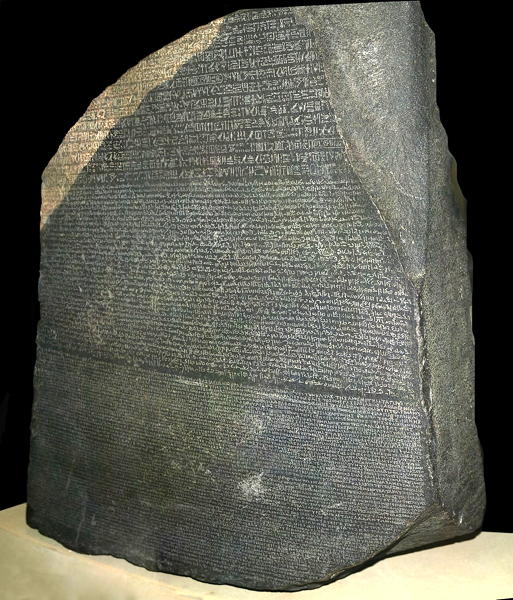
1808年,他开始研究罗塞塔石碑。让我们简要说明这件物品的重要性。1799年7月,拿破仑军队的士兵在罗塞塔镇附近挖掘堡垒地基时发现了罗塞塔石碑。负责的军官清楚这是一项重要发现,在拿破仑战败后,它成为英国的财产。它于1802年2月抵达英国。罗塞塔石碑是一块更大石板的一部分,该石板必定约为现存残片的两倍大。它包含三种文字:埃及象形文字、世俗体和古希腊文。尽管这三种文字并非彼此逐字翻译,但它们显然表达了相同的信息,即约公元前200年关于国王克劳狄乌斯·托勒密五世的一项法令。我们知道这一点,因为当时的学者能读懂古希腊文,最后一句写道:-
这项法令应刻在一块硬石石碑上,用神圣[象形]和本土[世俗]以及希腊文字,并设立在第一、第二和第三等级神庙中,在永活国王的形象旁边。
因此,罗塞塔石碑提供了一个机会,试图理解如何阅读埃及象形文字和世俗体文字。不幸的是,尽管大部分世俗体文字和古希腊文字幸存,但只有一小部分埃及象形文字保留下来,大部分已经断裂。
你可以在THIS LINK看到罗塞塔石碑的图片。
商博良于1810年离开巴黎,回到格勒诺布尔,当时他被任命为格勒诺布尔大学古代史教授。尽管这是一个古老的机构,但在法国大革命时期被关闭,直到1805-08年才由拿破仑重新建立。虽然商博良并非拿破仑的热心支持者,但在1813年拿破仑战败和保皇党复辟后,他认定拿破仑是两害相权取其轻。1815年,拿破仑从厄尔巴岛的流放中逃脱,集结了一支军队进入格勒诺布尔,受到热烈欢迎,被誉为解放者。商博良此时会见了拿破仑,他记得商博良曾以他的埃及工作重要为由设法避免了被征召入伍。拿破仑询问商博良进展如何,并要求他将他的科普特语语法寄往巴黎出版。商博良的兄弟商博良-菲雅克加入了拿破仑的军队,在1815年滑铁卢战败后,两兄弟都因支持拿破仑而处于危险之中。商博良失去了在格勒诺布尔的教授职位,被流放到菲雅克。
商博良在继续尝试理解埃及象形文字的过程中,对罗塞塔石碑以及许多其他象形文字实例进行了研究。为了取得任何进展而必须回答的问题是[48]:-
……埃及象形文字是否构成一种口语语言。这些书写字符和图画是表示字母、音节还是单词,或者它们仅仅是表意符号,代表一个想法或动作,就像今天的“禁止吸烟”图标或表情符号一样。这些传达概念,但不代表言语。
当然,埃及象形文字已经困扰了世界许多世纪,研究它们的人所接受的看法是它们是象征性的而非语音的。换句话说,一只鸟的图画并不代表一个口语声音,而是代表一个想法,如“迅速”。在理解象形文字方面进展甚微,直到几乎同时的两个人的工作,即托马斯·杨和商博良。这两个人非常不同,因为托马斯·杨是一位数学家、物理学家和博学家,对极其广泛的主题做出了贡献,而商博良则完全专注于对埃及及其语言的研究。尽管今天许多人认为托马斯·杨首先研究了象形文字,然后商博良在托马斯·杨的工作基础上取得了重大进展,但实际上这是极大的过度简化。事实上,我们在上面看到商博良于1808年开始研究罗塞塔石碑,但尽管它从1802年起就在伦敦展出,托马斯·杨直到1814年才开始他的研究。他在1815年取得了重大突破,当时他[46]:-
……能够追踪可识别的象形文字,展示人物、动物、植物和各种物体,如何发展成僧侣体和世俗体文字中的草书等价物。
他意识到没有世俗体字母表,而是由象形文字的模仿与字母表中的字母混合而成。他写信给商博良的前老师Silvestre de Sacy,讲述他的发现,并收到了一个令人惊讶的回复(例如见[46]):-
如果我冒昧地建议您,我建议您不要对M 商博良过于透露您的发现。可能他以后会声称优先权。他在他的书的许多部分中,试图让人相信他发现了罗塞塔石碑埃及铭文中的许多单词;但我担心这只是纯粹的江湖骗术:我可以补充说,我有很好的理由这样认为。
这里正在上演一场复杂的三方政治局面。我们刚刚经历滑铁卢战役,英国和法国之间存在着明显的政治紧张。但是,滑铁卢战役之后,法国国内本身也存在着强烈的政治分歧,一方是保皇派德·萨西,另一方是拿破仑的支持者商博良。遗憾的是,学术往往无法超越政治。话虽如此,德·萨西大概对商博良了解得足够多,能够理解这个年轻人的性格。
在继续讲述商博良的成就之前,让我们注意到,1818年12月30日,在格勒诺布尔,商博良与罗西娜·布朗(1794-1871)结婚,她来自格勒诺布尔的一个手套制造商家庭。他们唯一的孩子是一个女儿,佐拉伊德·谢罗内-商博良(1824-1889)。1821年,商博良卷入了一场反对法国国王的起义[5]:-
三月,商博良的朋友泰弗内散布谣言说路易十八已经退位。作为回应,数百名格勒诺布尔人挥舞着三色旗聚集在省府前,多塞兹竭力说服他的部队冒险出去对抗他们。“多塞兹和庞菲勒随后发布了令人毛骨悚然的公告,”罗伯特·亚历山大写道,“使格勒诺布尔进入戒严状态,并下令逮捕。”商博良已经受到怀疑。3月3日,皇家委员会暂停了他在中学的职位,而在叛乱期间,有人看到他在叛乱者中间。多塞兹以 renewed ferocity 发起攻击,试图让商博良被控叛国罪,这是一项可判处死刑的罪行。商博良逃脱了这一命运, thanks to the arrival in Grenoble of Claude-Victor Perrin, Duc de Bellune,他被国王派来防止 destabilising repercussions。在民事法庭而非因煽动叛乱受审,商博良被宣告无罪,但他在中学的职位已经无望。由于这一挫折只是证实了他岳父对他的低评价,寄居在罗西娜富裕的家庭也是不可能的。除了放弃伊泽尔省,把罗西娜留在她家人那里,并在巴黎他兄弟的保护下重新集结之外,别无选择。
商博良于1821年7月离开格勒诺布尔前往巴黎,但三个月前他发表了一篇关于象形文字的论文。在这篇论文中,他提出了四个主张,其中两个很重要。这两个中的一个与托马斯·杨在1819年提出的主张相同,即世俗体是象形文字的简单变体。这个主张是正确的,但没有提到托马斯·杨。他声称在这个阶段他没有读过托马斯·杨的论文,这可能是真的。另一个主张是象形文字是事物的符号而非声音的符号,这是不正确的。一到巴黎,商博良确实读了托马斯·杨的论文。他意识到自己的论文有误,并试图压制它。然而,他声称这不是因为托马斯·杨的论文,这一点很难令人相信。尽管商博良从这一事件中几乎没有得到什么声誉,但他随后走得比托马斯·杨远得多,并取得了非凡的突破。
1822年9月27日,他在给铭文与美文学术院的一篇论文中宣布了他的重大突破,并在下个月发表了一份完整的象形文字和世俗体符号及其希腊语对应物的列表。托马斯·杨在9月27日铭文与美文学术院的会议上坐在商博良旁边,对他的进展印象深刻。然而,他很难过没有从商博良那里得到他认为自己应得的荣誉。商博良继续取得进一步的重大进展,于1823年4月宣布这些进展,然后在Précis du système hiéroglyphique des anciens ÉgyptiensⓉ(古埃及象形文字系统概要
)(1824年)中发表了最终结果。
1824年,他前往都灵查看埃及材料,并对其进行了编目,然后前往罗马查看更多的埃及纪念碑。他开始计划访问埃及。1826年,他被任命为卢浮宫博物馆埃及收藏品的馆长,在他兄弟商博良-菲雅克的帮助下,他在卢浮宫创建了一个四个房间的埃及展览。1828年7月,商博良乘船前往埃及。一到那里,他检查了许多遗址的文本,并在能够阅读时间划分方面迈出了重要一步。然而,他对帝王谷国王陵墓中发生的掠夺感到震惊。他于1830年返回法国,带回了许多古物。
回到巴黎后,法兰西公学院的埃及历史和考古学讲席专门为他设立,他于1831年3月被任命为该讲席。他只讲了三次课就病得无法继续。他一生中糟糕的健康状况因他的埃及探险而恶化,他于1832年3月死于中风。他被安葬在巴黎的拉雪兹神父公墓。
他去世时几乎完成了Grammar and Dictionary of Ancient Egyptian,他的兄弟商博良-菲雅克于1838年出版了这本书。
商博良在菲雅克有一座博物馆以纪念他,在他兄弟位于格勒诺布尔附近维夫的家中有一座商博良博物馆。开罗有一条街以他的名字命名,月球背面也有一个以他的名字命名的陨石坑。埃及于1972年10月16日发行了一枚110埃及米利姆邮票,以纪念“商博良、罗塞塔石碑和象形文字”。同样在1972年10月14日,法国发行了一枚90生丁邮票,纪念“商博良和罗塞塔石碑”。摩纳哥也于1990年9月4日发行了一枚5法郎邮票,以纪念商博良诞辰200周年。埃及于1999年发行了一枚商博良邮票,以纪念罗塞塔石碑发现200周年,中非共和国于2002年发行了一枚邮票。
见THIS LINK。
Jean-François Champollion was the son of the book seller Jacques Joseph Champollion (1744-1821) and his wife Jeanne Françoise Gallieu (1744-1805). Jacques Joseph married Jeanne Françoise in Figeac on 28 January 1773. They had seven children: Guillaume Champollion (1773-1773); Thérèse Champollion (born 1774); Pétronille Champollion (born 1776); Jacques-Joseph Champollion-Figeac (1778-1867); Jean-Baptiste Champollion (born 1780); Marie Jeanne Champollion (born 1782); and Jean-François Champollion (1790-1832), the subject of this biography. Jacques Joseph Champollion had been born in La-Roche-des-Engelas which today is known as Valbonnais, Rhône-Alpes, France. He was an itinerant book seller before he moved to Figeac in 1770 where he bought a house in the narrow lane, the Rue de la Boudousquerie, in 1772, and a bookshop overlooking the market place in the Place Basse in 1779 [42]:-
There are strong hints from his contemporaries that Jacques enjoyed the bohemian life, and he unquestionably took to the bottle in his later years, which destroyed his bookselling business and poisoned relations with his children.
Let us say right at the beginning of this biography that Jean-François Champollion was not a mathematician, having very little mathematical training. We have included him in this archive, partly because his approach to solving the problems of hieroglyphics was similar to the approach that a mathematician would take in solving problems, partly because some mathematicians worked on the same problems, and partly because his work in understanding hieroglyphics eventually led to others understanding more about the mathematical skills of the ancient Egyptians.
Jean-François Champollion was the last of his parents' children, born eight years after the next youngest. Some biographers, for example Alain Faure, Jean Lacouture and Andrew Robinson, suggest that he was not the child of Jeanne Françoise but rather an illegitimate child of his father Jacques Joseph. Among the reasons for suggesting this is the age of Jeanne Françoise in 1790, the fact that Jean-François Champollion never mentioned his mother in any of the many letters he wrote but does mention a woman in Figeac who is dear to him, a marked difference in temperament between Jean-François and his siblings, and the fact that Jean-François was so dark skinned that he could pass as an Arab in Egypt.
The family were poor and Jean-François seems to have been brought up by his brother Jacques-Joseph Champollion-Figeac who was twelve years older. We should explain why his older brother is known as Champollion-Figeac. As the brothers grew up Jean-François became known as 'Champollion le Jeune' but eventually he became the more famous and at this stage his older brother began calling himself Champollion-Figeac. Jean-François's mother, Jeanne Françoise, was illiterate so could not teach her son to read and write. She was, however, a very religious Roman Catholic and had memorised large parts of the Mass. When he was about five years old, she taught Jean-François to recite these from memory and he then seems to have been able to teach himself to read by comparing what he had learnt by heart with the printed text in the prayer book. We note that this experience may have been a positive one when in later life he attempted to decipher hieroglyphics. Jacques-Joseph was impressed when he realised how his young brother had taught himself to read and, beginning in the spring of 1797, he gave the young boy further instruction in reading and writing.
Jacques-Joseph left Figeac and went to Grenoble in 1798 to work for an export firm and, left without his brother's tutoring, Jean François was sent to primary school. He did not do well, hated mental arithmetic and soon gave up the schooling. He was then tutored by Jacques-Joseph's former teacher, who taught the young boy Greek and Latin.
By the age of ten, Jean-François had not only mastered French but could read Greek and Latin and recite passages from Homer and Virgil [42]:-
His relations recalled enjoying the family's youngest son act out dramatic scenes from these classics in his own French translation during winter evenings spent around the fireplace at home. Sometimes their friends would slip into the room and gaze with curiosity at the unheard-of spectacle of the boy, seated on a stool next to the hearth (Champollion always relished physical warmth as a child and as an adult) with his eyes sparkling, bringing alive for his family the ancient stories he had learnt how to read.
Jean-François's tutor became worried about his progress, however, writing to Jacques-Joseph in Grenoble to say that his young brother had an apathy to learning, sometimes being keen and at other times refusing to work at all. Jean-François also wrote to his brother explaining his difficulties with studying and in February 1801 Jacques-Joseph asked Jean-François to join him in Grenoble. He seems to have travelled alone on the stagecoach, arriving in Grenoble on 27 March and there lived with his brother in a two-room flat on the Grande Rue. He was now taught by his brother and by a private tutor employed by his brother. In November 1802 he entered an excellent day school run by the Abbé Dussert. He did well at this school and studied Hebrew. By the end of his first year of study in 1803 he received an excellent report and now also began to study Arabic, Syriac and Chaldean. At the age of thirteen, in 1804, Champollion wrote his first paper Remarks on the fable of the Giants as taken from Hebrew etymologies.
Abbé Dussert's school was excellent and Champollion was thriving there but his brother could not afford the fees. Champollion sat the entrance examinations for the Grenoble Lycée and was accepted and given a bursary to cover his boarding expenses. After a visit back to Figeac, in November 1804 he became a boarder at the Grenoble Lycée. This was not a great success for its extremely strict regime was hated by Champollion. He did take an active part in school activities but his health deteriorated, partly because he spent his nights in private study which was not allowed during the strict school day. Life became a little better for Champollion during his second year at the school. His brother was a friend of Joseph Fourier who at this time was Prefect of Grenoble. Fourier had joined Napoleon's army in its invasion of Egypt in 1798 as a scientific adviser. He had helped found the Cairo Institute and was one of the twelve members of the mathematics division; he helped establish educational facilities in Egypt and carried out archaeological explorations. He shared a love of Egypt with Champollion's brother and was writing Description of Egypt. Fourier was interested to hear about the brilliant pupil Champollion who was not allowed time for private study by the Lycée. He spoke to his friend Jean-Baptiste Biot who met the young student and set about getting the Lycée to allow him time for independent study.
Certainly the Lycée recognised Champollion's talents and, in August 1806, he was chosen to give a speech during a school visit by Prefect Fourier. Champollion spoke about the Hebrew text of the Bible and answered questions about Oriental languages. In his report, Fourier noted that he was very impressed by Champollion's wide knowledge which included skills in biology. Champollion continued his independent studies, demanding many texts from his brother. Fourier became more involved with Champollion whose deep interest in Egypt he was able to encourage. On 1 April 1807 Champollion stopped boarding at the Lycée and returned to live with his brother. This was possible with official permission granted by Prefect Fourier. He continued to study for the leaving examinations and gained some remarkably high marks in the subjects he loved but poor marks in those he disliked. He even received a prize for mathematics which was one of his weakest subjects. When he graduated from the Lycée all his friends knew that studying the mysteries of the Egyptian civilisation would be the passion of his life. At this time the Napoleonic Wars were taking place and Champollion would have been drafted had it not been for Fourier arguing that his work studying Egypt was too important to be interrupted.
Champollion's brother Champollion-Figeac was a secretary of the Grenoble Society of Arts and Sciences and, with Fourier's approval, arranged for Champollion to deliver the lecture Essay on the geographical description of Egypt before the conquest of Cambyses to the Society on 1 September 1807; Champollion was only sixteen years old. He was elected to the Society a few months later.
Soon after delivering his lecture, Champollion went to Paris where he studied with Silvestre de Sacy, Louis-Mathieu Langlès, and Raphaël de Monachis. Muriel Weissbach writes [51]:-
In Paris, Jean François attended courses at the College de France and the École des Langues Orientales, where he studied Hebrew, Arabic, Persian, Syriac, Chaldean, and Coptic. He loved languages, and threw himself into their study with incredible joy. As he wrote his brother in December 1807, his course of study was intensive:-
At nine o'clock [Mondays] I follow M de Sacy's Persian class until 10.00. Leaving the Persian class, since Hebrew, Syriac, and Chaldean are at 12.00, I go to M Audran's, who offered to take me Mondays, Wednesday, and Fridays from 10.00 to 12.00. ... We spend these two hours talking oriental languages, translating Hebrew, Syrian, Chaldean, or Arabic. And we always dedicate a half-hour to work on Chaldean and Syriac grammar. At noon, we go down, and he gives his Hebrew class. He calls me the patriarch of the class, because I am the best ... .
All this intensive study, Champollion experienced as great fun. In fact, play was a constant element in his language study. When he was concentrating on Arabic, Jean François sported Arab dress, and adopted the nickname, "al Seghir," the younger, in Arabic. And when he immersed himself in Coptic, the language which became his overriding passion, he knew no bounds. He wrote his brother in 1809: "I am totally immersed in Coptic, I want to know Egyptian as well as I know French, because my great work on the Egyptian papyrus [hieroglyphics] will be based on this language ... . My Coptic is moving along, and I find in it the greatest joy, because you have to think: to speak the language of my dear Amenhotep, Seth, Ramses, Thuthmos, is no small thing. ... As for Coptic, I do nothing else. I dream in Coptic. I do nothing but that, I dream only in Coptic, in Egyptian. ... I am so Coptic, that for fun, I translate into Coptic everything that comes into my head. I speak Coptic all alone to myself (since no one else can understand me). This is the real way for me to put my pure Egyptian into my head. ... In my view, Coptic is the most perfect, most rational language known."
In 1808 he first began working on the Rosetta stone. Let us briefly explain the importance of this object. The Rosetta stone was found by soldiers from Napoleon's army when digging the foundations of a fort near the town of Rosetta in July 1799. It was clear to the officer in charge that it was an important discovery which, after Napoleon's defeat, became the property of the British. It arrived in England in February 1802. The Rosetta stone is a part of a larger slab which must have been about twice the size of the existing fragment. It contains three types of writing, Egyptian hieroglyphics, demotic script and ancient Greek. Although the three scripts are not literal translations of each other, they clearly expressed the same message, a decree about King Ptolemy V from around 200 BC. We know this since scholars of the time could read the ancient Greek and the final sentence reads:-
This decree shall be inscribed on a stela of hard stone in sacred [hieroglyphic] and native [demotic] and Greek characters and set up in each of the first, second, and third rank temples beside the image of the ever-living king.
The Rosetta stone, therefore, provided an opportunity to try to understand how to read Egyptian hieroglyphics and demotic script. Unfortunately, although most of the demotic script and ancient Greek script survive, only a small part of the Egyptian hieroglyphics remain, the majority having been broken off.
You can see a picture of the Rosetta stone at THIS LINK.
Champollion left Paris and returned to Grenoble in 1810 when he was appointed as Professor of Ancient History at Grenoble University. Although an ancient institution, it had been shut down at the time of the French Revolution and was only re-established by Napoleon in 1805-08. Although Champollion was not an enthusiastic supporter of Napoleon, after the defeat of Napoleon and the restoration of the royalist in 1813, he decided that Napoleon presented the lesser of two evils. In 1815 Napoleon escaped from exile on Elba and assembled an army which entered Grenoble being enthusiastically acclaimed as liberators. Champollion met Napoleon at this time and he remembered that Champollion had managed to avoid being drafted into the army on the grounds that his Egyptian work was important. Napoleon asked Champollion how it was progressing and requested that he send his Coptic grammar to Paris for publication. Champollion's brother Champollion-Figeac joined Napoleon's army and, after defeat at Waterloo in 1815, both brothers were in danger, being supporters of Napoleon. Champollion lost his professorship at Grenoble and was exiled to Figeac.
Continuing in his attempt to understand Egyptian hieroglyphics, Champollion undertook research on the Rosetta stone as well as using many other examples of hieroglyphics. The question that had to be answered in order to make any headway was [48]:-
... whether Egyptian hieroglyphics even constituted a spoken language. Did the written characters and pictures denote letters, syllables, or words, or were they solely ideographic symbols representing an idea or action like today's "no smoking" icons or emojis. These convey concepts, but do not represent speech.
Of course Egyptian hieroglyphics had puzzled the world for many centuries and the accepted view of those studying them was that they were symbolic and not phonetic. In other words, a picture of a bird did not represent a spoken sound but rather represented an idea such as 'swift'. Little progress had been made in understanding hieroglyphics until the work of two men at almost the same time, namely Thomas Young and Champollion. These two men were very different in that Thomas Young was a mathematician, physicist and polymath who made contributions to the most amazingly wide range of topics, while Champollion was completely single minded in his research on Egypt and its languages. Although today there is a belief among many that Thomas Young studied hieroglyphics first, and then Champollion made a major advance building on Young's work, in fact this is a vast over simplification. In fact we saw above that Champollion began studying the Rosetta stone in 1808 but, although it was displayed in London from 1802 onwards, Young did not begin his studies until 1814. He made a major breakthrough in 1815 when he [46]:-
... was able to trace how the recognisably pictographic hieroglyphs, showing human figures, animals, plants and objects of many kinds, had developed into their cursive equivalents in the hieratic and demotic scripts.
He realised that there was no demotic alphabet but it consisted of imitations of the hieroglyphics mixed with letters of an alphabet. He wrote to Silvestre de Sacy, Champollion's former teacher, about his discoveries and received a surprising reply (see for example [46]):-
If I might venture to advise you, I would recommend you not to be too communicative of your discoveries to M Champollion. It may happen that he may hereafter make pretension to the priority. He seeks, in many parts of his book, to make it believed that he has discovered many words of the Egyptian inscription of the Rosetta Stone; but I am afraid that this is mere charlatanism: I may add that I have very good reason for thinking so.
There is a complicated three-way political situation playing out here. We are just post-Waterloo with obvious political stresses between Britain and France. But, post-Waterloo, there are strong political differences in France itself between the Royalist, de Sacy and the supporter of Napoleon, Champollion. Sadly, scholarship often fails to rise above politics. This said, de Sacy probably knew Champollion well enough to understand the young man's personality.
Before continuing with Champollion's achievements, let us note that, on 30 December 1818 in Grenoble, Champollion married Rosine Blanc (1794-1871), who came from a family of glove makers from Grenoble. Their only child was a daughter, Zoraïde Chéronnet-Champollion (1824-1889). In 1821 Champollion was involved in an uprising against the French King [5]:-
[In] March, Champollion's friend Thévenet started a rumour that Louis XVIII had abdicated. In response, several hundred Grenoblois converged on the prefecture waving the tricolore, and d'Haussez struggled to persuade his troops to venture out against them. "D'Haussez and Pamphile then issued blood-curdling proclamations," writes Robert Alexander, "put Grenoble in a state of siege, and ordered arrests." Champollion was already under suspicion. On 3 March the Royal Council had suspended his position at the lycée, and during the revolt, he had been seen among the rebels. D'Haussez attacked with renewed ferocity, attempting to have Champollion charged with treason, an offence punishable by death. Champollion escaped this fate thanks to the arrival in Grenoble of Claude-Victor Perrin, Duc de Bellune, who had been sent by the king to prevent destabilising repercussions. Tried in civil court rather than for sedition, Champollion was acquitted, but his position at the lycée was a lost cause. As this setback only confirmed his father-in-law's low opinion of him, sheltering with Rosine's well-to-do family was also out of the question. Nothing was left but to abandon Isère, leaving Rosine with her family, and to regroup under his brother's protection in Paris.
Champollion left Grenoble for Paris in July 1821 but three months earlier he had published a paper on hieroglyphics. In this paper he made four claims, two of which were significant. One of these two was the same claim Young had made in 1819, namely that demonic was a simple modification of hieroglyphic. This claim was correct but made no reference to Young. He claimed he had not read Young's paper at this stage, which is probably true. The other claim was that hieroglyphics was signs of things not of sounds, which is incorrect. Once in Paris, Champollion did read Young's paper. He realised that his own paper had been in error and tried to suppress it. He claimed, however, that this was not because of Young's paper, something which is hard to believe. Although Champollion comes out of this incident with little credit, he then went on to go far further than Young and made remarkable breakthroughs.
On 27 September 1822 he announced his major breakthrough in a paper to the Academy of Inscriptions and in the following month he published a complete list of signs of both hieroglyphics and demotics with their Greek equivalents. Thomas Young sat beside Champollion at the 27 September meeting at the Academy of Inscriptions and was very impressed by his advances. He was, however, sad not to receive the credit from Champollion that he felt he deserved. Champollion continued to make further major advances, announcing these in April 1823 and then publishing definitive results in Précis du système hiéroglyphique des anciens Égyptiens Ⓣ (1824).
In 1824 he travelled to Turin to view Egyptian materials, which he catalogued, then went to Rome to view further Egyptian monuments. He began to make plans to visit Egypt. In 1826 he was appointed curator of the Egyptian collections of the Musée du Louvre and, with the help of his brother, Champollion-Figeac, he created an Egyptian exhibition in four rooms at the Louvre. In July 1828 Champollion sailed to Egypt. Once there he examined texts at many sites and made an important step in being able to read divisions of time. He was, however, appalled at the looting that had gone of at the tombs of the kings in the Valley of the Kings. He returned to France in 1830 bringing many antiquities with him.
Back in Paris the chair of Egyptian history and archaeology at the Collège de France was specially created for him and he was appointed to it in March 1831. He gave only three lectures before he became too ill to continue. Poor health throughout his life had been made worse by his Egyptian expedition, and he died of a stroke in March 1832. He was buried in Père Lachaise Cemetery in Paris.
He had almost completed Grammar and Dictionary of Ancient Egyptian at the time of his death and his brother Champollion-Figeac published this in 1838.
Champollion has been honoured with a museum in Figeac and there is a Champollion Museum at the home of his brother in Vif, near Grenoble. A street in Cairo is named for him and there is also a crater named for him on the far side of the moon. Egypt issued a 110 Egyptian millieme stamp in honour of 'Champollion, the Rosetta Stone and Hieroglyphics' on 16 October 1972. Also on 14 October 1972 France issued a 90-centimes stamp for 'Champollion and the Rosetta Stone'. A 5-franc stamp has also been issued by Monaco on 4 September 1990 to commemorate the 200th anniversary of Champollion's birth. Egypt issued a Champollion stamp in 1999 to commemorate 200 years of discovery of the Rosetta Stone and the Central African Republic issued a stamp in 2002.
See THIS LINK.
正文里的方括号编号指向这里,悬停即可直接看到条目。书目保留原文——译了书名反而查不到文献。
原站列出的延伸阅读与外部数据库,照原样保留,目标多为英文页面。
关于让-弗朗索瓦·商博良的其它页面:
关于让-弗朗索瓦·商博良的其它网站:
原站的交叉引用。指向本站已镜像专题的留在站内,其余仍指回原站。